SEARCH
  • [:en]Recent Posts[:af]Onlangse bydraes

  • [:en]Categories[:af]Kategorieë

  • [:en]Archives[:af]Argiewe

Internet

[:en]Free sites for students and staff[:]

Wednesday, February 22nd, 2017

[:en]

The following sites are open to students and staff. This means that you won’t need inetkey to access them and your account won’t be billed. Most of these are for academic purposes. In addition to this, you can also request free access to other sites you need for academic and research purposes. Therefore, if you need to access a site regularly for work, let us know by sending an email to helpinfo@sun.ac.za.

Office365
mirror.ac.za
cput.ac.za
uwc.ac.za
tenet.ac.za
rims.ac.za
cengage.com
slack.com
Smartevals.com
wiley.com
kuali.co
sansa.org.za
google.com
youtube.com
c9.io


[:]

[:en]Selfie: Is it worth the risk?[:af]Selfies: die risiko werd?[:]

Thursday, March 31st, 2016

[:en]

We don’t bat an eyelid anymore when someone takes a photo of themselves in a public place. Selfie-sticks, aka  Naricissticks, have become the new normal.. Estimates of daily selfie posts range from one million to as high as 93 million on Android devices alone, according to Michael Weigold of the University of Florida. (http://businesstech.co.za

Yes, it’s sometimes irritating and obtrusive, but surely it’s just a bit of harmless fun?

Quite the opposite seems to be true in some cases.

In February tourists in Argentina removed an endangered baby La Plata dolphin from the sea to take pictures of themselves with it. The animal died from sheer trauma and heat exhaustion. 

In March a tourist dragged a swan from a lake in Macedonia to take a selfie. Again the animal died.

The selfie trend not only endanger the lives of animals, but also humans. (though some of these might qualify for the Darwin awards)

In 2015 Russia launched a campaign to warn its population against the dangers of selfies, called “A cool selfie could cost you your life.” The reason? Apparently an estimated hundred Russians have died trying to take photos of themselves in dangerous situations. This includes a woman shooting herself, two men blowing themselves up with a hand grenade and people taking pictures on top of moving trains.

India also has a rising selfie problem, with more citizens dying while taking selfies than any other country in the world. Mumbai now has “no-selfie zones.”

In Seville, Spain, a Polish tourist fell of a bridge while trying to take a selfie. In May of 2014 a Cessna pilot lost control of the plane and killed himself and all his passengers.

On Tuesday an Egyptian Airline plane was hijacked and a British man used the opportunity to take a selfie with the hijacker. He reckoned he had nothing to lose at that stage. Today another Brit had to be rescued from Britain’s highest mountain, Ben Nevis. She was trying to take a selfie on the mountain and was inadequately dressed for the cold conditions. More on selfie-related deaths on CNN.

What would drive a person to risk endangering himself for the sake of a “cool”photo? 

Maybe the need to constantly prove and compare ourselves to other people? Social media provides an easy platform where almost instant feedback and possibly approval is given. 

Michael Weigold of the University of Florida published an article in The Conversation, in which he explores this question. He also mentions research done by psychologist Gwendolyn Seidman.

Dr Seidman suggests that there is a link between narcissism and selfies and she bases her statement on two studies looking specifically at Facebook selfies. Read dr Seidman’s article in Psychology Today and decide for yourself. Also let us know what you think of selfies and why you think they are so popular?

[:af]

Die selfie is so algemeen, ons merk nie eers meer op as iemand in die openbaar `n foto neem met `n selfie-stok, of te wel, `n  Naricisstick, nie. Volgens Michael Weigold, van die Universiteit van Florida, word beraam dat daagliks tussen een miljoen en 93 miljoen selfies geplaas word met Android-fone alleen. (http://businesstech.co.za

Ja, dit is soms irriterend en indringerig, maar dis tog net onskuldige pret?

Die teenoorgestelde blyk waar te wees in sommige gevalle. 

Vanjaar in Februarie is `n bedreigde La Plata babadolfyntjie in Argentinië dood as gevolg van trauma en hitte-uitputting, omdat `n groep toeriste selfies daarmee op die strand wou neem.

In Maart gryp `n toeris `n swaan uit `n meer in Macedonië vir `n selfie en kort daarna beswyk dit.

Selfs al is jy nie `n dierliefhebber nie, bedreig die selfie ook menselewens (hoewel ‘n paar van hierdie gevalle dalk kwalifiseer vir Darwin-toekennings?)

In 2015 loods Rusland `n veldtog om te waarsku teen die gevare van selfies  — “A cool selfie could cost you your life”. Inderdaad.

Blykbaar is `n honderd Russe reeds dood as gevolg van selfies. Dit sluit `n vrou in wat haarself per ongeluk geskiet het, twee mans wat hulle misgis het met `n handgranaat en ander wat waaghalsig bo-op bewegende treine poseer het.

In Seville, Spanje, het `n Poolse toeris van `n brug geval terwyl sy `n selfie wou neem. In Mei 2014 verloor `n Cessna-loods beheer oor sy vliegtuig en verongeluk homself en sy passasiers — vir `n selfie.

Dinsdag is `n Egyptian Airline-vliegtuig gekaap en `n Britse man het die geleentheid aangegryp om `n selfie saam met die kaper te neem. Hy’t gereken hy’t in elk geval niks om te verloor nie. 

Gister moes `n Britse vrou gered word vanaf Brittanje se hoogste berg, Ben Nevis, omdat sy nie behoorlik toegerus was vir die weertoestande toe sy `n selfie wou neem nie. Meer oor selfie-verwante sterftes op CNN.

Wat dryf iemand om homself in gevaar te stel om bloot `n “cool” foto te neem?

Dalk die behoefte om onsself te bewys en vergelyk met ander? Met sosiale media is dit net soveel makliker om te doen en dadelik kommentaar en reaksie te kry.

Michael Weigold van die Universiteit van Florida het `n artikel in The Conversation publiseer waar hy hierdie vraag ondersoek. Hy verwys ook na navorsing deur die sielkundige Gwendolyn Seidman.

Dr Seidman beweer dat daar `n skakel tussen narsissisme en selfies is en baseer haar navorsing op twee steekproewe wat fokus op Facebook-selfies. Lees gerus dr Seidman se artikel in Psychology Today en besluit self. Laat weet ons wat jy dink van selfies en hoekom jy dink dis so populêr?

[:]

[:en]Is Google Street View invading our privacy?[:af]Maak Google Street View inbreuk op ons privaatheid?[:]

Thursday, March 31st, 2016

[:en]

google-mapsGoogle Street View gives us access to parts of the world we have never seen before. You can travel to the Great Barrier Reef, the Grand Canyon or the Eiffel tower without setting foot outside your house. Even our own university has been added to Street View recently. 
Unfortunately access to areas previously inaccessible, could also pose a threat to safety and privacy. 

Objections have been made to Google images showing “people engaging in activities visible from public property in which they do not wish to be photographed and have published online.” Google maintains that these images are removed or blurred. Number plates and people’s faces are blurred to protect privacy.

They also maintain that the photos were taken on public property. However, Street View cameras are mounted on elevated structures to enable them to take better pictures, so they might take photographs NOT in a public area.

“On May 13, 2009, Google Japan announced that it would modify their cameras to scan from a lower height of 2.05 meters above ground level, 95 centimeters lower than the original height of the camera head. The new height is intended to avoid having cameras view over fences in front of homes and into homes. This reduced height is to apply immediately, and all areas previously visited will be rescanned from the reduced height. Scans taken at the original height will remain available until they are replaced with the new images.” (www.wikipedia.org)

Various countries have laid complaints against Google’s Street View policy and tried to prevent them from photographing. In most cases they conceded and Google continued filming. 

If you do have a problem with an image Google reported, there is the option to report it via Google’s Street View support page. Just keep in mind that the image will not be removed, but only blurred.

[SOURCE: https://en.wikipedia.org]

[:af]

google-mapsGoogle Street View laat ons toe om dele van die wêreld te sien wat ons nie andersins sou nie. Jy kan nou die Great Barrier Reef, Grand Canyon of Eiffeltoring besoek, sonder om ʼn tree oor jou drumpel te gee. Selfs ons eie universiteit is al op Street View.

Ongelukkig beteken toegang tot voorheen ontoeganklike areas, ook ʼn uitdaging vir privaatheid en veiligheid.

Besware is gemaak teen Google foto’s wys van persone wat besig is met aktiwiteite wat hulle nie noodwendig afgeneem of aanlyn publiseer wil hê nie. Nommerplate en gesigte word wel verdof om privaatheid te beskerm.

Google hou egter vol dat hierdie beelde heeltemal wettig is aangesien dit geneem is in ʼn publieke area. Wat hulle wel nie noem nie, is dat hulle kameras op strukture monteer word wat hoër is as die normale mens en dit dus oor heinings en mure kan kyk. 

Op 13 Mei 2009 het Google Japan aangekondig dat hulle kameras aangepas sal word na 2.05 meter bo die grondvlak, 95 cm laer as die gewone hoogte van die Google kamera. Die doel hiervan was om te voorkom dat kameras oor heinings en in huise kan kyk. Die verminderde hoogte was dadelik van toepassing en alle areas wat voorheen verfilm is, moes oorgedoen en vervang word.

Verskeie lande, insluitende Brittanje, Denemarke, Duitsland, Pole en Indië, het klagtes gelê teen Google se Street View beleid en probeer om te voorkom dat daar verfilm word. In die meeste gevalle het Google egter die sake gewen en voortgegaan met hul dokumentasie.

Jy kan wel, as jy ʼn probleem met ʼn Google foto het, dit rapporteer op Google Street View ondersteuningsblad. Hou net in gedagte dat die foto nie verwyder sal word nie, maar net verdof sal word.

[SOURCE: https://en.wikipedia.org]

[:]

[:en]Stellenbosch campus available on Google streetview[:af]Stellenbosch-kampus beskikbaar op Google Street View[:]

Thursday, March 17th, 2016

[:en]

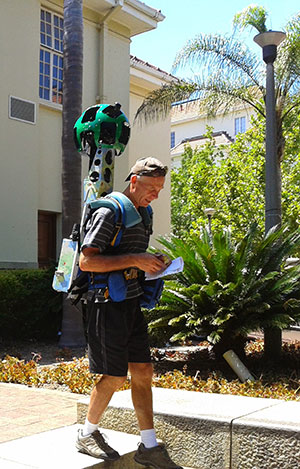
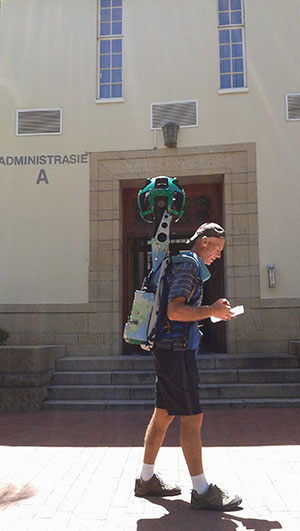
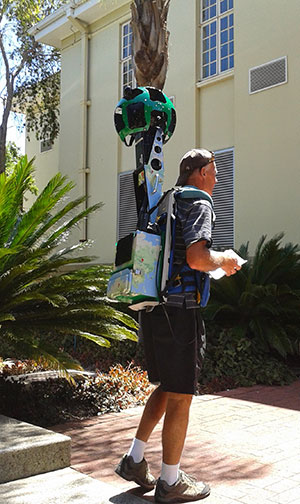
If you were still on campus from 17 to 19 December at the end of 2014, you might have seen someone walking around with an unusual device strapped to his back. This device is called the Google Trekker camera and is used to photograph the environment for Google Street View.

Thanks to a collaboration between IT, Facilities Management and Google, various locations on our own Stellenbosch campus have now been mapped and are available on Google Street View.

“Google Street View is a technology featured in Google Maps and Google Earth that provides panoramic views from positions along many streets in the world. It was launched in 2007 in several cities in the United States, and has since expanded to include cities and rural areas worldwide. 

Google Street View displays panoramas of stitched images. Most photography is done by car, but some are done by trekker, tricycle, walking, boat, snowmobile, and underwater apparatus.  A Trike (tricycle) was developed to record pedestrian routes including Stonehenge, and other UNESCO World Heritage sites.

In 2010 a snowmobile-based system captured the 2010 Winter Olympics sites. Trolleys have been used to shoot the insides of museums, and in Venice the narrow roads were photographed with backpack-mounted cameras, and canals were photographed from boats.”(www.wikipedia.org.za)

google-streetview-logoOn 8 March a mzansi experience was launched on Google Maps. Together with the launch, our university street view images were also made public. The images can be accessed on phone and desktop.

Streets with Street View imagery available are shown as blue lines on Google Maps. When you hover over the mini-map in the left-hand corner, you will see where street map is available on campus.

You can now see the Rooi PleinBotanical Gardens and Coetzenburg on Street View, as well as Jonkershoek. View the rest here and you can also click on the shortcuts at the bottom of your Street View to take you to various other locations on campus. 

More on the Mzansi experience.

[:af]

As jy jouself in 2014 tussen 17 en 19 Desember op kampus bevind het, sou jy iemand toegerus met `n vreemde toestel opgemerk het. Die toestel is `n Google Trekker kamera en word gebruik om die omgewing te fotografeer vir Google Street View.

Te danke aan `n gesamentlike poging tussen IT, Fasiliteitsbestuur en Google oor die afgelope jaar, is verskeie areas op ons Stellenbosch-kampus ook nou karteer.

Google Street View is tegnologie in Google Maps en Google Earth wat panoramiese beelde van strate wêreldwyd verskaf. Dis in 2007 bekendgestel in verskeie Amerikaanse stede, maar is mettertyd uitgebrei na stede en plattelandse areas regoor die wêreld. 


Street View
vertoon `n panoramiese beeld deur middel van verskeie fotos wat aanmekaar gelas word. Die meeste fotografie word met `n motor uitgevoer, maar trekkers, driewielfietse, bote, sneeuvoertuie, onderwatertoestelle en voetslaan, word ook gebruik. `n Driewielfiets is ontwerp om staproetes, soos Stonehenge en ander UNESCO Wêreld Erfenis-areas, in te sluit.

In 2010 is `n stelsel monteer op `n sneeuvoertuig om die 201o Winter Olimpiese Spele se ruimtes te karteer. Trollies is gebruik om binne-in museums te fotografeer. Venesië se nou straatjies is afgeneem met `n kamera wat op `n rugsak monteer is en kanale is vanaf bote waargeneem. (www.wikipedia.org.za)

google-streetview-logoOp 8 Maart is die Mzansi experience op Google Maps bekendgestel. Terselfdertyd is ons Street View fotos ook gelaai. Jy kan die fotos op jou rekenaar of slimfoon kyk.

Strate wat deel uitmaak van die Street View-projek word deurlopend met blou lyne op Google Maps aangedui. As jy die muis hou oor die mini-kaart in die linkerkantse hoek, sal jy ook sien watter areas op kampus beskikbaar is.

Jy kan nou, onder andere, die Rooi PleinBotaniese Tuin en Coetzenburg, sowel as Jonkershoek, op Street View besigtig. Kyk gerus na die res hier en jy kan ook kliek op die kortpaaie onderaan jou Street View om na ander plekke op kampus te gaan. 

Meer oor die Mzansi-ondervinding.

[:]

The Internet of ThingsDie “Internet of Things”

Friday, November 20th, 2015

“The internet of things” — a rather unimaginative way to describe something vast.  What did Kevin Ashton mean when he used the phrase for the first time in 1995?

What is it?

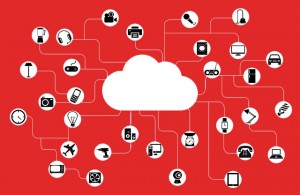
The Internet of Things (IoT) refers to connected devices communicating with each another and using machine-to-machine (M2M) communication via virtual, mobile or instantaneous connections.

This network of physical objects is embedded with electronics, software, sensors, and network connectivity, enabling the objects to collect and exchange data.

They can include any object fitted with the right technology and the ability to connect to the internet. For example, home appliances, most forms of transport, shops and machines used for manufacturing, farming, healthcare, etc. Existing M2M applications include smart metering, patient monitoring, CCTV surveillance, vehicle tracking, secure ATMs and digital signage.

network-782707_640What can it be used for?
 
The main advantages of The Internet of Things is increased productivity, efficiency and better organisation of tools, machines and people.
 
One area where IoT can be most beneficial, is healthcare. Diseases can be monitored and analysed to create new treatments and also prevented in the long run.
 
In farming, sensors are connected to crops and cattle to increase production and track herds.
 
In the home environment security systems and household appliances can be monitored and controlled. In future your fridge will be able to let you know when you are out of milk and possibly even order it online for you. You will be able to activate your coffee machine from your cell phone to have a cup of hot coffee waiting when you get home.
 
LG recently introduced LG Homechat which enables you to SMS any of your LG home appliances. And yes, they answer back. Unfortunately this functionality isn’t available in South Africa yet, but it’s out there and being used.
 
These are simple examples, but the possibilities are vast. For more ideas, have at this interactive web application.
 
Is it safe?
 
IoT has many advantages, but the biggest concern, especially in its early stages, is security and privacy. To function optimally these devices need your personal data and since everything will be connected, in the cloud or on companies’ databases, it will also be available for if proper security is not in place.
 
Healthcare is most at risk if data is tampered with or leaked. Deleting sensitive medical information, such blood group info, could have fatal repercussions. (More in the Guardian)
 
According to experts IoT is relatively safe, but there’s no guarantee.


“The internet of things” — `n taamlike flou manier om iets vreeslik omvangryk te beskryf.  Wat was Kevin Ashton bedoel daarmee toe hy dit vir die eerste keer in 1995 gebruik het?

Wat is dit?

Die Internet of Things (IoT) verwys na enige toestelle wat verbind is aan mekaar en met masjien-tot-masjien (M2M) kommunikasie werk, met behulp van van virtuele, mobiele en onmiddellike verbindings.

Hierdie netwerk van fisiese toestelle is toegerus met elektronika, sagteware, sensors en netwerkverbindings wat hulle in staat stel om data uit te ruil en te versamel.

Toestelle kan enigiets insluit wat toegerus is met die regte tegnologie en aan die internet kan verbind. Byvoorbeeld, huishoudelike toestelle, vervoermiddele, toestelle in winkels, vervaardigingsmasjienerie, landbou-masjinerie, sowel as toestelle gebruik in gesondheidsorg. Bestaande M2M toepassings sluit slim meterlesings, monitering van pasiënte, CCTV-toesig, voertuig-opsporing, sekure ATMs en digitale kennisgewingborde in.

network-782707_640Wat is die nut daarvan?

Die grootste voordele van The Internet of Things is verhoogde produktiwiteit, effektiwiteit en organisasie van hulpbronne, masjinerie en mense.
 
In gesondheidsorg kan siektes kan monitor en analiseer word om nuwe behandelings te ontwikkel en op die lang duur, siektes te kan voorkom.
 
In vervaardigingsomgewings, soos landbou, word sensors aan gewasse en vee vasgemaak om produksie te verhoog en troppe na te speur.
 
Tuis kan sekuriteitstelsels en huishoudelike toestelle monitor en beheer word. In die toekoms sal jou yskas jou laat weet as die melk op is en dit moontlik vir jou aanlyn bestel. Jy sal jou koffiemasjien kan aktiveer met jou selfoon sodat daar ʼn koppie vars koffie wag as jy by die voordeur instap.
 
LG het onlangs LG Homechat, ʼn toepassing wat jou in staat stel om enige van jou LG huishoudelike toestelle te SMS, bekendgestel. En ja, hulle antwoord terug. Ongelukkig is dié nuutjie nog nie in Suid-Afrika beskikbaar nie, maar dit word reeds oorsee gebruik. 
 
Hierdie is net die ysberg se punt. Die impak van IoT strek veel wyer. Om ʼn idee te kry van wat alles moontlik is, kyk gerus na hierdie informatiewe webtoepassing.
  
Is dit veilig?
 
Die grootste bekommernis, veral in die vroeë stadium van ontwikkeling, is sekuriteit sekuriteit en privaatheid. Om optimaal te kan funksioneer, het hierdie toestelle jou persoonlike data nodig. Dit moet ook verbind wees aan ander toestelle d.m.v. die cloud of maatskappye se databasisse. Indien streng sekuriteit nie in plek is nie, sal persoonlike inligting toeganklik kan wees vir enigiemand wat dit wil misbruik.
 
Gesondheidsorg bied die hoogste risiko indien daar met data gepeuter of dit uitgelek word.  Sensitiewe inligting wat uitgevee word, byvoorbeeld bloedgroep inligting, kan noodlottige resultate hê. (Meer hieroor in die Guardian)
 
Deskundiges beweer dat dit relatief veilig is, maar daar is geen waarborg nie.