SEARCH
  • [:en]Recent Posts[:af]Onlangse bydraes

  • [:en]Categories[:af]Kategorieë

  • [:en]Archives[:af]Argiewe

phishing

[:en]Gmail account phishing[:af]Phishing via Gmail-rekeninge

Wednesday, April 20th, 2016

[:en]

A large number of phishing e-mails are arriving in university mailboxes from GMail accounts with subjects like “DOCS” or “PAYMENT”.

The e-mail reads “Hello, Please find attached, Thanks.” or something similar.

The attachment is usually a PDF. When you attempt to open it, it seems to be encrypted and asks you to enter personal details to access the document.

The PDF is in fact an executable file that installs malware on your computer to steal personal details, such as passwords etc. This way the scammers can get hold of personal details and defraud you.

Earlier this week a person at Tygerberg campus was defrauded of over R6000 when they sent an EFT payment to a catering supplier who was using a hijacked GMail account.

The scammer intercepted the victim’s mail and inserted their own bank account details into the attached invoice. The EFT was then paid to the scammer’s account instead of the supplier.

Compromised GMail, Yahoo!Mail and Hotmail accounts are often used by fraudsters, so it is imperative that you do not respond to mails such as these.  

If someone wants to send you a document, they should at least contact you and tell you that they are sending the mail before sending it, usually not unannounced.

It is far too easy for scammers to defraud people, because we are not alert enough and too trusting. Please be careful.

Also read more on phishing and other security risks on our blog.

[ARTICLE BY DAVID WILES]


[:af]

Gedurende die afgelope week het ʼn groot aantal phishing e-posse, vanaf Gmail-rekeninge, in universiteitsposbusse beland.

Die e-posse se onderwerpveld bevat die woorde “DOCS” of “PAYMENT” en die e-pos se inhoud lees “Hello, Please find attached, Thanks.”, of iets soortgelyk.

Die aanhangsel is gewoonlik ʼn PDF, lyk of dit enkripteer is en vra dat jy persoonlike inligting invul om toegang tot die dokument te kry.

Die PDF is inderwaarheid ʼn uitvoerbare program wat malware op jou rekenaar installeer sodat dit persoonlike inligting, soos wagwoorde, kan bekom. Op so ʼn manier kan die kuberkrakers jou persoonlike inligting gebruik om jou te beroof. 

Vroeër die week het ʼn persoon op Tygerberg-kampus R6000 verloor toe hulle ʼn EFT-betaling gedoen het aan ʼn spysenieringsverskaffer wat ʼn gekaapte Gmail-rekening gebruik het.

Die kuberkraker het die slagoffer se e-pos onderskep en sy eie bankdetails in die aangehegte kwitansie ingevul. Gevolglik is die EFT-betaling in die verkeerde rekening betaal.

Gmail, Yahoo!Mail en Hotmail-rekeninge word gereeld deur krakers gebruik, so dis belangrik dat jy nie reageer op e-posse met hierdie kenmerke nie. Indien iemand vir jou ʼn belangrike dokument wil stuur, veral waar betaling betrokke is, behoort hulle jou eers te kontak om te laat weet hulle stuur dit. 

Ongelukkig maak tegnologie en ons blinde vertroue daarin, dit vir kuberkriminele geweldig maklik om mense te besteel. Wees asseblief versigtig.

Lees ook meer oor phishing en ander sekuriteitsrisikos op ons blog.

[ARTIKEL DEUR DAVID WILES]


[:en]Phishing attack on same day as migration of Tygerberg accounts[:af]Phishing attack on same day as Tygerberg accounts were migrated[:]

Friday, March 4th, 2016

Today, between 07:00-08:00 the Tygerberg personnel accounts were migrated to the STB domain. E-mail, logins, etc. were affected and hopefully most of you were moved with relatively few issues.

The phishers do not stop their attacks and e-mails to try to get you to reveal your usernames, passwords etc,  and still flood many people’s mailboxes.

However, today there was another attack, which is particularly sinister, because apparently it is from from “HELPDESK” and asks you to log in to a page and give your username and password so you can enjoy the *improved* services. It is sent from the “Webmail Upgrade Team”.

An unfortunate coincidence that on the same day we are migrating, we receive a phishing scam about “upgrading”, hence its danger to Tygerberg.

Please don’t respond, or go to the site that you are being asked to go to. Do not fill in your username, password or ANY other details on any site. The Stellenbosch University Information Technology migration took place without there being any need for users to provide user names and passwords. Any issues with the migration can be reported telephonically to the IT Helpdesk at 021-8084367.

Here is an example of the phishing mail that many are receiving. If you are in doubt about any e-mail you receive, call your local computer geek or at least ask the IT HelpDesk.


—–Original Message—–

From: Webmail Upgrade Team [mailto:phisher@scam.com]

Sent: 03 March 2016 12:23 PM

Subject: HELP DESK

ATTN: Outlook Web Access User,

Take note of this important update that our new webmail has been improved with a new messaging system from Outlook Web Access which also include faster usage on email, shared calendar,web-documents and the new 2016 anti-spam version. Please use the outlook web access link below to complete your update for our new Outlook Web Access improved webmail.

http://link.to.phishing.site/

NOTE: Failure to do this within 24 hours of receiving this notice we will immediately render your Outlook Web App account deactivated from our database and you cannot hold us responsible since you fail to adhere to our request.

___________________

Regards,

IT Service Desk Support.

Admin Team

Miss Annie Phisher

[INFORMATION SUPPLIED BY DAVID WILES]


[:en]E-mail account hijacked[:af]E-pos rekening gekaap[:]

Monday, February 29th, 2016

[:en]

The phishing scammers are at it again. The mail below is “spoofing” a university account, or they are using an e-mail account that they have hijacked to send out mail to fool Stellenbosch users into divulging their personal e-mail addresses, account names and passwords. Do no respond to it or go to the site in the mail. 

Here is the example of the mail that several SU users have already received:


From: SU staff member <sunstaffmemberaddress@sun.ac.za>
Sent: Saturday, February 27, 2016 10:05 AM
To: ‘dummyaddress@mail.com’
Subject: Dear Stellenbosch account users.

Dear Stellenbosch account users.

You have exceeded your sun.ac.za e-mail account limit quota of 575MB and you are requested to expand it within 48 hours or else your sun.ac.za e-mail account will be disable from our database. Simply CLICK with the complete information requested to expand your sun.ac.za e-mail account quota to 1000MB.

Thank you for using Stellenbosch University Webmail.

Copyright © 2016 Webmaster Center.

[INFORMATION SUPPLIED BY DAVID WILES]

[:af]

Die phishing skelms is alweer bedrywig. Die e-pos onder vervals `n universiteit e-posadres of gebruik `n e-posadres wat hulle gekaap het om e-pos aan Stellenbosch-gebruikers te stuur. Die e-pos mislei en oortuig die leser om sy persoonlike e-posadresse, rekeningname en wagwoorde bekend te maak.

Moenie daarop reageer nie en moenie na die webwerf in die e-pos gaan nie. 

Hier is die voorbeeld van die e-pos wat vele US-gebruikers reeds ontvang het:  


From: SU staff member <sunstaffmemberaddress@sun.ac.za>
Sent: Saturday, February 27, 2016 10:05 AM
To: ‘dummyaddress@mail.com’
Subject: Dear Stellenbosch account users.

Dear Stellenbosch account users.

You have exceeded your sun.ac.za e-mail account limit quota of 575MB and you are requested to expand it within 48 hours or else your sun.ac.za e-mail account will be disable from our database. Simply CLICK with the complete information requested to expand your sun.ac.za e-mail account quota to 1000MB.

Thank you for using Stellenbosch University Webmail.

Copyright © 2016 Webmaster Center.

[INLIGTING VERSKAF DEUR BY DAVID WILES]

[:]

[:en]Phishing and whaling[:af]Phishing en whaling[:]

Friday, February 5th, 2016

[:en]

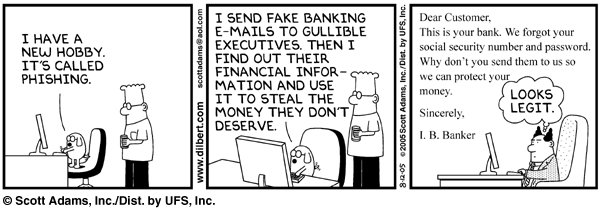
Recently we gave you some pointers on identifying phishing e-mails. So now that you know all the signs and how to outwit the criminals, there’s another variant – spear phishing. But don’t panic, it’s almost the same, with a bit of a twist.

Spear phishing is an e-mail that seems to be sent from an individual or business you know. Of course it’s really from hackers attempting to obtain you credit card, bank account numbers, passwords and financial information.

These types of attacks focus on a single user or department within an organisation and use another staff member from the organisation’s name to gain the victim’s trust. (Also see our recent article on the incident at Finance.)

They often appear to be from your company’s human resources or IT department, requesting staff to update information, for example passwords or account details. Alternatively the e-mail might contain a link, which will execute spyware when clicked on.

But wait, there are even more fishing comparisons.

When a phishing attack is directed specifically at senior executives, other high profile staff or seemingly wealthy people, it’s called whaling. By whaling cyber criminals are trying to catch the “big phish”, or whale.

phishing

[SOURCE: http://www.webopedia.com]


[:af]

Ons het onlangs vir jou `n paar wenke gegee hoe om `n phishing e-pos uit te ken. So noudat jy gereed is om enige krimineel uit te oorlê, het ons vir jou nog `n weergawe van phishingspear phishing. Maar moenie paniekbevange raak nie. Dis amper dieselfde, net ʼn bietjie anders. 

Spear phishing is wanneer ʼn e-pos lyk of dit gestuur is vanaf ʼn individu of besigheid wat jy ken. Inderwaarheid kom dit van kuberkrakers wat probeer om jou kredietkaart, bankrekening, wagwoord en finansiële inligting te aas.

Hierdie tipe aanvalle fokus op ʼn enkele gebruiker of departement binne `n organisasie. Deur die e-pos te stuur vanaf iemand binne die organisasie se e-pos, word jou vertroue gewen en gee hy makliker die inligting. (Sien ook ons berig oor die onlangse insident by  Finansies)

Die e-posse lyk dikwels asof dit gestuur word deur jou menslike hulpbronne of IT-afdeling en versoek gewoonlik dat personeel hulle inligting (byvoorbeeld wagwoorde of rekeninginligting ) opdateer of heraktiveer. Alternatiewelik bevat die e-pos ʼn skakel wat spyware aktiveer indien daarop gekliek word. 


Maar dis nie al nie – daar is selfs nog meer visvang-analogieë.

Wanneer `n phishing-aanval direk geloods word op senior uitvoerende hoofde, hoë-profiel personeel of skynbaar finansieël welaf persone, word dit whaling genoem. Deur whaling probeer kuberkrakers een “big phish”, of te wel die walvis, vang.

phishing

 
[BRON: http://www.webopedia.com]

[:]

[:en]New cyber crime e-mail targets individuals[:af]Nuwe kubermisdaad e-pos teiken individue[:]

Wednesday, January 13th, 2016

[:en]

Over the past two weeks a new e-mail scam has reared its head on campus. Scammers use contact information, available on the internet, to target individuals at the university.

One example is an e-mail which has been sent to various staff at the Finance department with a request to transfer money. (see e-mail with inactive addresses below)

The e-mail is sent from a gmail address, but the display name is a SU staff member’s name. Since the cyber criminal also saw the contact person’s name on the website (in this case Finance’s website), they address the receiver personally as, for example, Karin.

Similar scams use fax numbers available on the internet and then a fax is sent directly to the contact person.

Do not, under any circumstances, react to these e-mails. It is clearly an attempt to attract your attention and convince you to conduct a financial transaction. Delete and ignore the e-mail.

Report suspicious e-mail to sysadm@sun.ac.za and also read our articles on security on our blog, as well as the fortnightly newsletter, Bits & Bytes.


FROM: Stellenbosch University staff member name<example@gmail.com>
TO: Stellenbosch University staff member name<example@sun.ac.za>

Karin, 

Let me know if you can process a same day domestic bank transfer to a client. You will code it to professional services

The amount is R870,000, kindly confirm so i can forward the appropriate beneficiary details to enable instant clearance.

Regards

Sent from my iPhone

[:af]

Daar is die afgelope twee weke `n nuwe tendens op kampus waar kubermisdadigers kontakinligting wat op die internet beskikbaar is, gebruik om individue te teiken.

Een voorbeeld hiervan is `n e-pos wat aan verskeie personeel van Finansies gestuur is met `n versoek vir die oorbetaling van gelde. (sien e-pos onder met onaktiewe adresse)

Die e-pos word gestuur vanaf `n gmail adres, maar die display name is `n US personeellid se naam. Omdat die kubermisdadiger die kontakpersoon se naam ook op die internet (in die geval Finansies se webwerf) kon kry, rig hy die e-pos persoonlik aan byvoorbeeld Karin. 

Soortgelyke gevalle gebruik ook faksnommers wat op die internet beskikbaar is en stuur dan `n faks aan `n spesfieke persoon.

Moet onder geen omstandighede op hierdie e-posse reageer nie. Hierdie is duidelik `n e-pos wat poog om u aandag te trek en te oortuig om `n finansiële transaksie uit te voer. Verwyder en ignoreer dit bloot.

Meld verdagte e-posse aan by sysadm@sun.ac.za en lees ook artikels oor sekuriteit op ons blog, sowel as die twee-weeklikse nuusbrief, Bits & Bytes.


 FROM: Stellenbosch University staff member name<example@gmail.com>

TO: Stellenbosch University staff member name<example@sun.ac.za>

Karin,

Let me know if you can process a same day domestic bank transfer to a client. You will code it to professional services 

The amount is R870,000, kindly confirm so i can forward the appropriate beneficiary details to enable instant clearance.

Regards

Sent from my iPhone

[:]