[:en]Forest Measurements and Modelling[:de]Tree & Forest Modelling[:]
[:en]The site for the FMM Research Group at Stellenbosch University[:de]The site for the TFM Research Group at Stellenbosch University[:]
[:en]The EucXylo Phase 2 has kicked off![:]
[:en]The second phase of EucXylo, which will run from 2024 – 2028 has been officially approved by the Board of Trustees of the Hans Merensky Legacy Foundation.
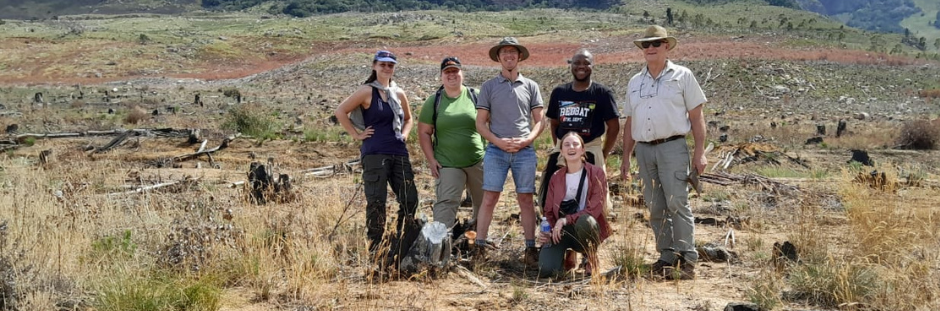
With strong funding for the support of new students and post-docs, and the implementation of the new IMPACT Open-Air Laboratory, this is a very exciting next step for us. Read more about it here. Pictured above are Prof Dave Drew (centre) with some of the team who will be involved in the IMPACT experiment, at the site during lay-out of the research plots.[:]
[:en]Visitors from East Africa[:]
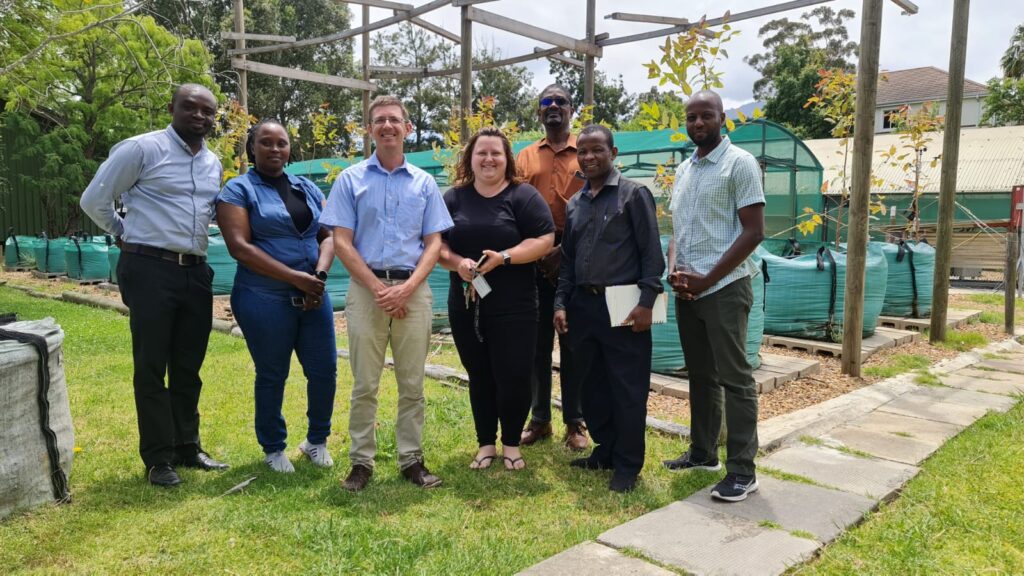
[:en]Recently, the FMM group hosted a group of visitors from Gatsby Africa (Kenya) and Sokoine University of Agriculture (Tanzania). The teams were in Stellenbosch mainly working with Prof. Brand Wessels on a broader project, but were eager to learn more about EucXylo and opportunities for future collaboration. We hope some future opportunities do arise, and look forward to more Tanzanian students on our team!
[:]
[:en]New paper in “Frontiers”[:]
[:en]
Dave Drew was part of the team of authors led by Dr. Annemarie Eckes-Shepard who recently had a new paper, entitled “Wood formation modelling – a research review and future perspectives”, published in Frontiers in Plant Science.

This is a comprehensive review, covering 16 wood formation models (WFMs) from three different disciplines, the earliest from 1968 and the latest from 2020. It is the first systematic cataloging, characterisation, and process-focused review of WFMs. Some important areas for future research are identified: (1) the extent of hormonal influence on the final tree ring structure; (2) the mechanism underlying the transition from earlywood to latewood in extratropical regions; and (3) the extent to which carbon plays a role as `active’ driver or `passive’ substrate for growth.
The abstract of the article is available here, pending final quality checks.
[:]
[:en]Oluwaseun graduates[:]
[:en]
Oluwaseun recently received his M.Sc. degree during the December graduation, which took place at Stellenbosch University from 13 to 16 December 2021.
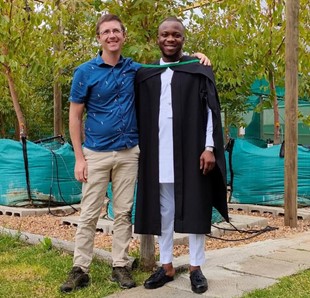 This year the graduation ceremony followed a hybrid model where small physical (face-to-face) ceremonies, as well as virtual faculty-specific graduation ceremonies were held. Oluwaseun, one of our M.Sc. students, received his master’s degree in Forestry and Wood Science. His thesis titled ‘Parameter testing and application of the 3-PG model for Eucalyptus grandis x urophylla on the Zululand coastal plain, South Africa’ aimed at using a simple process-based, stand level model called 3-PG (Physiological Principles Predicting Growth) and satellite driven data to calculate biomass production, and provide information on the growth dynamics of Eucalyptus grandis x urophylla hybrids under varying climate conditions in South Africa.
Due to the limitations of conventional empirical growth models and the complexity of process-based models, the 3-PG model was developed to bridge the gap between conventional empirical growth and yield models and process-based carbon-balance models, coupled with the objective of providing a forest management tool with practical value to forest managers. The 3-PG model has gained popularity with researchers and forest managers (especially pulp growers in South Africa) as a practical tool for sustainable forest management strategies. This is because the classical growth and yield models used have become unsustainable as we are in a time where forest growth cannot be reliably predicted from historical bioassays.
The 3-PG model has been adopted in several countries due to its simplicity, availability (free access to the code and software) and practicality. Although it has been tested for Eucalyptus grandis in South Africa, it has not been tested for Eucalyptus clones such as Eucalyptus grandis x urophylla. Therefore, the objectives of this project were to test and set up the 3-PG model for Eucalyptus grandis x urophylla (the most planted hybrid clones in South Africa) and compare its performance with the currently used conventional growth and yield model.
The outcomes of this project will be invaluable as it will provide forest managers with an operational tool that can accurately predict the growth and yield under changing environments and management practices, as well as provide data useful in the economic management of stands and predict the productivity of a new site that has not been previously afforested.
 Oluwaseun, who originally hails from Nigeria, also became the proud father of a baby daughter, Michelle, during his studies in South Africa. Congratulations Oluwaseun! This is truly an inspiring example of his hard work, perseverance, and strong work ethic. Oluwaseun’s dedication is commendable and has earned him the respect and appreciation of his peers. His passion and commitment to achieve his goals never failed to amaze the EucXylo team. We are very glad that he can now spend some quality time with his family.
Being back in Nigeria, Oluwaseun is now working on publishing a manuscript from his thesis, and he is also enrolling for online courses to continue developing his skills in R and Python. He is also in the process of applying for forestry positions in South Africa. Oluwaseun has proven himself to be a very skilled individual who has the capacity to do great things in his future endeavours.
Congratulations on your graduation Oluwaseun! We are so proud of you! Best wishes and good luck for your future and the next journey you decide to embark on.
[:]
[:en]Dave visits kwaMbonambi industry trials[:]
[:en]
Prof Dave Drew attended a workshop hosted by Prof Zander Myburg, University of Pretoria, in kwaMbonambi on 28th February.
The meeting was to bring together stakeholders and current/potential future participants in a new project which Prof Myburg is leading to undertake “…large-scale genome sequencing to decipher woody biomass production and environmental interactions of eucalypt trees”.
Participants in the workshop visited two of the replicated field sites in the Zululand region at which a wide range of families of E. grandis have been planted. The response of these different families at the site was strikingly variable, in terms of growth, as well as things like pest and disease resistance. A wide variety of other growth, wood property and physiological variables are and will be measured.
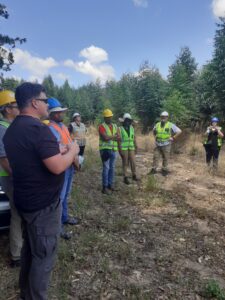
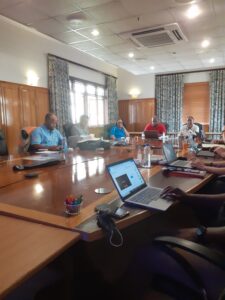
Prof Drew hopes to be able to bring one or more students into the project to understand growth responses and other physiological differences, to link to the genotypic variation which will be extensively undertaken.
[:]
[:en]Prof K. von Gadow guest lecture[:]
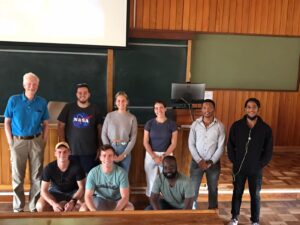
[:en]Prof Klaus von Gadow is visiting South Africa at the moment. We were very glad when he agreed on Tuesday 1st March to give a guest lecture to the 3rd year Growth and Yield students! He was able to bring to them a wonderful breadth of ideas and experiences from his long and rich career. Thanks again Klaus!
[:]
[:en]Visit to Prof Jim Hanan opens some exciting opportunities[:]
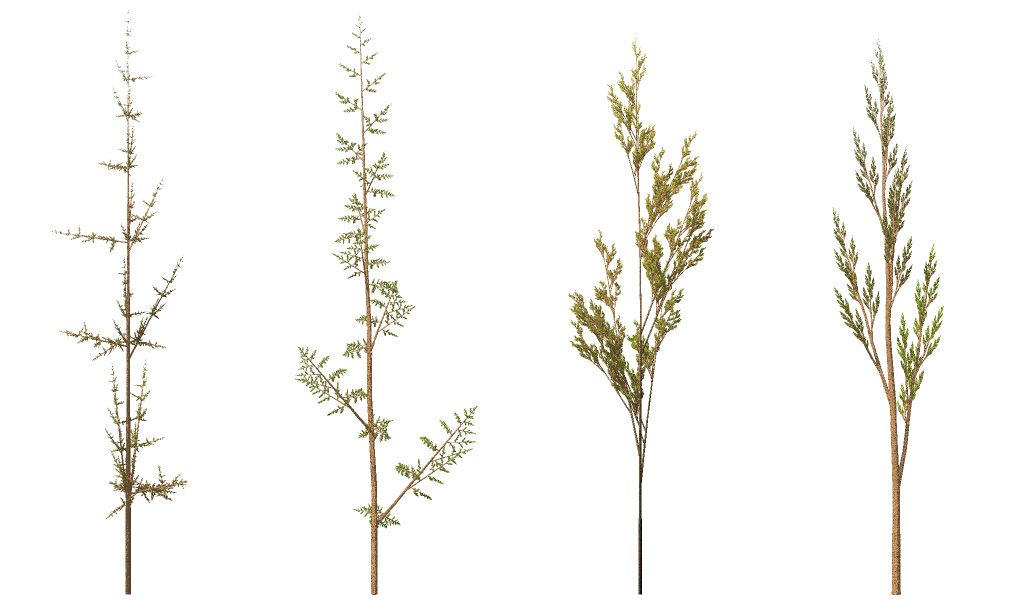
[:en]In May 2019, Dave Drew visited Prof Jim Hanan at the University of Queensland in Brisbane Australia, to discuss opportunities to work together on aspects of the Hans Merensky EucXylo Chair.
Jim has a large amount of experience in using L-systems (Lindenmayer systems) to model plant development. A Lindenmayer system is a parallel rewriting system and a type of formal grammar and could present a very useful approach in terms of modelling Eucalyptus tree form (see image below). He also has experience in modelling “cellular” systems of various kinds, using tools like NetLogo to explore interactions between individual elements. Dave and Jim agreed to work towards student exchange and mutual visits centred around research in the EucXylo Chair.
 [:]
[:]
[:en]Prof von Gadow honoured with honorary doctorate from the University of Santiago de Compostela[:]
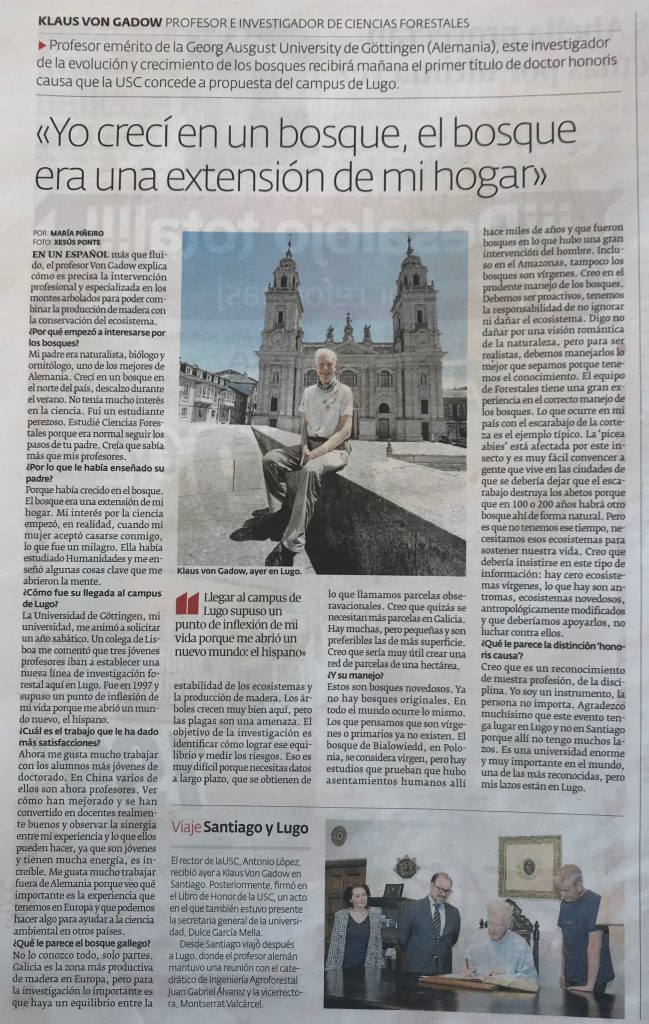
[:en]We are thrilled to congratulate Prof Klaus von Gadow on the recent investiture of the degree Doctor Honoris Causa from the University of Santiago de Compostela.
Klaus is an extraordinary Professor with Forest and Wood Science, and a close friend of all of us here at FMM. The investiture of this honorary degree is certainly well deserved, and we are extremely pleased that the excellence Klaus has always exhibited in his esteemed academic career has been honoured in this way. It is a great privilege to be able to continue to work with him and to have him as part of our Stellenbosch team! We have posted copies below of just some of the media coverage this auspicious event got in Spain.

[:]
[:en]New HMF EucXylo Research Chair Contract Signed[:]
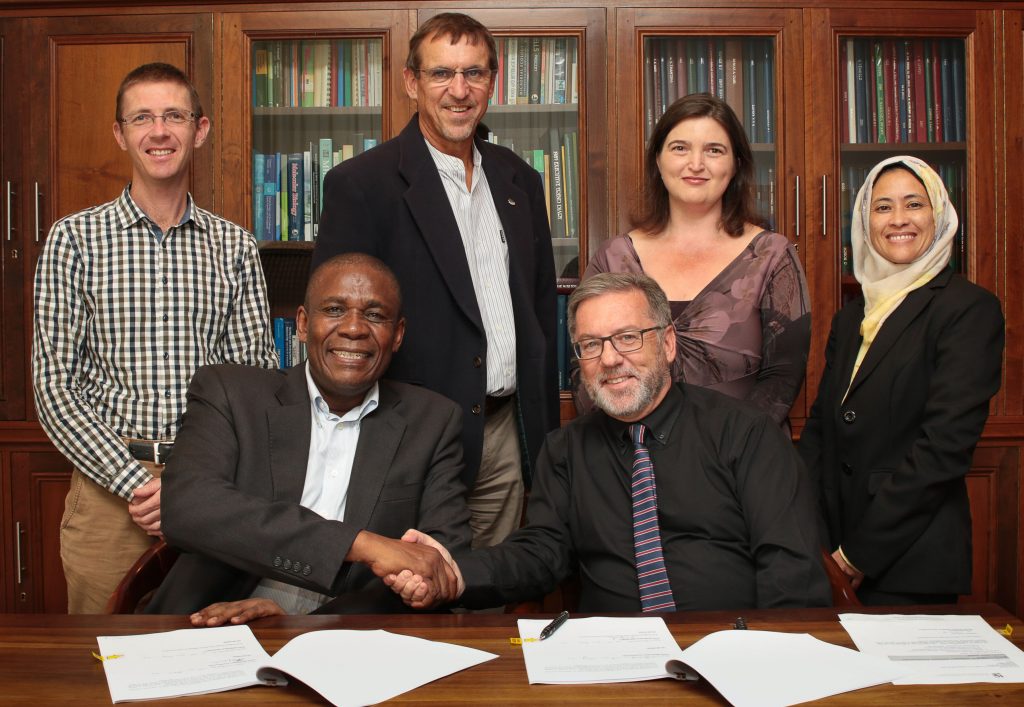
[:en]The the new Hans Merensky Research Chair in Advanced Modelling of Eucalyptus Wood Formation, or “EucXylo” has officially started! The contract formalizing the start of the new 10-year initiative was signed on Friday 17th May 2019 by Dr Khotso Mokhele (President of the Board of Trustees of the Hans Merensky Foundation) (front left) and Prof Eugene Cloete (Vice Rector, Research and Development at SU) (front right).
The new Research Chair, in keeping with the inspiring legacy of Dr Hans Merensky, contributes to an important area of science: how trees form wood. The global significance of the process of wood formation in trees cannot be under-estimated. Wood formation is fundamental to the fixing of carbon dioxide into a stable, valuable and beautiful material, and to the ongoing production of increasingly important renewable timber resources. To this end, the main scientific objective of the EucXylo Chair is to develop an evolving, inter-connected set models of wood formation (xylogenesis) in the important genus Eucalyptus (commonly known as “gum trees”), arguably the world’s most widely planted hardwood tree. A range of projects led by post-graduate students, post-doctoral fellows and academics, will use cutting edge, high precision measurement techniques, combined with intensive sampling and laboratory analyses, to answer important questions about the Eucalyptus wood formation system. These insights will be the basis by which researchers in the project continually build and improve predictive models at multiple scales. The models will be incorporated into a software-based simulation framework, which is envisaged to become a platform for scientific collaboration and the generation of new hypotheses and ideas within South Africa and around the world.
The lead researcher will be Dr David Drew, Senior Lecturer in the SU Department of Forest and Wood Science (DFWS) (back left). Dr Drew will collaborate closely with scientists from across the faculties of Agrisciences and Science at SU, and with a number of leading international researchers. In the first five-year phase of the Research Chair, six post-graduate students (M.Sc. and PhD) will be funded along with at least two postdoctoral fellows. The Chair will also co-fund new laboratory and research facilities and a new technical position within the DFWS, to support the research activities at the level which will be required. It is planned that the first students will start in 2020.
[:]
[:en]NFFF 2018 a great success![:]
[:en]The Tree and Forest Modelling Group at DFWS hosted an international scientific conference, New Frontiers in Forecasting Forests (NFFF), in September 2018. The meeting brought together 85 experts from 16 countries to present research and discuss advances in models predicting future attributes of forests. It was strongly supported by the International Union of Forestry Research Organisations (IUFRO), particularly Division 4 and Working Party 5.01.04.
The meeting was opened by Prof Eugene Cloete, Vice Rector Research and Innovation, and Prof Danie Brink, the Dean of the Faculty of Agrisciences. It was characterised by an atmosphere of discussion and debate and delegates enjoyed several opportunities to share ideas and build new and existing collaborations. A special issue of papers from the meeting is being prepared in the respected scientific journal Annals of Forest Science.
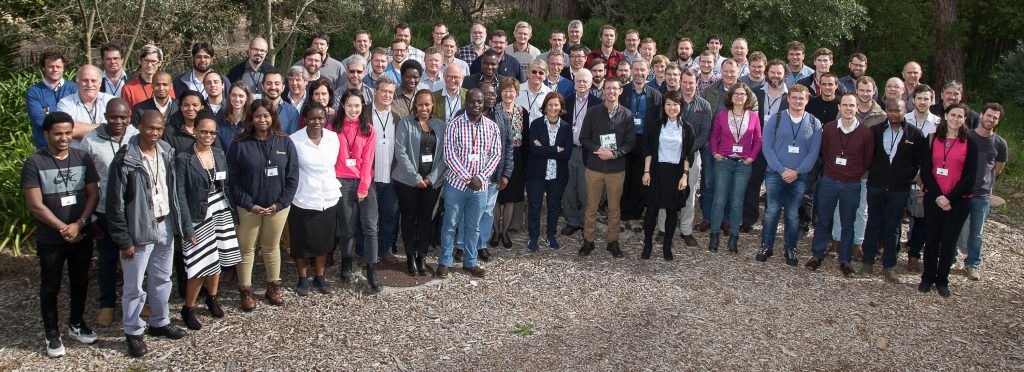
Delegates for the IUFRO-supported New Frontiers in Forecasting Forests meeting pose for a picture outside the conference venue at STIAS. [:]