Month: November 2025

Beyond Transformative Agreements: A new direction for Open Access in South Africa

South Africa has made significant strides toward Open Access (OA) in scholarly publishing, yet critical challenges remain. While Transformative or Read-and-Publish Agreements (TAs) have helped shift traditional subscription models toward open access, evidence increasingly shows that these agreements have not fully delivered on their promise of equity, sustainability, and transparency.

Limitations of Transformative Agreements

Experiences from countries like Sweden and the United Kingdom reveal that despite increased OA content, paywalled research continues to grow, and costs have risen. In many cases, only well-resourced institutions can afford to participate, leaving much of the research community behind. Moreover, publisher opacity around pricing and limited competition have reinforced rather than dismantled inequitable systems.

Sweden’s recent policy shift provides useful guidance. The country has moved away from hybrid TAs and is instead focusing on agreements with fully OA publishers, developing a national OA platform, supporting researcher-owned journals, and addressing copyright barriers. Similarly, the UK’s JISC review highlights that eight years after the first TAs, full and immediate OA remains elusive.

Myths and Realities of TAs

A review of Transitional Agreements in the UK – JISC  March 2024, lists and debunks several common myths:

  1. Equity – False; OA publishing remains unaffordable for many.
  2. Transition to OA – Only wealthy institutions can fully participate.
  3. Moving away from APCs – Caps and hybrid costs make TAs even more expensive.
  4. Transparency – Publishers often refuse to reveal costs.
  5. Competitive pricing – Market remains uncompetitive and opaque.
  6. Better library positioning – Libraries remain intermediaries without real negotiating power.

For South Africa, the lesson is clear: it is time to move beyond Transformative Agreements to more impactful and sustainable models of OA. The Universities South Africa Research and Innovation Strategy Project proposes a forward-looking solution — a national Diamond Open Access publishing platform that removes author and reader fees, promotes equitable participation across institutions, raises the visibility of South African research, and fosters collaboration by removing access barriers. Coalition S defines Diamond Open Access as “a scholarly publication model in which journals and platforms do not charge fees to either authors or readers. These journals are community-driven, academic-led, and academic-owned publishing initiatives… They are equitable by nature and design.” Through its SUNJournals platform, the Library is able to provide Diamond Open Access publishing services to faculties and departments.

It is critical that we ensure that true open access enhances broader and deeper research impacts to serve the public good, not commercial interests. South Africa has a great opportunity to lead the way in building a more inclusive, transparent, and sustainable open scholarly ecosystem. However, this will require bolder decisions by the government and other stakeholders that will move us beyond the extortionate and unsustainable TA models.

For information on how to join the Diamond Open Access movement by publishing Stellenbosch University journals on the SUNJournals platform, please contact Mrs Mimi Seyffert-Wirth.

References

A review of Transitional Agreements in the UK – JISC  March 2024. https://zenodo.org/records/10787392/files/A_review_of_transitional_agreements_in_the_UK.pdf?download=1

Widmark, W. (2024). How can we get beyond the Transformative Agreements: a Swedish perspective. Revista Española De Documentación Científica, 47(4), e402.

Author: Ellen Tise
 

The Library’s Open Access journey

As a transformative approach to scholarly communication, Open Access (OA) seeks to remove barriers to accessing, sharing and reusing research outputs.

Scholars such as Raffaela Kunz and Monika Plozza believe that this approach not only contributes to the sharing of research but could potentially advance universal access to information, as envisioned by the United Nations Human Rights framework and the Sustainable Development Goals (SDGs).

It can also play a transformative social justice role by closing the digital gaps and dismantling information disparities between those who have the resources and means to purchase and access information and those who do not, according to Paul Ginsparg, founder of the open-access archive arXiv. University of Cape Town academics Laura Czerniewicz and Sarah Goodier highlight the need for OA as both an economic and democratic one.

Worldwide, universities and academic libraries are involved in OA advocacy, encouraging researchers to publish their work in OA platforms.

These institutions believe that OA enhances the reach and impact of scholarship.

The commitment of Stellenbosch University (SU) to OA was cemented 15 years ago with the signing of the Berlin Declaration on Open Access by the former rector and vice-chancellor, Professor Russel Botman, on 20 October 2010. In doing so, Botman became the first VC of an African university to sign the declaration, positioning SU as a pioneer on the continent in taking the OA pledge.

This landmark commitment marked the acceleration of OA, giving the university library strategic impetus and legitimacy in its advancement, support and advocacy of OA and other open-science initiatives.

The signing of the declaration itself was symbolic as it was signed during International Open Access Week. In an opinion piece for the Mail and Guardian on 29 October 2010, aptly titled ‘Stellenbosch takes open access lead’, the Senior Director of the SU Library and Information Services, referred to the signing of the OA pledge as “an important step towards sustainable human development” and towards the realisation of equitable information access.

Fifteen years later, we reflect on the progress, challenges, and future under the theme of the International Access Week 2025: “Who Owns Our Knowledge?”‘

Open Access has been embraced by the Library and the University and has become a vehicle for increasing the impact of research at this institution and allowed the library to go on this journey.

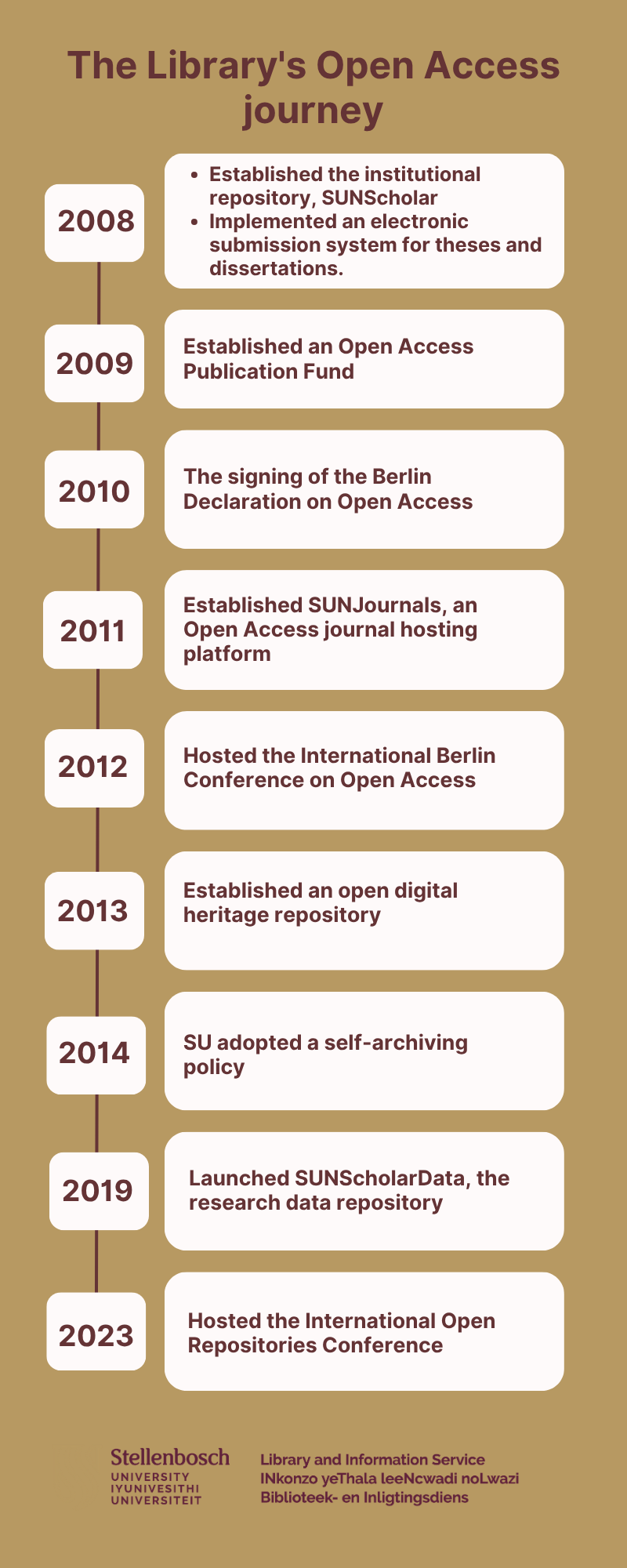
The Library’s OA journey began in 2008 with the establishment of the institutional repository, SUNScholar, and the implementation of an electronic submission system for theses and dissertations. SUNScholar boasts over 35 000 full text research outputs with more being added annually.

The Library’s commitment to Open Access was furthermore manifested in the establishment of an Open Access Publication Fund in 2009, which funded 1035 SU research publications until its closure in 2021.

The hosting of an Open Access Seminar in 2010 was also a highlight where Stellenbosch University became the first African University to sign the Berlin Declaration of Open Access to Knowledge in the Sciences and Humanities.

In 2011 the Library established SUNJournals, an open access journal hosting platform for journals with an SU affiliation. We currently host 23 journals in various disciplines.

In 2012 we hosted the International Berlin Conference on Open Access. This was the first time that the Berlin Open Access Conference was held in Africa. It explored the transformative impact that open, online access to research has on scholarship, scientific discovery, and the translation of results to the benefit of the public.

In 2013 the library established an open digital heritage repository to showcase and allow access to the library’s special and unique collections and currently provides access to over 18 000 unique records in 50 collections. We can see examples of these materials being accessed and used in a range of outputs.

In 2014 the University adopted a self-archiving policy that asks SU authors to submit a copy of their accepted manuscript to the institutional repository.

In 2019, with research data widely recognised as crucial to the research process and the preservation of and access to such data becoming an absolute necessity, the library launched SUNScholarData.

This research data repository enables Stellenbosch University researchers to share and disseminate their research data in accordance with good research data management practices and will serve to facilitate the findability, accessibility and reusability of the university’s research data.

In 2023 the Library hosted the International Open Repositories Conference, the first time this event was held on African soil.

Our Open Access journey continues with ongoing negotiations regarding transformational agreements and our commitment to Open Access will remain steadfast and help us to take on whatever new OA developments may come our way.

Authors: Ellen Tise, Mimi Seyffert-Wirth, Siviwe Bangani

This article is based on notes prepared for Miss Ellen Tise’s speech during the International Open Access Week celebrations and the 15-year commemoration of the signing of the Berlin Declaration on Open Access at Stellenbosch University on 22 October 2025. Some of the text was extracted from an article Open access and research outputs: Who owns our knowledge? which was published in University World News, Africa Edition.

SU recognises research visibility and impact through Open Access Awards

The establishment of institutional repositories such as SUNScholar, SUNScholarData, SUNDigital Collections, and SUNJournals stands as a direct testament to the University’s ongoing investment in supporting and expanding OA. The Library continues to promote OA through initiatives such as staff and student training, Open Access workshops, and participation in International Open Access Week.

In recognition of the role of OA in enhancing research visibility, impact, and societal benefit, the Library and Information Service initiated the introduction of the Open Access Awards at the University’s Research and Innovation Excellence Awards held on 22 October 2025. This initiative acknowledges that OA contributions often remain under-recognised, despite their importance.

2025 Open Access Award Categories and Winners

Category 1: Most Prolific OA Author (Scopus-indexed)

Awarded to the SU-affiliated researcher with the highest number of OA publications indexed in Scopus over the period 2022–2024. This was awarded to Professor Soraya Seedat, Department of Psychiatry. In her own words: I think I’m particularly encouraged by the Open Access Award, because it is really important. We ensure that all the work we produce is widely accessible, particularly to people living in a lower-income context, where they do not have ready access to scientific and medical literature. (View video of highlights of the event here)

Category 2: Highest Cited OA Output (Scopus-indexed)

Awarded for the OA publication by an SU-affiliated author, indexed in Scopus and published between 2022–2024, that received the highest number of citations. This was awarded to  Dr Houriiyah Tegally, Centre for Epidemic Response and Innovation.

Category 3: Most Downloaded OA Output (SUNScholar & SUNScholarData)

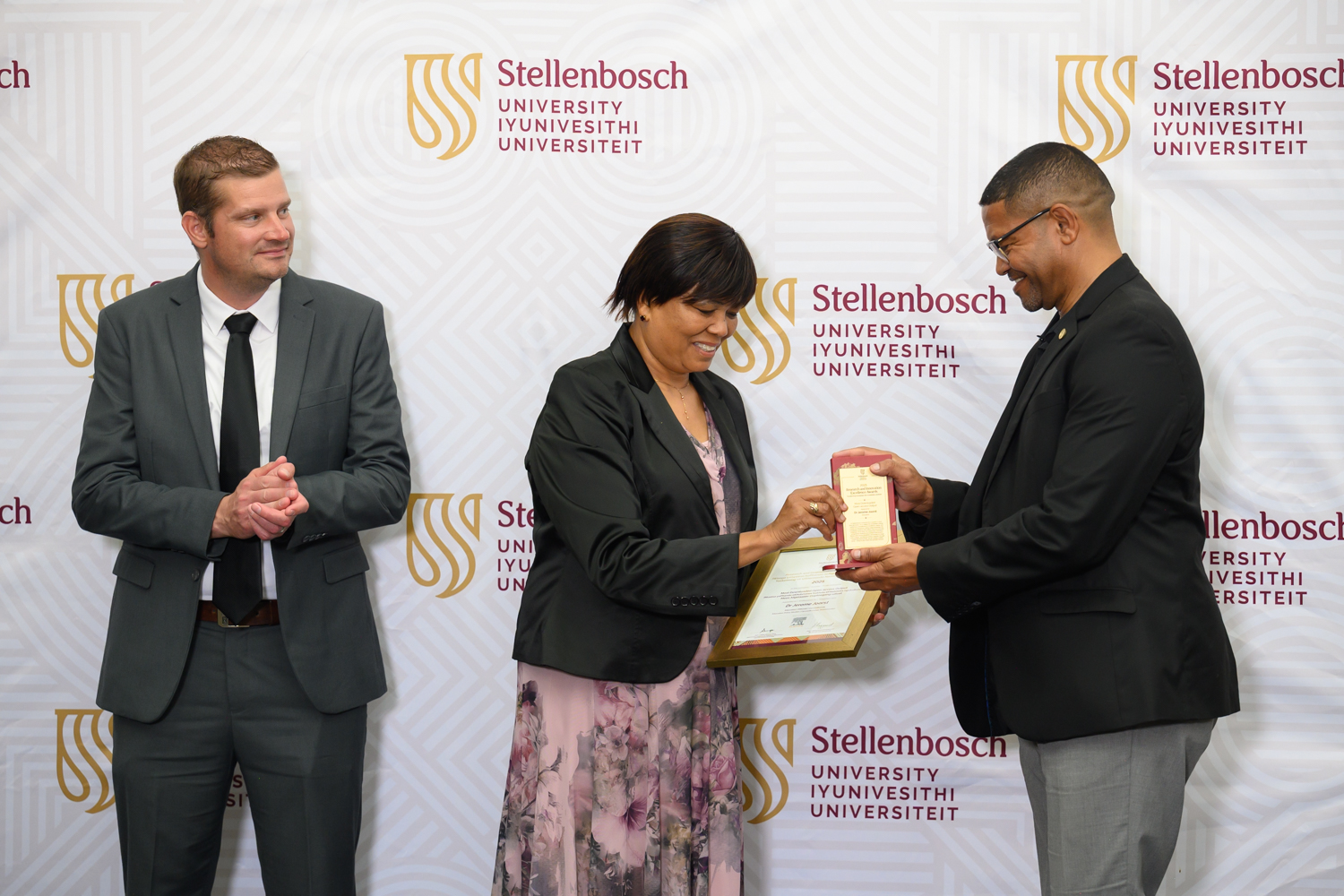
Awarded to the SU-affiliated author(s) whose OA output deposited in SUNScholar from 2020-2024 received the highest number of downloads. This was awarded to:  Drs Jerome Joorst, Education Policy Studies, Technology Transfer/Innovation team, and  Willie Smit, Mechanical and Mechatronic Engineering.

Prizes were sponsored by Elsevier, while the Office of the DVC: Research, Innovation and Postgraduate Studies provided the plaques. Through the introduction of these awards, the Library aims not only to recognise and celebrate researchers who actively choose Open Access, but also to encourage broader participation in OA publishing across the University.

Strengthening the University’s leadership in advancing equitable access to research is both a social justice imperative and a contribution toward sustainable human solutions. Increased Open Access publishing enhances the visibility and impact of SU research and aligns directly with the University’s aspiration to be Africa’s top university, which is ranked within the Top 100 globally.

From left to right: John Sterley (Research Account Manager, Elsevier), Ellen Tise (Senior Director: Library and Information Services and Dr Jerome Joorst (Education Policy Studies)

Author: Dr Siviwe Bangani

International Open Access Week: Who owns our knowledge?

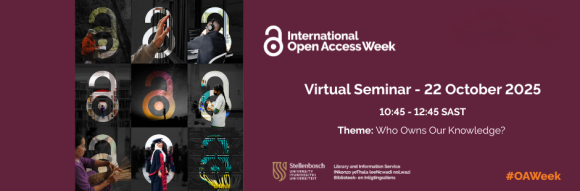
International Open Access Week is a flagship global event dedicated to open access, held annually in October.  This year’s theme was Who Owns Our Knowledge? and it took place 20 – 26 October 2025. The Library aimed to use this year’s Open Access Week event to also commemorate the signing of the Berlin Declaration on Open Access by the then Rector of Stellenbosch University, Professor Russel Botman, on 20 October 2010.

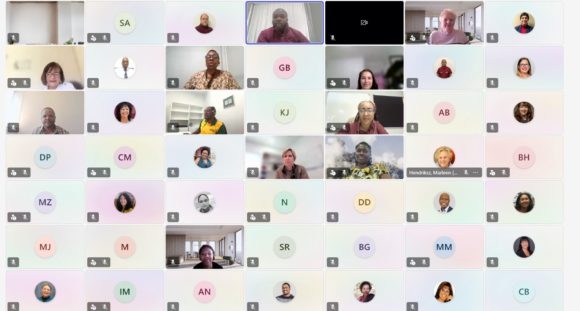
On 22 October 2025, a virtual seminar was held, involving various stakeholders. The programme included a presentation by the Library: “15 Years Unlocked: Celebrating Open Access since signing the Berlin Declaration,” by Ms Ellen Tise, the Senior Director of the Library.  She shared a candid account of the Library’s open access journey since the commitment to open access was made. She also highlighted the milestones and pitfalls encountered along the way.  This was followed by a lively panel discussion involving three experts, Emilie Algenio (Mason University Libraries), Dr Charles Akwe Masango  (University of Cape Town) and Denise Nicholson (Scholarly Horizons). While expressing frustration with the slow pace of assenting to the new South African Copyright Bill, the speakers empowered researchers and librarians on copyright, creative commons and fair use, and how these can be used by producers of knowledge to retain rights to their works. Ina Smith’s presentation “Policy and Research Ownership in the Age of Open Access” emphasised the need for clear institutional and national OA policies that prioritise researcher rights. She further encouraged universities to deposit research outputs in trusted institutional repositories for visibility and long-term preservation, as well as for compliance with funder requirements.

Screenshot of some attendees, by Theresa Schoeman

Author: Dr Siviwe Bangani

The University’s data repository, SUNScholarData, is a proud member of the World Data System

The Stellenbosch University Library and Information Service is proud to announce its membership in the World Data System (WDS), a global network that promotes trusted data services and open science. WDS membership supports the long-term preservation, accessibility, and interoperability of research data worldwide. This membership confirms SU’s commitment to the FAIR principles (Findable, Accessible, Interoperable, Reusable) and positions SUNScholarData as part of an international effort to advance data sharing and collaboration.

Joining WDS brings significant benefits for SUNScholarData and Stellenbosch University. It heightens the repository’s profile, giving worldwide visibility through the International Science Council, international funders, and the global data community. Membership also demonstrates our commitment to open science, promoting SUNScholarData as a trustworthy scientific data service aligned with WDS Data Sharing Principles. Finally, it enhances our repository’s performance and agility by improving data discovery and supporting international data exchange, thus ensuring our researchers’ work is more accessible, impactful, and globally connected.

SUNScholarData is also among a select group of CoreTrustSeal-certified data repositories in South Africa. These recognitions assure SU researchers that the data sets they deposit are curated and preserved according to internationally recognised standards of quality and trustworthiness.

Author: Kirchner van Deventer

Springer Nature “Free” Open Access allocation reached national annual cap

The Library and Information Service has long supported Open Access (OA) publishing, including the development of strong institutional repositories enabling both green and diamond OA. More recently, as part of the South African National Library and Information Consortium (SANLiC), the Library entered several “Read and Publish” (Transformative) Agreements. These agreements have allowed SU researchers to publish OA in selected journals without paying Article Processing Charges (APCs).

However, some agreements have a national annual cap on the number of OA articles that can be published. Once this cap is reached, APC waivers are no longer available for the remainder of that year.

As such, we wish to inform SU researchers that the 2025 national allocation for OA publishing in Springer Nature hybrid journals has now been fully used. Of the 1,074 articles allocated for South African institutions, SU researchers contributed 96 articles (approximately 9% of the national total).

As a result, Springer Nature has deactivated the no-fee OA publishing option for SU authors in hybrid journals with immediate effect. Any new OA submissions to Springer Nature hybrid journals will now incur APCs, which will be invoiced to authors or their departments, as they are no longer covered by the agreement. Researchers may still publish in Springer Nature hybrid journals without paying APCs if they choose the standard (paywalled) publication route.

Despite the latest developments, the 15% discount for BioMed Central (BMC) fully OA journals remains in place. Researchers will continue to be responsible for the full APCs when publishing in other fully OA Springer Nature journals.

We understand that this change may affect research publication planning. We encourage researchers to consider other OA options available through SANLiC’s remaining “Read and Publish” agreements, which still provide no-fee OA publishing in hybrid journals from several other publishers.

For more information, please consult the Library’s Open Access Publishing LibGuide.

For further assistance, please contact Sizwe Ngcobo.