Month: February 2026

Update on Open Access publishing options for SU researchers

We are delighted to share an update on the Library and Information Service’s recent Open Access (OA) ‘read and publish’ agreements with various publishers. Over the years, we have established deals that provide substantial discounts on article processing charges (APCs) and, in many instances, enable authors to publish their work open access at no cost to them. In practical terms, as of 2026, SU researchers can now publish Open Access in 10 933 journal titles, many of which are subscription-based journals to which the Library subscribes. These advancements are largely facilitated through SANLiC (South African National Library and Information Consortium) negotiated ‘read and publish’ agreements with the aim of removing financial barriers to information access and boosting the global visibility of South African research.

For some of the agreements, there is a cap on the number of articles that may be published by South African authors, while others are unlimited. Unfortunately, in the last few months of 2025 and in early January 2026, there were instances where authors were informed that the cap for South African open access publishing had been exhausted. In response, the Library has put a monitoring mechanism in place this year to ensure that authors are informed timeously when the publishing cap for specific publishers is reached. We hope that all authors whose open access publications could not proceed towards the end of last year due to the exhaustion of the publication cap for South African authors have already been informed of the renewal of the publisher agreements.

In 2026, the American Institute of Physics was added to the list of publishers with which the Library holds “read-and-publish” agreements. Six agreements due to expire in 2025 were successfully renewed: the American Chemical Society, Elsevier, IOPscience Extra, Oxford University Press, Springer Nature, and Wiley. These were in addition to agreements still in force with the Association for Computing Machinery, Cambridge University Press, Emerald, the Royal Society of Chemistry, SAGE Publishing, Taylor & Francis, and The Company of Biologists.

The Library will continue to pursue opportunities to make open-access publishing the default for SU researchers, to enhance global visibility, research impact, and ultimately the University’s ranking. For the latest eligible journals, publisher-specific details, or submission guidance, you can visit the SU Library’s Open Access publishing support page and libguide.

For enquiries about open access agreements or any open access related queries, contact Mr Sizwe Ngcobo (Manager: Open Access Scholarship).

Telephone: 021 808 9907

Author: Sizwe Ngcobo

Why Persistent Identifiers matter in research publishing

Researchers have witnessed exponential growth in the number of journals and articles published over the past few decades. Much of this expansion is often attributed to the public introduction of the internet in 1993. However, it has also created challenges such as broken links, researcher name ambiguity, and difficulty in distinguishing between different articles and journals. To address these challenges, persistent identifiers (PIDs) were introduced.

Persistent identifiers are unique, long-lasting, and machine-resolvable codes that serve as permanent references to digital objects, people, or organisations on the web. Unlike standard URLs, PIDs ensure that resources remain accessible even if their location changes, making them essential for scholarly publishing processes.

Some of the key features of PIDs include reliability and resolvability. A PID never changes and therefore helps to avoid broken links. Each PID is a unique identification and assists with the disambiguation of authors, research data, publications and more. The embedded metadata often found in PIDs provides more context, for example publisher details and publication dates.

The following common types of PIDs are available in the research and publishing environment:

  • DOI (Digital Object Identifier): Used for articles, datasets, and publications.
  • ORCID (Open Researcher and Contributor ID): Identifies individual researchers throughout their careers.
  • ISSN/ISBN: Mandatory identifiers for journals and books
  • Handles/URNs: Used by some repositories for persistent, non-commercial identification.
  • ROR (Research Organisation Registry): Identifies research organisations and institutions.
  • ARK (Archival Resource Key): Provides stable, long-term access to digital information, physical objects, and concepts.
  • IGSN (International Generic Sample Number): Identifies physical samples in scientific research.

The importance of PIDs lies in the enhanced discoverability of research outputs, to find them, cite and track them and therefore increasing the visibility of the item, author, resource or sample. Disambiguation and interoperability are two other very important features of PIDs. They work across different systems, libraries and publishers to ensure seamless data connections. They also contribute to the reproducibility and trustworthiness in scientific scholarly communication.

For authors and researchers, one of the most important PIDs is your ORCID iD. Stellenbosch University has been a member of ORCID since 2015. By February 2026, at least 9 504 SU-affiliated researchers and students have ORCID IDs. About
5 250 of these have added a current affiliation to their records. For the University to fully realise the benefits of this affiliation, it is essential that researchers actively maintain their ORCID records and link them to the institution and their research outputs. Researchers can link their ORCID iDs to their researcher profiles on Sympletic Elements and then export their research output from here to ORCID. The more well-populated ORCID records there are, the more value the research community will gain from participating in ORCID.

Please contact Marié Roux for further assistance.

New appointments: Research support staff

To strengthen research support in the Library’s offering, the following three staff members have been appointed or promoted in the past few months at the Research Services or Information Services divisions. We welcome them warmly to their new positions.

Sizwe Ngcobo

To strengthen our open access support, Sizwe Ngcobo was recently appointed as Manager: Open Access Scholarship. Prior to him assuming this position, he served as Stellenbosch University’s (SU) Research Data Services Librarian, where he was responsible for the management and curation of research data assets, as well as providing specialised research data management support to SU researchers.

Sizwe joined SU as a qualified Information Professional, holding a B Information Science Honours degree from the University of South Africa. He completed his Master’s in Information Science from the same institution in 2025. Sizwe demonstrates a strong commitment to promoting equitable access to knowledge and advancing the transformation of scholarly communication within the Library and Information Service.

Over the course of his career, Sizwe has developed extensive expertise in research support, scholarly publishing, and open access advocacy. In his current role, he oversees the Library’s open access initiatives, supports the publication submissions by SU researchers through SANLiC’s (South African National Library and Information Consortium) ‘read and publish’ agreements, and promotes sustainable publishing practices.

Sizwe collaborates closely with SU researchers, academic departments and divisions, and strategic partners to enhance research visibility, ensure compliance with funder mandates, and support innovative approaches to knowledge dissemination.

Bhekizizwe Nkosi

Bhekizizwe Nkosi has recently been promoted to a Scholarly Communication Librarian, where he supports and advances open scholarship and research dissemination. He joined Stellenbosch University in June 2025 as a Junior Librarian: Scholarly Communication. In his current role, he helps manage digital repository platforms and e-journal systems, provides training and guidance to researchers and students, and actively advocates for open access initiatives. His work focuses on strengthening scholarly publishing support, improving access to research outputs, and enhancing institutional research visibility and impact.

Before joining Stellenbosch University, Bheki held several roles at the University of the Western Cape (UWC), including Library Assistant and Senior Library Assistant: Research Support & Scholarly Communications, where he contributed to institutional repository management, digitisation workflows, bibliometric analysis, RDM training, journal evaluation support, and open access journal development.

Currently pursuing a Master’s in Library and Information Science with a specialisation in data stewardship and knowledge management, Bheki’s research focuses on data stewardship in physics and astronomy – bridging research excellence with responsible data practices. He is passionate about ethical, transparent, and accessible scholarly publishing and is dedicated to helping researchers navigate journal selection, research data management (RDM) best practices, and open access publishing platforms.

Grace van Niekerk

Advocate Grace van Niekerk currently serves as Senior Faculty Librarian (Law). She previously held the position of Faculty Librarian for Law at the University of the Western Cape for 29 years, where she provided specialised research support, advanced training, and academic guidance to law students, researchers, and faculty members.

Throughout her career, she has played a pivotal role in strengthening legal research capacity within the faculty by designing structured information literacy programmes, developing comprehensive research guides, and facilitating access to complex legal resources in both print and digital environments.

Grace holds an LLB degree together with qualifications in Library and Information Science, complemented by additional professional certifications in legal research and information management. She is also an Advocate of the High Court of South Africa, bringing a distinctive integration of legal expertise and academic librarianship to her role. In addition, she has provided Commissioner of Oaths services within the university environment, reflecting her broader professional contribution to institutional support.

Recognised for her professionalism, strong organisational ability, and student-centred approach, Grace is committed to strengthening research excellence and advancing innovative library services that respond to the evolving needs of legal education.

Author: Theresa Schoeman

Library launches a smarter, more client-centred website

Surveys and other research conducted by the Library highlighted the need for a more client-focused and smarter website to better support research. As a client-centred environment, the Library took this feedback seriously. In response, on 19 December 2025, the Library and Information Service proudly launched its newly implemented website, now live at https://www.su.ac.za/library.

This launch forms part of Stellenbosch University’s broader initiative to migrate all SharePoint website content to the institutional Drupal web content management system. By leveraging SU-specific templates and Drupal components, the library has been able to streamline content, present information more compactly, and deliver a fresh, modern, and user-friendly online experience.

The library supports researchers at every stage of research, and these resources are designed to guide you through every phase of your academic journey. From starting a project with information resources and consultations with librarians, to managing data and references, publishing your research and measuring its impact, the library provides expert tools and guidance, all accessible from this page. You will also find opportunities to grow through workshops, events, and training. With these services the library is your partner in discovery, research and innovation. From the Library homepage, simply select Research to explore all available research services and resources.

Some of the research services highlighted include:

  • Carnegie Research Commons: A dedicated space offering support and services to strengthen postgraduate and academic research.
  • Open access publishing support: Including the Read & Publish agreements with multiple publishers make open access publishing more affordable and increase visibility for SU researchers.
  • Research impact tools: Access specialised resources to assess scholarly performance and measure research impact.
  • Research data management: Consultations, training, interactive tools, and the secure SUNScholarData repository help researchers manage, preserve and share data effectively.
  • Special Collections: Rare and valuable materials preserved for future generations, supporting current research needs.

For more information and other services, visit the Library website or consult your faculty librarian.

The Library welcomes feedback on the new website. Share your thoughts at https://web.lib.sun.ac.za/feedback.

Author: Natasja Malherbe

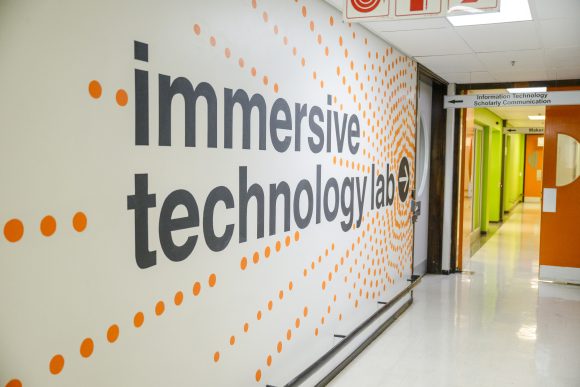
Step inside the future: SU Library opens Immersive Technology Lab

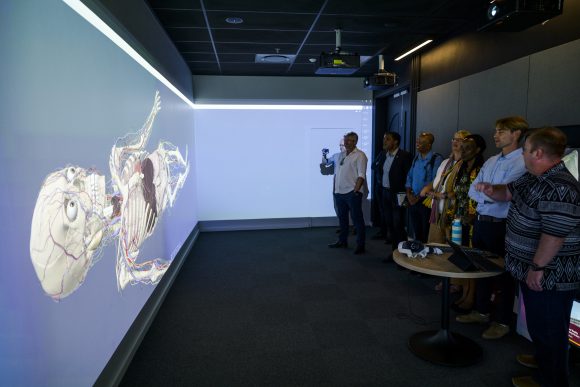
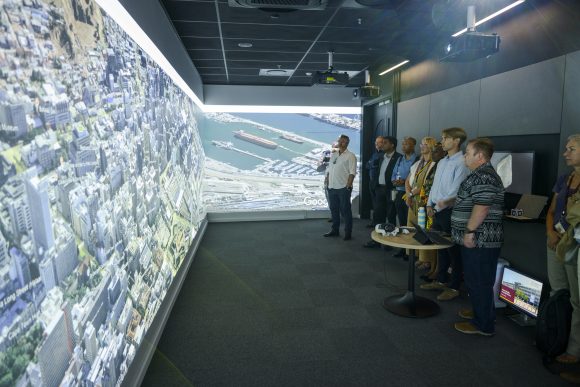
On Tuesday, 27 January 2026, the Library officially opened its new Immersive Technology Lab. It is a virtual and augmented reality visualisation space that provides an in-room panoramic visualisation across a 270° display area.  The Immersive Technology Lab was designed as a “true immersive” projection-based experience.

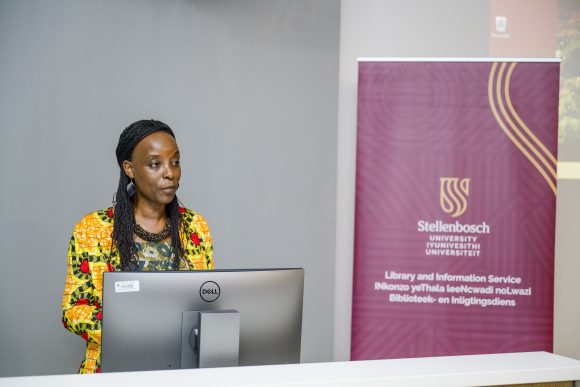
The opening marked the culmination of a seven-year journey. Ellen Tise, Senior Director: Library and Information Service, reflected: “What started as a much simpler vision has evolved alongside the rapid development of technology. This is a space where staff and students don’t just look at data – they can step inside it.” Originally conceived as a modest visualisation space, the Immersive Technology Lab has grown into a fully immersive environment supporting teaching, research, innovation, training, and industry collaboration.

Prof Deresh Ramjugernath, Ms Ellen Tise and Prof Sibusiso Moyo during the opening talks of the event.

Professor Sibusiso Moyo, Deputy Vice-Chancellor: Research, Innovation and Internationalisation, highlighted the Lab’s strategic importance: “Across disciplines, we are working with much larger datasets and more complex information. We need to interpret, explore and communicate our findings clearly and responsibly.” Located in the Library, the facility encourages interdisciplinary collaboration and strengthens SU’s core functions of teaching, learning, and research, as well as innovation.

Professor Deresh Ramjugernath, Rector and Vice-Chancellor, described the Immersive Technology Lab as a world-class facility that equips students and staff with new skills and ways of thinking, preparing them to meet the demands of a rapidly evolving academic and digital landscape.

Implemented as an extension to the existing Makerspace, the Lab adds enhanced visualisation services to the library’s existing data visualisation support service offering. It expands on the Makerspace’s existing suite of 3D content creation and editing services. In doing so, the Immersive Technology Lab integrates existing data visualisation literacy training services, virtual reality (VR) head mount display experience services and new research data visualsation services into one consolidated immersive visualisation environment. This uniquely positions the Lab as an interdisciplinary research support service at SU, accessible to students and faculty members across the whole spectrum of academic disciplines.

In practice, this means that staff and students using the Immersive Technology Lab will experience being visually immersed in a project – applying technologies such as virtual and augmented reality to create deeply engaging, simulated experiences for education, research, training, and industry. Examples of practical use could be nursing students practicing hospital procedures; engineers, being ‘in’ virtual 3D models of construction sites; and creating climate science models, such as translating invisible greenhouse gas data into visible, understandable experiences.


Accordingly, the Immersive Technology Lab was implemented as a direct consequence of the data-intensive environment in which Higher Education institutions with a strong research focus have to operate.

To visit the Immersive Technology Lab, please contact your faculty librarian to assist with an appointment or contact the Head: Makerspace, Norman Hebler, directly at nhebler@sun.ac.za.