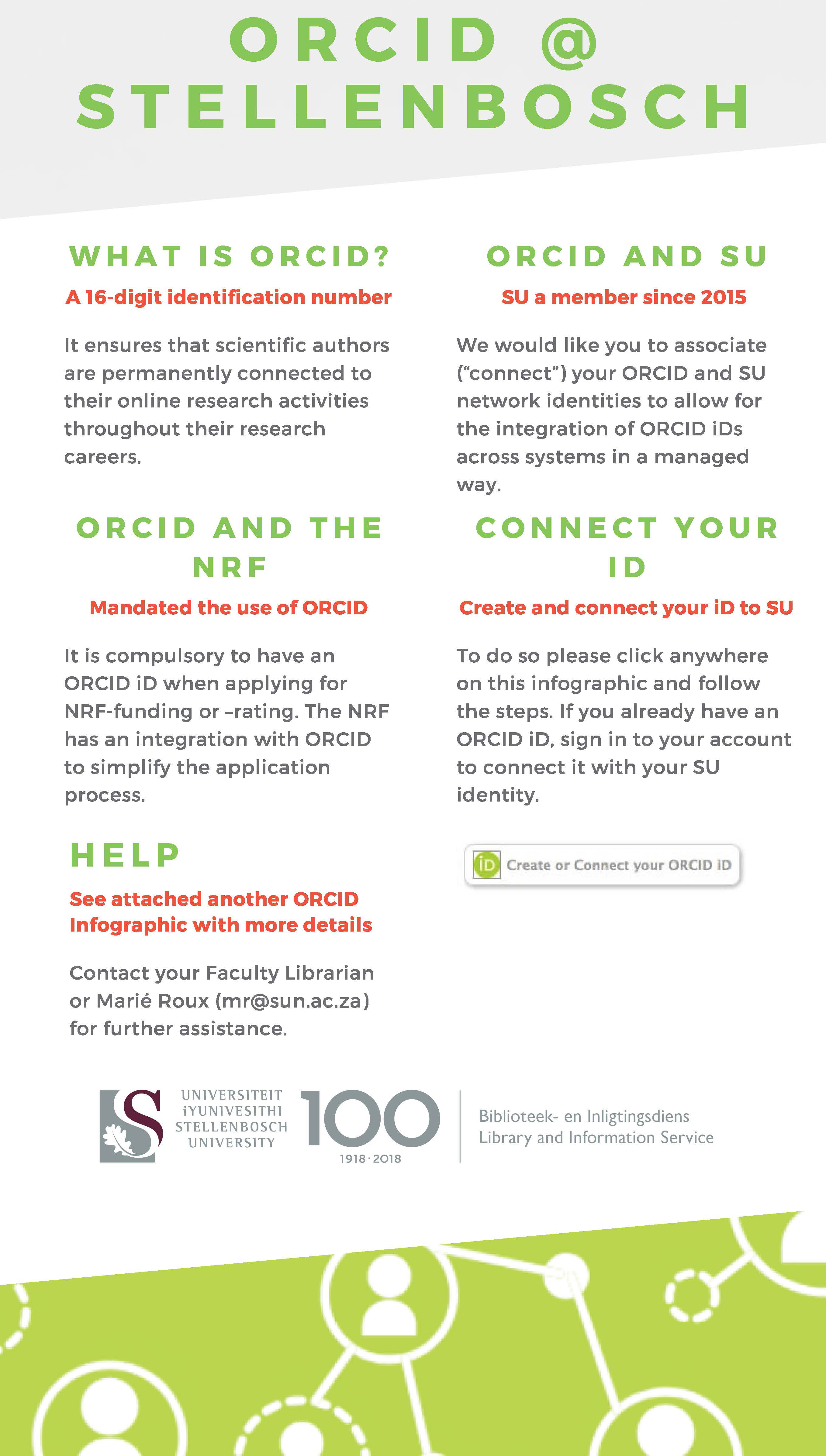
Create and connect your ORCID iD here….

International Open Access week is celebrated every year globally during the last week of October. The theme this year is “Open for Whom? Equity in Open Knowledge”.
In celebration of Open Access week the Academy Science of South Africa in partnership with the Library and Information Service will be hosting a dialogue on Open Access publishing lead by Prof Jonathan Jansen. More information on the event is available here.
During Open Access week the Library also uses the opportunity to draw attention to our own Open Access initiatives, which are the following:
Article by : Mimi Seyffert-Wirth
This week was Peer Review Week, with the theme “Quality in Peer Review”. Herewith important information about how to get help on improving your peer review skills.
Prof Christopher Jackson explains in this video what quality peer review looks like.
The Peer Review Week channel on YouTube features short videos by researchers, editors, publishers, and others on the theme of quality in peer review.
With Publons you can track more of your research impact all in one place, your publications, citation metrics, peer reviews and journal editing work. It is a product of Clarivate Analytics and therefore integrated with Web of Science citation metrics. It is also fully integrated with ORCID.

A very useful feature is the Publons Academy, a practical peer review training course developed together with expert reviewers and editors in order to give you the core competencies and skills needed of a peer reviewer. Please have a look at this if you are new at peer reviewing. It is a free online course which you can complete in your own time.
For more information or any assistance please contact your Faculty Librarian, Research Impact Services or Research Commons staff.
SUNScholarData is an institutional research data repository which can be used for the registration, archival storage, sharing and dissemination of research data produced or collected in relation to research conducted under the auspices of Stellenbosch University. An institutional research data repository is defined in this sense as a database with a set of services to capture, store, index, preserve and redistribute a university’s research data in digital formats.

There are two purposes for relying on SUNScholarData:
SUNScholarData has a public interface which can be used for finding content as well as a private user accounts which can be used by Stellenbosch University users in order to upload, share or publish their research data. In addition to this Stellenbosch University researchers can also use SUNScholarData in order to collaborate with researchers from other institutions whilst working on their research projects.
SUNScholarData is powered by Figshare which is a web-based interface designed for research data management and research data dissemination. The repository provides the following functionality:
Private, controlled storage and collaborative spaces for every user within the agency.
A customisable public portal with all digital files made public at an institutional, departmental and group level.
A portal where administrators can manage curation of files to be made public, storage space allocation and user rights.
Impact and usage reporting.
Author: Samuel Simango
Megan Bruwer from the Stellenbosch Smart Mobility Lab will talk on how big data and its visualisation is being used to alleviate traffic problems in Stellenbosch. Please attend this very interesting session at Library Research Week! (Thursday, 16 May, 12:30-13:30)
Please see the full Research Week programme here.
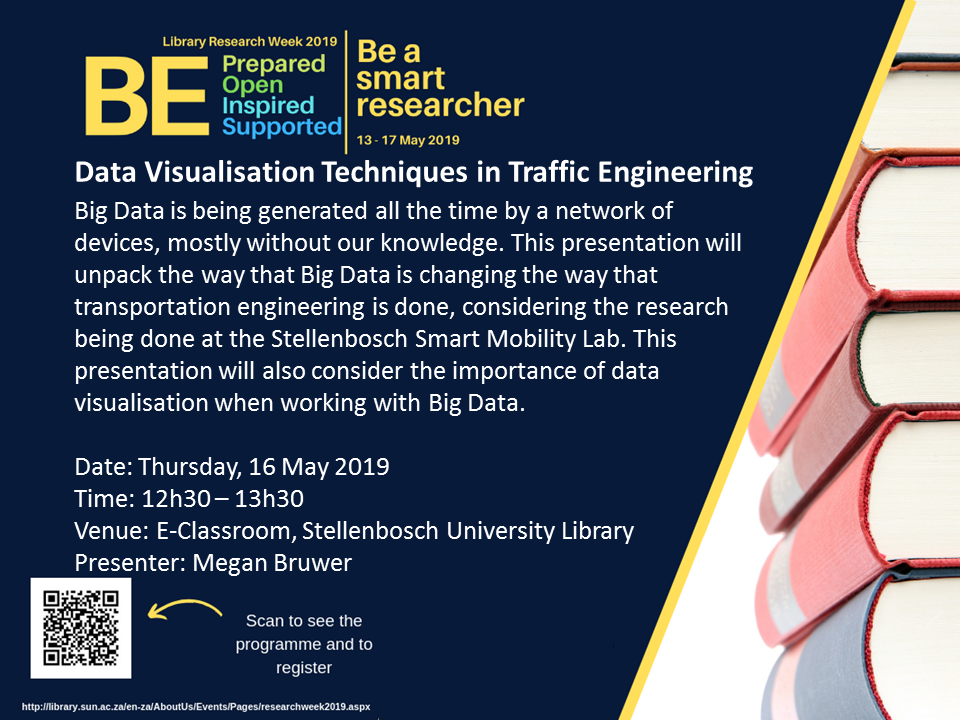
Library Research Week will take place during the week of 13-17 May. The theme this year is “Be a smart researcher” and you can look forward to presentations on Be prepared, Be open, Be inspired and Be supported.
For the full programme and to register for the sessions, please see the Research Week webpage.
Herewith a preview of what to expect on the first day of Library Research Week:
This video might be helpful in developing your digital research profile. It’s been published by the Open Science MOOC.
Think of this as a way of creating an online CV for showcasing your research. It teaches four tools:
1. ORCID – A persistent identifier for you and your research.
2. ImpactStory – A place to document how your research has been shared and re-used online.
3. Publons – A place to document your peer review activities.
4. Open Science Framework – A place to openly collaborate on your research.
The Library can also assist with this and a few other tools to develop your digital online presence. Attend the workshop Increase your online research visibility on 8 May to find out more or contact the librarians at the Research Commons.
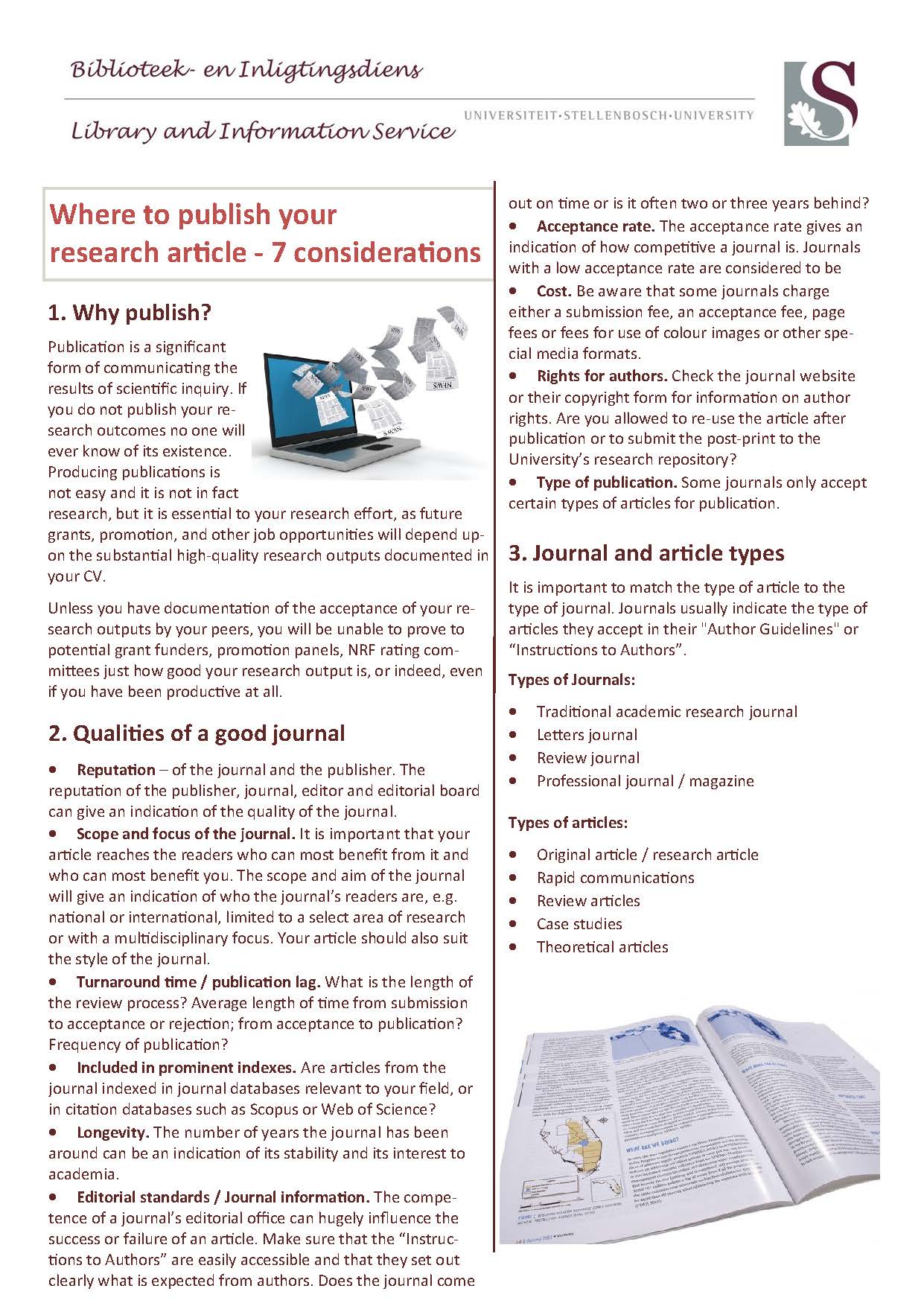
A handout about seven important aspects to consider when publishing, is available from the Library. The content will give you guidance about the qualities of a good journal, how to match journal and article types, predatory journals, Open Access, journal metrics and accredited journals. See the handout below. You are also welcome to download the pdf version here: Publishing_handout. More detailed information on the topic is also available in the full Library Guide: Where to publish your research article. For one-on-one consultation and advice, please contact your faculty librarian or Research Impact staff.

This post was originally published as an article in Bibnuus, the Library’s electronic newsletter.
What is research data management?
It is like a shadow in the darkness, a mystery lingering in academic minds, the words themselves have been whispered in the corridors all across campus: What is research data management?
To adapt what legendary investor Philip Fisher wrote in relation to the hullabaloo about dividends in his famous investment classic Common Stocks and Uncommon Profits:
There is a considerable degree of twisted thinking and general acceptance of half truths about a number of aspects of research data management. However, whenever the significance and importance of research data management is considered, the confusion of the typical researcher becomes little short of monumental.
In summary, research data management can be described as a process which consists of two components:
So what is the hullabaloo about research data management?
In the past decade the management of research data has come take on a more prominent role in tertiary education institutions around the world. This has been primarily due to the increasingly data-centric nature that academic research has taken. At the same time academic institutions have come to be influenced by the Open Access movement which advocates for the unrestricted access and use of published research outputs. A convergence of these two developments has culminated in a call for the unrestricted access and use of research data. The move itself is being pushed through by research funding agencies. In recent years, some of Stellenbosch University’s research funders have instituted mandates that require the implementation of adequate research data management practices in order to enable the open access of research data. Such practices should comply with certain best practices such as the following:
What are the implications?
The recent developments relating to Open Access and Open Science have necessitated the creation of a research data management system at the university in order to facilitate adequate research data management practices. As a leading research institution, Stellenbosch University would like to address this issue by taking the necessary steps in order to adopt appropriate data management practices. Thus over the foreseeable future, students and staff members at the university can expect to see a number of developments related to the creation of our university’s research data management system.
Watch this space for future developments!
Samuel Simango
Manager: Research Data Services
ssimango@sun.ac.za
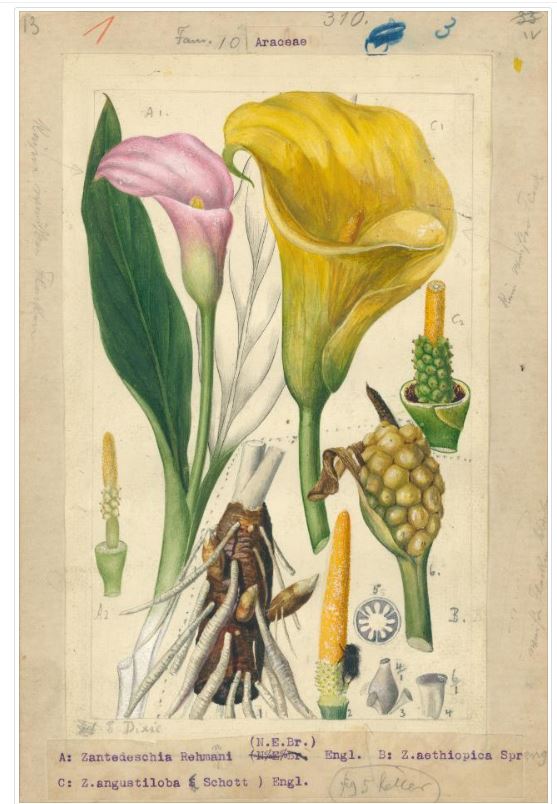
Rudolf Marloth (1855-1931), a German chemist and pharmacist who immigrated to the Cape of Good Hope in 1883, is regarded as one of South Africa’s greatest early botanists. Marloth is best known for his magnum opus, The Flora of South Africa, compiled between 1912 and 1932 in collaboration with botanical illustrator, Ethel Dixie. Over the years the Marloth family donated the original illustrations and plates with handwritten notes to Stellenbosch University Library. This precious collection has now been taken up in the SUNDigital Collections of the Stellenbosch University Library.
Marloth’s association with Stellenbosch University started in 1888, when he was appointed as a lecturer in Chemistry and Experimental Physics at the then Victoria College, the forerunner of today’s Stellenbosch University. He was promoted to professor in 1889, but gave up this position in 1891. Later he became involved again as a lecturer in science at the then Government School for Agriculture and Viticulture, today’s Elsenburg. In 1922 the University of Stellenbosch awarded him with an Honorary Doctorate in recognition of his contribution to the understanding and knowledge of the Cape Floral Kingdom.
The Special Collections Division in the Stellenbosch University Library also hosts many of his personal documents, correspondence and photographs.
Marié Theron
© 2026 Library Research News
Theme by Anders Noren — Up ↑