Author: Marié Roux (Page 8 of 19)

Research Data Management regulations: A model for responsible data stewardship

Research data management is a core part of responsible research conduct; it covers the entire research data lifecycle and ensures the integrity, confidentiality and availability of research data.  Within the legislative realm of data protection, researchers need to understand their role and responsibilities in terms of various legislation and regulatory guidelines on protection of data, most notably the South African Protection of Personal Information Act 4 of 2013 (POPIA). It is for this purpose that the University developed and adopted research data management regulations for researchers. These regulations are aligned with the FAIR Principles (data should be Findable, Accessible, Interoperable, and Reusable), which serve as the international standard for Open Data and Open Science. The aim of these principles is to ensure that research data remains accessible and usable not only during the research lifecycle but also after the project concludes, promoting the sustainability of academic contributions.

The RDM regulations are not designed to lock research data away but rather to strike a balance between safeguarding sensitive information and ensuring ease of access for future research.

Why SU RDM regulations are crucial

SU researchers are strongly encouraged to familiarize themselves with these regulations, as they play a pivotal role in the proper planning, handling, and management of research data. The importance of adhering to these guidelines extends far beyond SU’s borders. The RDM regulations integrate a range of existing policies and legislations, both at the national and international levels, reflecting the complex landscape of data governance. These include national legislation, policies from research funders, regional and local guidelines, institutional policies, discipline-specific community standards, and publication-specific policies (journal requirements).

Given the diversity of data policies across these sources, researchers often find it challenging to remain compliant, especially regarding local institutional rules such as SU’s RDM regulations. This uncertainty is more prevalent in fields where data practices are less regulated. The SU RDM regulations seek to eliminate this ambiguity by equipping researchers with the knowledge and tools needed to manage their data effectively, ensuring both compliance and ethical data use.

Support and advocacy through the Library and Information Service

The  Library offers a wide range of support services to assist researchers with RDM, including guidance available through the RDM LibGuide. These resources help ensure that research data is properly managed in alignment with the institution’s standards and broader legislative requirements. To facilitate compliance with these regulations, the library services provide researchers with SunDMP, a data management planning tool designed to help structure and plan for responsible data handling throughout the research process. Moreover, research data can be stored and shared in SUNScholarData, SU’s institutional data repository, which ensures long-term preservation and access to data in line with global best practices.

SU’s RDM regulations advocate for the sharing of research data as a means of promoting scholarly communication, transparency in research, and maximizing the return on resources invested in SU’s research efforts. By encouraging the open sharing of data, these regulations support a collaborative research environment, where data is not just a byproduct of research, but a resource that amplifies the impact and reach of SU’s contributions to global knowledge.

Please contact Sizwe Ngcobo or Xabiso Xesi at rdm@sun.ac.za for any enquiries.
The 14th Annual Manuscript Lecture during the Woordfees

In light of celebrating democracy in 2024, the Library will be hosting the 14th Annual Manuscript Lecture as part of the Woordfees on 1 October at 12:00 in the SU Library auditorium. The theme of the lecture is “Democracy through the lens of primary documents at Special Collections” and will feature a panel discussion on democracy through the lens of primary documents at Special Collections. Participants will be asked, inter alia, to reflect on their interaction with primary resources.

Dr Marietjie Oelofsen, former IDASA member and current project manager at the Stellenbosch University Museum will facilitate the panel discussion. The invited participants are Riaan de Villiers, journalist, political researcher and author, Sherie Vollenhoven and Nkululeko Ndlovu, both BA Hons Journalism students. The event will also include a viewing of the democracy exhibition.

In celebration of 30 years of democracy and South Africa, the SU Library is currently presenting an exhibition, titled 1994–2024 – Democracy in South Africa: A History Told by Unique Library Collections, in front of the Learning Commons on the upper floor. The exhibition showcases rare and historically significant items from collections in the Special Collections division that chronicle the nation’s journey to democracy.

The exhibition focuses specifically on recently acquired collections that reflect a more comprehensive view of South Africa’s history, focusing on the road to democracy and decisive moments in the nation’s history. The exhibition is by no means an exhaustive expression of recent history as it is based on collections curated by the Library.

One of the main aims of the exhibition is to highlight the research value of manuscript collections. Researching these may lead to a deeper understanding of the historical context that led to the establishment of democracy in 1994. Some of the collections featured, for example, the Foreign Debt Collection of 1985/86, contains rare documents that have not previously been examined and can shed light on the impact that negotiating the country’s foreign debt in the 1980’s had on the eventual release of Nelson Mandela.

Some of the highlights of the exhibition include:

  • Handwritten excerpt from “A prayer for the ANC” by Beyers Naudé, 1994.
  • A letter from Nelson Mandela indicating that the renegotiation of South African debt overseas in the 1980s played a major role in his liberation –an item from the South African Foreign Debt collection, 1985/1986.
  • The Frederik van Zyl Slabbert collection with various interesting items relating to his resignation from Parliament, views on apartheid and the need for reform debate.
  • The IDASA collection, focusing on material related to voter education before the 1994 election.

Author: Mimi Seyffert-Wirth

Open Access: Events and advocacy

Stellenbosch University’s Library and Information Service is committed to advancing open science by implementing innovative services that support researchers, academics, and all stakeholders in the scholarly publishing process. Over the years, the Library has implemented several initiatives to promote open science/access. These include the celebration of the  International Open Access Week, an annual event where open access advocates share innovative ideas about developments in the open science/access sphere.

This year the Library’s International Open Access Week event will be celebrated in October. It will consist of a panel discussion of 3 researchers which will help increase awareness about the advantages of open science/access. Other SU open access initiatives include SunScholar, which is Stellenbosch University’s institutional repository that supports openness and dissemination of scholarly publication to wider audience with very limited access restrictions. This repository consists of theses and dissertations, journal papers, conference papers and many other types of research outputs. Another repository, SUNDigital Collections showcases digital content from the Library and Information Service’s unique digital and cultural heritage collections, while SUNScholarData is used for the registration, archival storage, sharing and dissemination of research data produced or collected about research conducted under the auspices of Stellenbosch University. The Stellenbosch University is also part of the South African National Library and Information Consortium (SANLiC), which signed “Read and Publish” (transformational) agreements with publishers. These agreements aim to open opportunities for SU researchers to publish open access without paying article processing charges (APCs). So far, 16 publishers allow SU researchers to publish in all hybrid journals at no APCs and in selected fully open access journals, at a discount. We continue to encourage researchers to educate themselves about the different open access options.  Open access increases the visibility and impact of research published at SU. However, we understand that new models of publishing come with their challenges. Not every researcher understands the role and benefits of OA. As such, the Library has been involved in various innovative initiatives that seek to introduce the open access publishing model to researchers.

One such innovation is the recently launched #BeOpenAccessSmart webinar series which commenced with an inaugural webinar on 17 September 2024. With the introduction of the webinar series, the library aims to consolidate its role as one of the foremost critical thought leaders in the open science arena. The webinar will strengthen the Library’s advocacy role for open science and ensure that scholars understand its benefits. Open Science initiatives typically seek to democratically provide knowledge, promote collaboration, and support the advancement of scientific innovation without any financial and access hindrances.

Ms Ellen Tise, the Senior Director of the Library, officially launched the #BeOpenAccessSmart webinar series and both internal and external attendees had the opportunity to learn more about open access/science. Conducted by Mr Thanos Giannakopoulos, from the United Nations Dag Hammarskjöld Library, the title of the inaugural presentation was “(G)AI, Open Access, and Sustainable Development: The Evolving Role of Libraries in a Transforming World.” The focus was on the intersection of generative Artificial Intelligence (AI), open access (OA), and sustainable development. Among other themes, the webinar explored the evolving role of libraries in promoting AI literacy, safeguarding data privacy, elevating the need to mitigate bias, and fostering OA for all. Mr Giannakopoulos stipulated that libraries play a critical role in mitigating misinformation and raising awareness about challenges like privacy, bias, and the environmental impact of generative AI in relation to sustainable human development. He further alluded that libraries should ensure that AI tools are accessible globally, particularly for underdeveloped regions. He warned that generative AI poses risks associated with misuse and abuse of personal data, among other concerns. It is the role of libraries, working with different stakeholders, to ensure responsible AI use. These libraries must advocate for sustainable and ethical AI practices aligned with sustainable development goals.

Meanwhile 460 registrations from about 23 countries were received for the webinar of which at least 180 people attended. Attendees alluded that Mr Thanos’ presentation greatly enriched their understanding of how these dynamic fields are shaping the future and the pivotal role libraries play in this transformation. Libraries are at the centre of the OA movement, and their role is to dissect the open science or OA concept and ensure that researchers are well-informed and educated on the issues of open science/access.

The Library hopes that these webinars will be a cornerstone for the scholarly communication landscape by providing essential education and support to researchers navigating the complexities of open science/access publishing.

Please contact Sakhile Mngomezulu for any assistance with Open Access publishing or for more information about the events.

Authors: Sakhile Mngomezulu and Siviwe Bangani

Frequently Asked Questions about Open Access publishing

Introduction

The Library and Information Service is dedicated to offering top-notch assistance for any open access-related inquiries. To guarantee that our researchers receive timely feedback on matters about open access, frequently asked questions (FAQs) have been added to LibAnswers.

Eligibility to use transformational agreements

One of the most frequently asked inquiries is concerning eligibility, and researchers are interested in the requirements, primarily the institution’s affiliation. It is also crucial to remember that, if one of our writers collaborates with an author from another university, the corresponding author of the paper needs to be affiliated with Stellenbosch University for the article to be eligible for the use of a transformational agreement.

How to avoid Predatory journals?

Finding information about predatory journals and ensuring that researchers are not duped into publishing in questionable journals are two commonly addressed questions. Ask your Faculty Librarian or Scholarly Communicaton staff to help you to avoid these journals and publishers.

Does Open Access mean lower quality?

NO, the quality of a journal is determined by its editorial standards, peer-review process, and the impact of its publications, not by its accessibility. Many reputable journals are open access including those published by major academic publishers.

Are all predatory journals Open Access?

NO, predatory journals can be both open access or subscription-based. The access model is not a determining factor, but predatory journals lack legitimate and transparent editorial practices.

Why do some researchers associate Open Access journals with lower quality?

The association stems from the existence of predatory publishers who misuse the open access model. Predatory publishers often lack proper peer review and editorial oversight, leading to the publication of low-quality or even fake research.

What are Article Processing Charges (APCs)?

Scholars consistently inquire about the types of publications included in transformational agreements and the distinction between publishing in fully open access vs hybrid journals. The FAQs have been updated, and researchers may now access crucial information including the fact that there are no APCs associated with publishing in hybrid journals, but that there are various reductions available for completely open access journals based on the institution’s arrangement with the participating publisher.

Is the Open Access Publishing Fund still available?

Scholars consistently inquire about the Open Access Publication Fund, which was discontinued in April 2021. This fund is therefore not available anymore. To address these questions, a Frequently Asked Questions (FAQ) on Libanswers was created, along with a link to our open access Libguide that offers a detailed explanation of the fund’s closure.

What is a Journal finder?

Researchers are welcome to contact their Faculty Librarians or Scholarly Communication to get assistance in selecting journals to publish their articles. Most publishers have a “Journal finder” section which also assists them with locating the appropriate approved journal for a publication. See these examples: Elsevier’s Journal Finder and Wiley’s Journal Finder. 

Where can I find the list of accredited journals?

Researchers frequently have inquiries concerning the DHET accredited journals list. You can find out whether a journal is accredited by consulting the Accredited journals page under “Outputs and Journals” on the Division for Research Development website. You are also welcome to ask your faculty librarian for assistance.

What is a Read and Publish agreement?

One of the frequently asked questions, revolves around understanding what a Read and Publish agreement really means. It is also known as transformational agreements, which means that these agreements provide access to publishing and reading simultaneously. One of the benefits of open access is unrestricted spreading of knowledge to the wider audience, to ensure improved impact, consumption, increased citations and growth as an author.

Conclusion

The open access team at Stellenbosch University is responsible for ensuring that researchers are fully informed on everything related to open access. The purpose of the recently introduced FAQs is to enhance our offerings and enable customers to access information when the Library is closed. Additionally, the group is dedicated to helping users and interacting with them to improve comprehension of scientific publishing and open access.

More information:

  • Stellenbosch University Transformational Agreements Libguide
  • The Library’s Open Access webpage
  • SANLiC
  • Publisher Websites: Many publishers provide details about their transformational agreements and participating institutions.

Enquiries: Sakhile Mngomezulu

#BeOpenAccessSmart webinars

Open access (OA) initiatives are rapidly gaining traction because of the increased subscription-based journal costs, access inequalities, advancements of digital technology, demand for greater transparency and collaboration, and funding agencies’ mandates calling for research published using their funds to be made publicly available.

Libraries, more than any other organisation, have been at the forefront of this evolving field of scholarly communications, helping to build institutional repositories, host open access books and journals, and publish open access textbooks, among other projects. Recently, libraries have been negotiating Transformational Agreements (TAs) to shield scholars from the astronomical Article Processing Charges (APCs) that journals demand for them to publish open access content. Despite all its achievements, it remains unclear if this approach has resulted in the fundamental transformation that proponents of open access and libraries had hoped for. Many OA supporters and libraries still believe that more can be done to advance OA despite all these efforts. As a result, libraries must launch creative campaigns to bolster their OA advocacy and guarantee that authors are aware of its advantages. Open Access (OA) projects generally aim to boost scientific innovation, foster cooperation, and democratically share knowledge.

The Library scheduled an open access (OA) webinar series, #BeOpenAccessSmart to share some open access insights with researchers. Mr. Thanos Giannakopoulos, Chief of the Information Management Section of the United Nations Dag Hammarskjöld Library, will lead the first-ever webinar. The session, titled “(G)AI, Open Access, and Sustainable Development: The Evolving Role of Libraries in a Transforming World,” will explore how (G)AI, Open Access, and sustainable development intersect. It will examine how libraries are becoming more and more important in advancing AI literacy, protecting data privacy, emphasising the need to lessen bias, and encouraging open access for all. Stellenbosch library aims to share practical approaches to appropriately addressing (G)AI while promoting international knowledge exchange and fair access to information. This webinar will take place on 17 September 2024 and the engagement will enlighten researchers on publishing in Open access, artificial intelligence and the role of the Stellenbosch library in the promotion of open access.

Date: 17 September 2024, 14:30 – 15:30 (SAST/CET) or 08:30-09:30 (ET)

Register here:  https://sun.ac.za.libcal.com/event/12695996

For further information: Please contact Sakhile Mngomezulu tel: 021 808 9907

Research Data Management Tools for SU Researchers

Historically, data collection has been paper-based. However, the developments in information and communication technologies have brought paperless data management within reach. This has made way for the adoption of new methods and tools (software, hardware, instruments and equipment), new data sources, and increased connection of global research via the internet. Having explored this paradigm shift and the challenges it comes with, particularly the reproducibility of research and the transparency of research methods. The Stellenbosch University’s Library and Information Service acknowledges that by carefully planning, documenting, and preserving data, the goals of having reproducible and transparent research data are far easier to meet. It is for this reason that the Library adopted modern research technologies in the form of SunDMP (Data Management Planning tool) and SUNScholarData (Institutional Research Data Repository).

SunDMP: A data management planning tool

Data Management Plans are the basis for structured research data management throughout the research data lifecycle. A Data Management Plan (DMP) is a formal written document that describes the data a researcher expects to acquire or generate during the course of a scientific research project. The need for having a DMP emanates from the understanding that research data is being produced at a rapid rate in a wide variety of digital forms in academic institutions like Stellenbosch University (SU). However, this data is most prone to loss due to mismanagement. These kinds of developments have over the years prompted research funders to require researchers to submit DMPs as part of their proposals for research grant applications. The Library and Information Service as the natural partner to the research process understands that without proper management and care, research data often does not exist much past the completion of the scientific research project. The launch of SunDMP has made it possible for SU researchers to automatically generate DMPs using the University’s standard template. Moreover, the Library recommends that SunDMP not be limited to the minimal creation of a DMP as per funder requirements or SU’s research data management (RDM) regulations. Instead, it ought to be treated as an invaluable part of the research data lifecycle that ensures research data remains usable to the primary researcher during the scientific research project (and beyond), as well as by other researchers with similar research interests.

SUNScholarData: An institutional research data repository

Data management and sharing have become more prominent among research organisations, and this has encouraged such organisations to develop local infrastructure (institutional research data repositories) to cater for such developments. A growing number of funders and publishers require researchers to publicly share their research data and sometimes recommend specific platforms in which data may be shared. Research data publishing is an approach for sharing research data to enable other researchers with similar interests to reuse the same data. In instances where SU researchers are unsure where to share their research data when publishing, our CoreTrustSeal-certified SUNScholarData should always remain the first point of reference. This does not in any way supersede the platform recommended by the funder or publisher. The use of SUNScholarData by SU researchers helps ensure that their research data is likely to be discovered by other users and more likely to be cited. This is due to the fact that SUNScholarData is an openly accessible platform that adheres to FAIR (Findability, Accessibility, Interoperability, and Reusability) principles of data handling and management.

Enquiries: Xabiso Xesi, Sizwe Ngcobo

A new face and place for theses/dissertations submissions

“SUNScholar is open to receive new nominations for the December 2024 graduation period.”

That was the opening line for every graduation period.  This year is no different, except now it has a new name, face and place.  The submission of theses and dissertations for graduation has moved to SUNStudent Academia.

The nomination for students to submit a thesis or dissertation for graduation now takes place on Thesis Management.

Thesis Management sits under the tab for Examinations, yet it has nothing to do with examinations.  For each functionality, Examinations and Thesis Management, it is two totally different, and separate processes and therefore two different outcomes.

During the process of Examinations, the thesis or dissertation has yet to be examined and reviewed.  In Thesis Management only the final revised thesis or dissertation needs to be uploaded.  This is the copy following examination, and after all corrections have been made.  This is also the copy that will be available on SUNScholar.

The User Guide for Thesis Management is available here.

For the most part, the workflow for Thesis management hasn’t changed.

To summarise the process:

  1. The final revised document must be submitted in PDF format.
  2. Log onto SUNStudent Academia.
  3. Click on Examinations, then click Thesis Management.
  4. The supervisor/promoter or administrative staff nominates the candidate.
  5. The thesis/dissertation is uploaded by the supervisor/promoter or administrative staff.
  6. The supervisor/promoter or administrative staff approves the submission.
  7. The thesis/dissertation will be publicly accessible on SUNScholar following graduation.

Due to the sensitive nature of security and ongoing enhancements to Thesis Management, the upload/submission of the final revised thesis or dissertation, must be done by the supervisor/promoter or administrative staff.

The final date for the submission of theses or dissertations for the December 2024 graduation is 28 November 2024.

Changes in the process

  • The Thesis Management function will remain open throughout the year.
  • It is compulsory for all master’s and doctoral students to complete this process for graduation.
  • Students will not be uploading any documents; this will be the responsibility of the nominator.
  • The process of nomination, submission and approval/rejection will take place on the same screen/programme.
  • The manual input of the student number will give a dropdown box of ALL postgraduate students within the faculty, ensure you ‘pick’ the correct student from the dropdown box.
  • The manual input of the supervisor/promotor staff number will give a dropdown box of ALL supervisors/promotors within the faculty, ensure you ‘pick’ the correct supervisor/promotor from the dropdown box.
  • Incorrect uploading of document(s) cannot be replaced after the submission process, so the process of nomination needs to be cancelled.
  • Only a cumulative maximum of 250 MB can be uploaded per student. Exceeding this threshold requires the user to send the document(s) to scholar@sun.ac.za.
  • Uploaded documents will remain visible to the staff member who did the nomination.
  • The discretion and security of uploaded documents remain with the department.
  • Thesis management will be ‘wiped’ clean after each graduation period.
  • The embargo period only goes up to three years. For extensions or moving from embargo to open access and vice versa, an email must be sent to scholar@sun.ac.za  to manually make the changes.  These changes will not be reflected in Thesis Management.

What remains

The recommendations and look and feel of the thesis document remain the same.  Such as the new SU title page, declaration page(s), abstract(s) and typesetting.  See the library help page, Thesis/Dissertation submission for templates.

Requesting Access to SUNStudent

Access will only be granted to SU staff and with the approval of their line manager.  Any user requesting access must get their line manager’s approval for the request to be processed.

Your access can be provisioned by following these steps:

  1. Please access the SUNStudent Service Desk here
  2. The tile marked “user access management” is the section that allows users to complete their user role access request

For enquiries about theses/dissertations submissions, please contact Paulette Talliard or scholar@sun.ac.za.

SU presentations at the IAML conference

​The International Association of Music Libraries, Archives and Documentation Centres (IAML) is a global organisation that fosters the activities of music libraries, archives, and documentation centres. These efforts support projects in music bibliography, music documentation, and music library and information science at both national and international levels. A key component of IAML’s work is its annual international congress, which rotates among different countries each year, offering a platform for knowledge exchange, collaboration, and the celebration of musical heritage.

This year the congress was held for the first time on African soil and it was organised by the Stellenbosch University Library and Information Service, in collaboration with representatives from the University of Cape Town. Delegates from 28 countries attended the congress. The programme included sessions on cataloguing and metadata, user experience and service development, historical and composer collections, church music, radio archives, digital collections, and the use of AI and machine learning in libraries, among other topics. The programme strongly emphasised African content, reflecting the continent’s diverse musical traditions and contemporary innovations. Sessions also covered colonial and post-colonial impacts, digital collections, music institutions, music encoding, indigenous and folk music and instruments, and popular culture in Africa. This thematic emphasis celebrated African musical heritage and fostered dialogue and collaboration among international and African scholars and practitioners.

In total about 107 presentations were presented during the week-long congress, with 11 presentations by Stellenbosch University:

  • Bridget Rennie-Salonen
    Illustrating transdisciplinary research innovation: Music, health, and wellbeing

  • Ingrid Gollom
    An overview of the life and career of South African concert pianist Lionel Charles Bowman (1919-2006) as compiled from the primary source material in the Lionel Bowman Collection (Stellenbosch University)

  • Anita Breckbill (University of Nebraska, Lincoln), Mnukwana Ncebakazi (Stellenbosch University)
    Freedom: Anders Nyberg and the Spread of Songs from South Africa

  • Jürgen May, Inge Engelbrecht, Anke Froehlich
    The Genadendal Music Archive (GMA): A Challenging Affair

  • Esther Pauw
    Curating a colonial archive: The Tamássy-Pauw flute and chamber scores collection

  • Amy Rommelspacher, Isabel Murray
    Tracing the history of a 1919-hymnbook in Malawi – a new reading of the DRC archival music collection

  • Prof Lizabé Lambrechts (Africa Open Institute for Music, Research and Innovation, Stellenbosch University) and Ms Saskia van der Want (Stellenbosch University)
    Making the invisible visible: Investigating the hidden life of fungi in the archive

  • Mieke Struwig
    The South African Music Encyclopedia: Perspectives from the Archive

  • Siviwe Bangani ( Library and Information Service)
    Demonstrating scholarly impact: acknowledgement of music libraries in students’ theses and dissertations in South Africa

  • Jonathan Hughes
    Settler Artefacts as Political Currency: Percival Kirby and a Chamber Organ by William Hill (c.1832)

  • Pakama Sbongile Ncume (Library and Information Service)
    Bringing the ‘hidden’ to the ‘public’: The case of Hidden Years Music Archive

Source

The Fay Singer South African Jewish Music Centre collection at DOMUS

The Fay Singer South African Jewish Music Centre collection at the Music Library’s Documentation Centre for Music (DOMUS)

The SA Jewish Music Centre (SAJMC) was established by Fay Singer, teacher Stuart Serwator and Cantor and teacher Ivor Joffe and inaugurated on 17 December 1992 in Cape Town. They were encouraged by Geraldine Auerbach, who, during her annual visit to Cape Town, noticed a lack of Jewish music sources in Cape Town. The Centre became affiliated to the Jewish Music Institute (JMI) at the School of Oriental and African Studies (SOAS), University of London in 1993. Geraldine Auerbach MBE, Director of the JMI, was the Honorary Patron from the beginning.

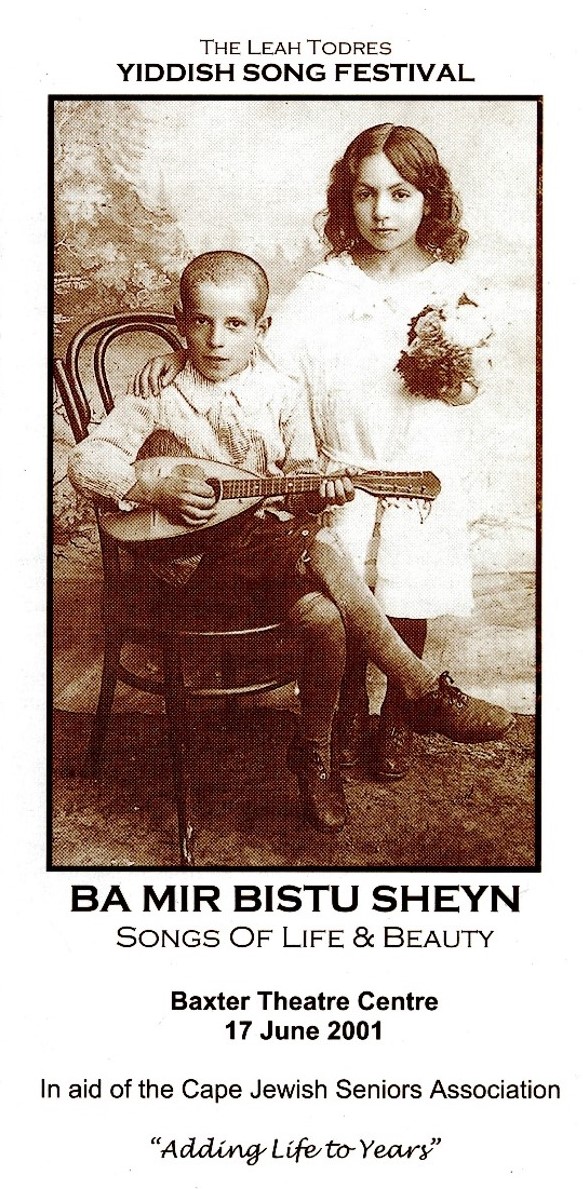
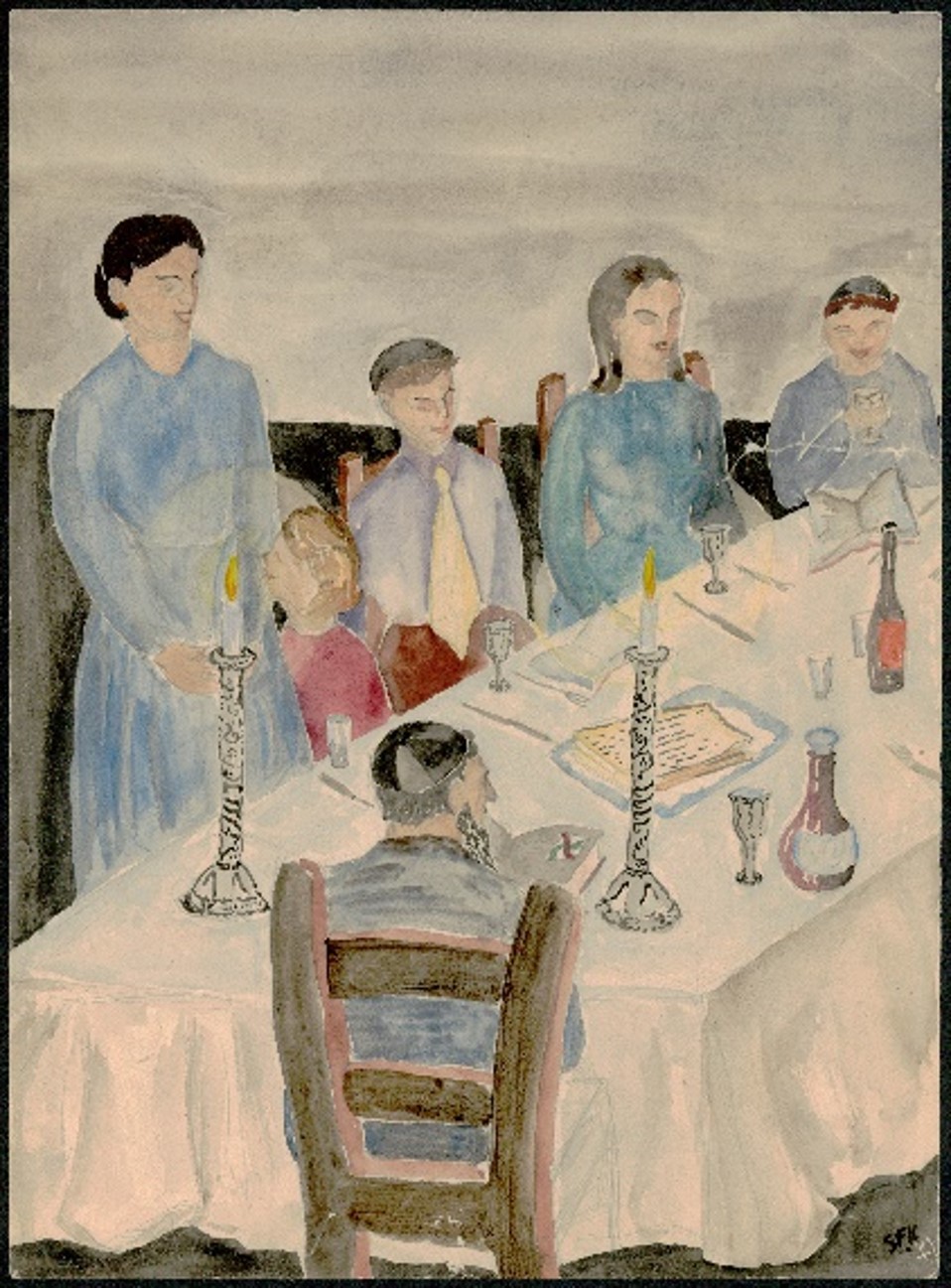
Supplemented by documentation in the collection, the SAJMC newsletters inform on the activities and events of the SAJMC. These activities included concerts, choir festivals and lectures on Jewish music. Annual events included the choir festival presented jointly by the Union of Orthodox Synagogues and the SAJMC in honour of Cape Town cantors Max and Philip Badash (in different synagogues in Cape Town) and the Leah Todres Yiddish Song Festival, organised by Philip Todres. The festival was established in 2000 in honour of his mother and took place annually until 2009. Every year there was a different theme, for example: Ba mir bistu sheyn: Songs of life and beauty (2001 – based on the song), L’ Chaim: Songs to life (2004), Ich Zing! Let us sing (2008) and A naye velt: Songs bridging oceans. Fay Singer was involved in selecting the music, while Matthew Reid was the music director. Reid and his Simcha Klezmer Ensemble also performed at the festival, which was a main fundraising event for the Cape Jewish Seniors Association. The image on the programme (below) depicts Leah Todres and her cousin Teddy Ruch (approximately 1918) and has become the logo for the Yiddish Song Festival. The festival included music, film and Yiddish language courses.

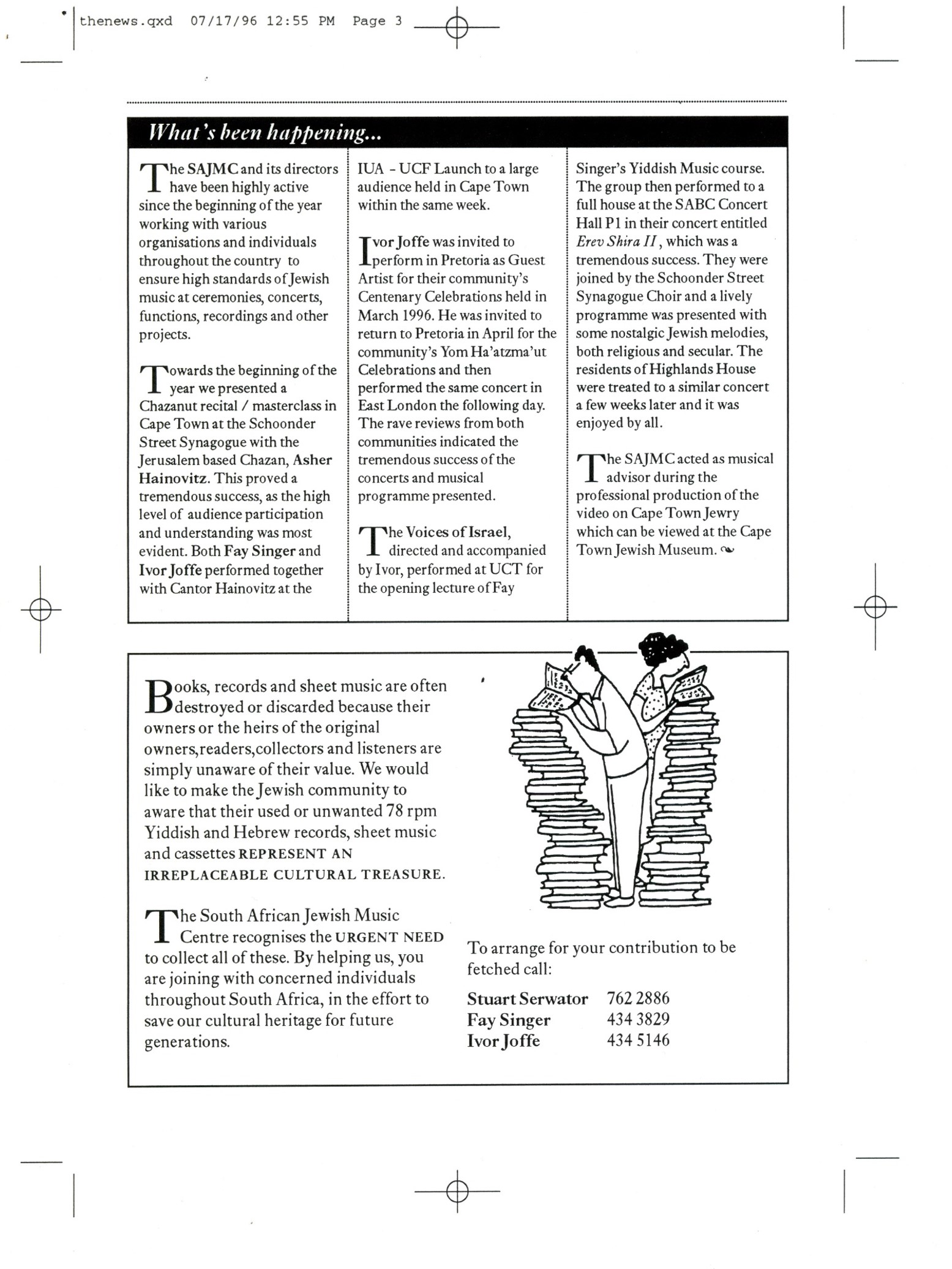
The main aims of the SAJMC were to collect, preserve and promote Jewish music through lectures and performances, and the urgency of preservation is illustrated by the following extract from a draft newsletter of July 1996:

The SAJMC collection reflects the activities of a specific community within a specific geographical location and time. Their materials were collected for their activities and generated from their activities.

The SAJMC collection was donated to Stellenbosch University by Mrs Fay Singer in 2011, thus the Fay Singer South African Jewish Music Centre Collection. This collection consists of items donated by synagogues, cantors and other individuals and includes work documents of the SAJMC, certificates, brochures, newsletters, periodicals, programmes, artwork by Fay Singer, sheet music and sound recordings. Items from the SAJMC collection are available on the Stellenbosch University Library and Information Service’s digital collections platform, SUNDigital.


Author: Santie de Jongh

Learn how to empower yourself with effective data management skills

SunDMP Wednesdays: Empowering SU researchers with effective data management skills

Following the successful launch of SunDMP, Stellenbosch University’s official data management planning tool, during Library Research Week on 13 May 2024, we have seen remarkable engagement from our research community. SunDMP is designed to assist researchers in creating comprehensive data management plans (DMPs) and easily navigate the complexities of research data management.

Weekly training sessions

To support our researchers in making the most of SunDMP, we introduced weekly training sessions starting on 5 June 2024. These sessions, held every Wednesday from 13:00 to 13:45, provide an invaluable opportunity for researchers to develop robust DMPs tailored to their specific needs.

Recent uptake and engagement

Since its launch, SunDMP has attracted many users and facilitated the creation of numerous projects. Our training sessions have seen encouraging participation, with a growing number of researchers registering. This increasing interest highlights the importance of effective data management and underscores the value of SunDMP in helping researchers achieve their goals.

Training outcomes

Attendees of SunDMP Wednesdays have expressed positive feedback, noting significant improvements in their understanding and application of data management practices. The sessions cover various topics, including:

  1. Introduction to SunDMP: An overview of the tool’s capabilities and benefits.
  2. Creating Comprehensive DMPs: Best practices for developing thorough data management plans.
  3. Navigating SunDMP: Step-by-step guidance on utilising the platform’s tools and resources effectively.

Participants have found these sessions particularly beneficial in ensuring compliance with funder requirements and adopting best practices in research data management. The training enhances their research efficiency and promotes a culture of responsible and transparent data stewardship within our academic community.

We encourage all SU researchers to use these training sessions to streamline their research processes and enhance their data management skills.

Contact

For more information or any other training requests, please contact Xabiso Xesi or Sizwe Ngcobo, telephone numbers: 021 808 9489/9978


« Older posts Newer posts »