What does a Faculty Librarian do beyond managing books and databases?
Stellenbosch University Library recently provided a practical legal research training session for a group of Hasselt University law students from Belgium, who were visiting South Africa as interns at the Stellenbosch University Law Clinic.
The Hasselt internship forms part of the longstanding collaboration between Hasselt University and Stellenbosch University’s Faculty of Law. Since 2022, Hasselt law students have participated in the SU Law Clinic’s international student internship programme, gaining practical exposure to South African legal practice while developing their own professional and clinical legal skills.
The interns’ time at the Law Clinic allows them to experience the South African legal environment first-hand. During their internship, they engage with the Clinic’s work and gain exposure to practical legal activities, including client consultations and court-related work.
It was within this context that the SU Law Library hosted the interns for a dedicated legal research training session on 16 July 2026.
Beyond Databases
The training, presented by the Law Librarian, was designed to do more than introduce the interns to South African law databases. The central aim was to help them understand how to approach a legal research problem, analyse a research topic, develop an effective search strategy and identify the most appropriate sources for their research.
Because the Hasselt students come from a different law and academic environment, the session also provided an opportunity to introduce them to the South African legal research landscape and the particular resources available to researchers at Stellenbosch University.
Research Focus
One of the key themes of the training was analysing a research topic before beginning the search.
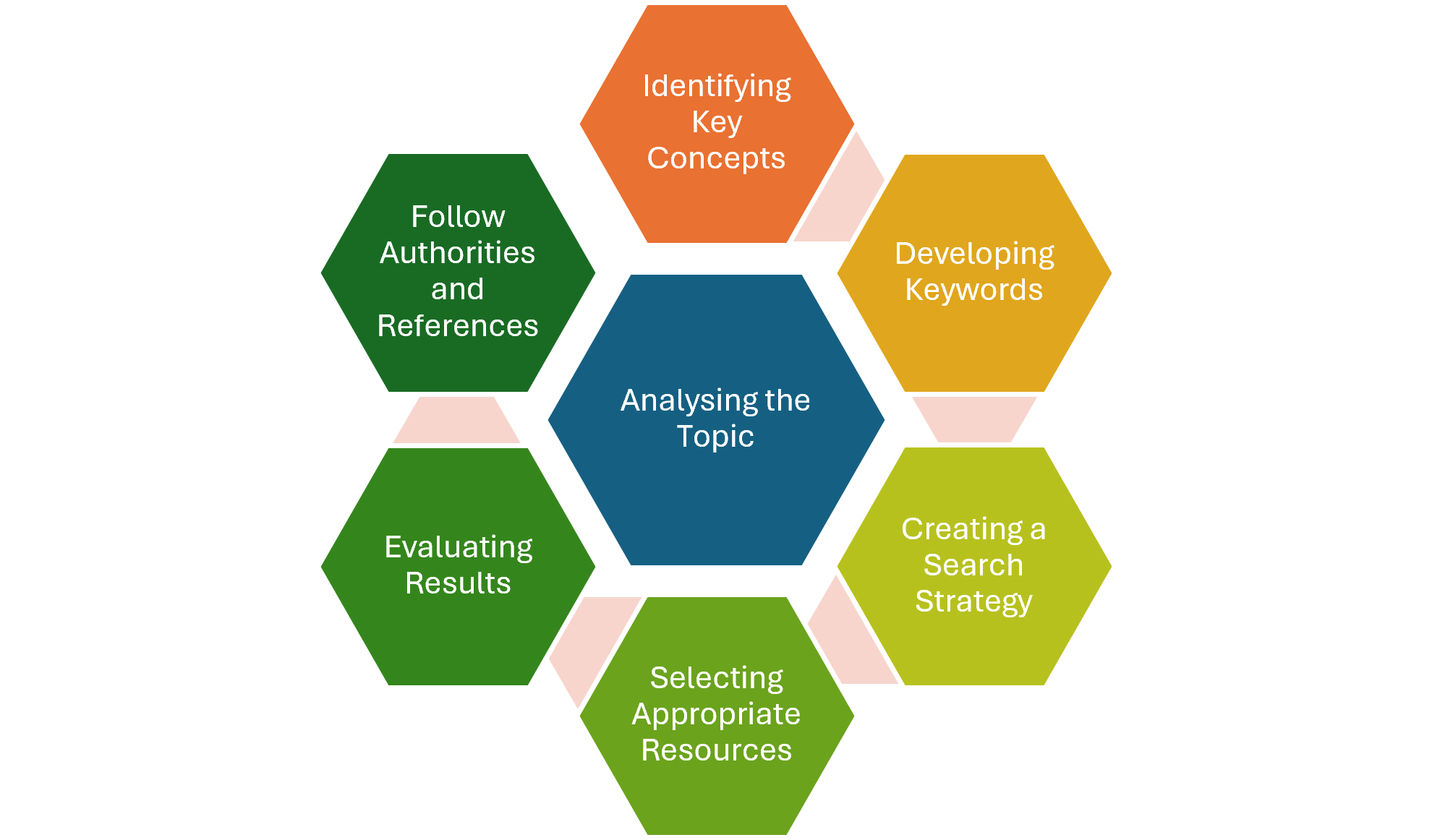
The interns were taken through the process of breaking a research topic down into its main concepts and identifying important legal terminology, alternative terms and related concepts. The interns were then introduced to the Search Strategy Builder Tool available through the SU Law Library LibGuide. The tool provides a practical way of developing keywords and structuring a search strategy before beginning a database search.
The session demonstrated that effective research is not simply about entering a question into a search box. Rather, it involves the following process:
Scholarly Searching
The session began with resources familiar to most students, including Google, Google Scholar and Google Books, before progressing to specialised legal research databases.
The interns explored Google Scholar’s library-link settings and advanced search functions, including the use of Boolean operators and targeted searches. Google Books was also explored through searches relating to South Africa, unlawful evictions and civil procedure.
Discovering the SU LibGuide for Law
The interns were also introduced to the SU LibGuide for Law. The LibGuide provides a central starting point for accessing the law databases, electronic books, journals, online textbooks and other research resources. The interns were encouraged to explore the different sections of the guide rather than limiting themselves to the database links they already knew. Open Access resources such as GlobaLex and the OA online textbooks were also highlighted.
Exploring Lexis+ SA
A substantial part of the training focused on Lexis+ SA, with practical examples drawn from South African legal research. The interns worked through the platform’s Content Areas, including Civil Procedure and South African case law. One example involved locating Hlobo v Multilateral Motor Vehicle Accidents Fund [2001] 1 All SA 322 (A) and examining the different ways in which the case could be researched.
Legal Citator
An important feature of the Lexis+ training was the Legal Citator. The interns were shown the different features of the tool and, importantly, how it can assist law students in investigating the treatment of cases by subsequent courts. The session emphasised that finding a case is not necessarily the end of the research process. Researchers should investigate what happened to that authority afterwards and determine whether it has been followed, distinguished, criticised, overturned or otherwise considered.
Exploring Juta
The interns were also introduced to Juta, with the training focusing on advanced search functions and South African resources. Practical examples included searches relating to emolument attachment orders and garnishee orders, as well as the use of Juta Law Reports to identify cases through flynotes and headnotes.
South African Research
The training concluded with electronic journals and databases, including HeinOnline and Sabinet. The comparison between HeinOnline and Sabinet also reinforced an important research principle that no single database will necessarily provide everything a researcher needs. Effective research often requires researchers to move between different platforms and types of sources.
International Research Skills
For the Hasselt interns, the session provided more than an introduction to South African law databases. It offered an opportunity to develop research skills that can be applied across jurisdictions and throughout their future legal careers.
The training also demonstrated the important role played by the SU Library in supporting the Law Clinic’s internationalisation and experiential-learning initiatives. By combining research strategy, topic analysis, database searching, legal citation tools and the effective use of the Law Library LibGuide, the session aimed to equip the interns with practical skills they could immediately apply during their time at the Clinic.
Author: Grace van Niekerk