Open access (OA), the movement to publish and distribute scholarly works without too many restrictions, for better visibility and research impact, is often advocated as one of the most critical pathways toward achieving information access parity, where both the “information-poor” and “information-rich” have access to similar knowledge resources. Suber (2012) explained that OA is concerned with the “removal of price barriers” and the “removal of permission barriers.” However, OA is more nuanced that it is often assumed. Different OA models and paths exist, varying in their degree of openness and in the extent to which scholarly works may be shared and reused. These models include Diamond OA, Green OA, Gold OA, Hybrid OA, Bronze OA, and even Black OA. The distinctions between these models have been discussed on another blog article.
Suber (2008) further referred to the degrees of openness in OA publishing as gratis OA and libre OA. Gratis OA refers to scholarly publications that are free to read but carry limited reuse rights, while libre OA refers to works that are both free to read and accompanied by additional reuse permissions.
The Creative Commons Licences
To govern the degree of openness of their works, authors often sign Creative Commons (CC) licences, which are standardised legal tools that creators use to indicate how others may reuse their work. In OA publishing, CC licences clarify whether users may legally share a publication and define the extent to which it may be reused for educational, research, policy, and commercial purposes.
Researchers are frequently confronted with several types of CC licences during the publication process. These are reflected in the visual depiction below (Figure 1):
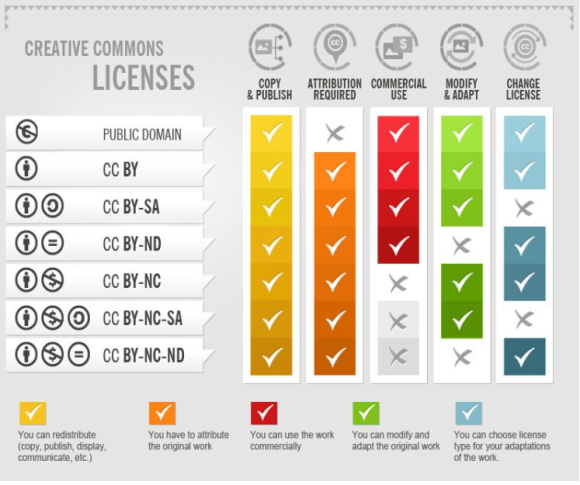
Figure 1: University of Edinburg (n.d.)
Confronted with these options at the publication stage, many researchers sign licences without fully considering their implications. In doing so, they may unintentionally transfer significant distribution rights back to publishers and restrict access to their own scholarly works, an outcome that defeats the very purpose of OA (Schneider, 2025). Certain licences may also affect the visibility, dissemination, and potential impact of scholarly outputs.
Which CC Licence Should Researchers Choose?
It is often difficult to advise researchers on which CC licence they should select when signing authorship agreements as these may differ between publications. The National Research Foundation (NRF) Open Access Statement (NRF, 2019) outlines several principles regarding publications arising from publicly funded research, including the facilitation of:
- dissemination of knowledge;
- utilisation, uptake, and application of knowledge;
- accelerated transformation and globalisation of science; and
- rapid translation of knowledge into innovative and developmental applications for the benefit of society.
Similarly, the new South African Open Science Policy (South Africa, 2026) promotes the principle of “As Open As Possible, As Closed As Necessary.” At face value, the least restrictive licence, CC BY, appears to align most closely with this principle because it maximises reuse and dissemination opportunities. However, researchers who are concerned about the commercial exploitation of their works may prefer the CC BY-NC licence, which restricts commercial use while still permitting educational and research-related reuse.
Should you face a dilemma regarding the CC license to choose when signing the author agreement, please feel free to contact Sizwe Ngcobo at sngcobo@sun.ac.za.
Reference list
NRF. 2015. Statement on Open Access to Research Publications from the National Research Foundation (NRF)-Funded Research. https://chelsa.ac.za/wp-content/uploads/2018/12/NRF_open_access_-statement_19Jan2015_V6.pdf.
Schneider, R. 2025. How publishers use “license to publish” agreements to try to transfer all rights held by authors and contravene the spirit and goals of open access. https://files.su.ac.za/public/about-library/documents/2026-01/beoasmart-20250917-how-publishers-use-licensetopublish-agreement.pdf.
South Africa. 2026. South African Open Science Policy. https://www.dsti.gov.za/index.php/documents/policies/296-south-african-open-science-policy.
Suber, P. 2008. Gratis and libre open access. SPARC Open Access Newsletter, 124.
Suber, P. 2012. The rise of libre open access. SPARC Open Access Newsletter, 164.
University of Edinburg. n.d. Choosing a Creative Commons Licence for your resource. Edinburg: University of Edinburg. https://open.ed.ac.uk/how-to-guides/choosing-a-creative-commons-licence-for-your-resource/.
Authors: Dr Siviwe Bangani and Sizwe Ngcobo