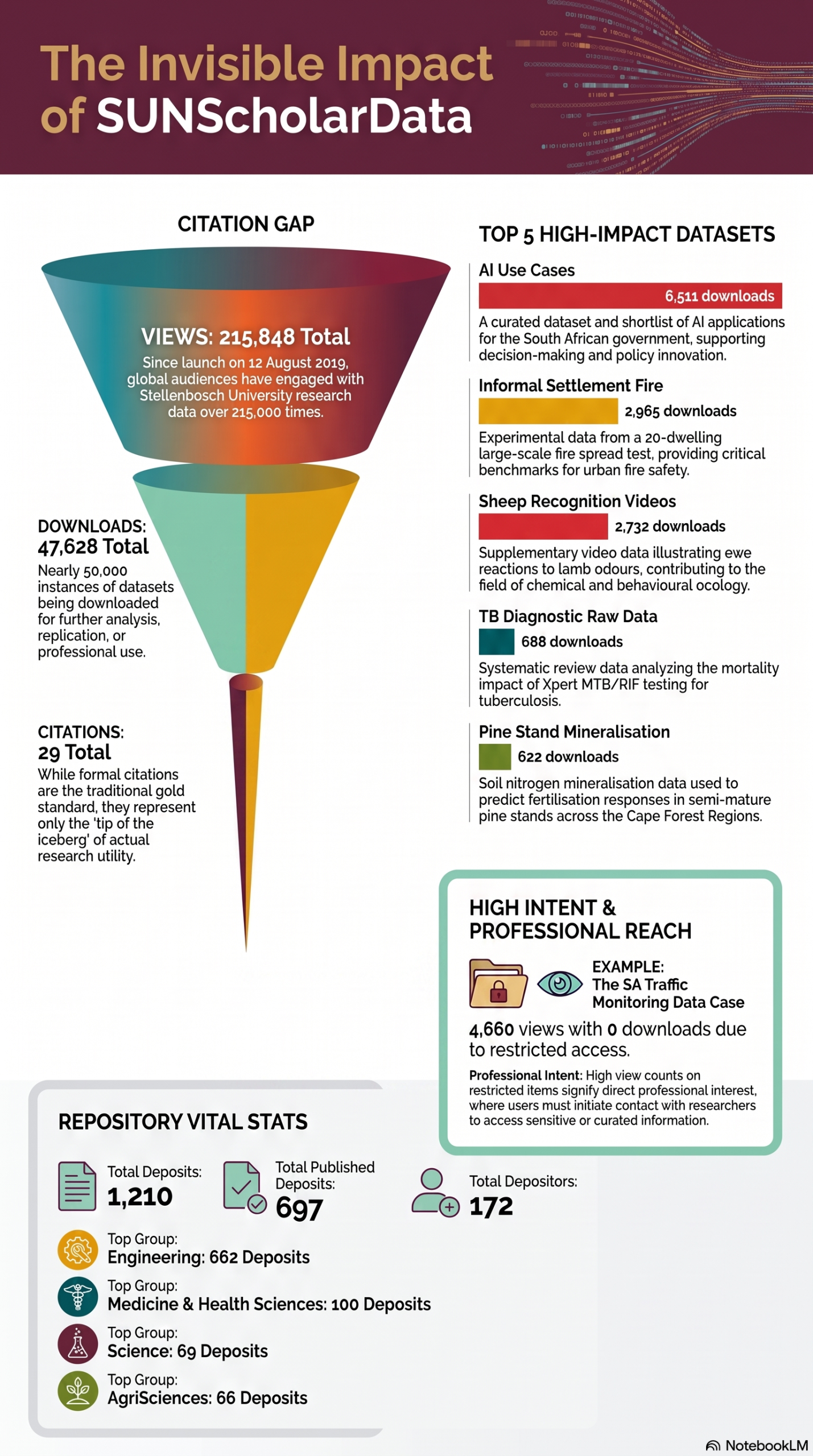
In the traditional academic landscape, a researcher’s contribution is often measured by a single metric: the citation. Stellenbosch University’s open-access data repository, SUNScholarData, however, is revealing a massive layer of “invisible impact” that traditional metrics fail to capture. Since its launch in August 2019, the platform has amassed 215 848 views (of which 170 428 were from the USA, with South Africa being the second largest number of viewers with 8 597) and 47 628 downloads, yet it shows only 29 formal citations. This staggering discrepancy could suggest that datasets are being utilised as practical, real-world tools rather than just subjects for further academic papers. It is important to note that the possible applications of the case studies outlined below constitute conjecture and that there is no evidence that this may be the true cause for the high number of downloads, but low level of citations.
The Utility vs Research Gap
The analysis of SUNScholarData’s most popular records suggests that high engagement often signals “research utility”. Users may be downloading data to calibrate industry tools, train AI models, or inform government policy – activities that rarely result in a formal citation in a peer-reviewed journal.
Case Study 1: AI for the People
The most downloaded dataset on the platform is the Curated dataset and shortlist of AI use cases for the South African government (2025), which has reached 6,511 downloads despite having zero citations. Linked to the Policy Innovation Lab briefing note, A Catalogue of Artificial Intelligence Tools for Use by South African Policymakers (2024), this dataset serves as a practical guide for the public sector. Its high download rate may suggest that government officials and digital entrepreneurs are using it as a blueprint for deploying AI in public services, such as monitoring physical processes or automating administrative tasks. As this was a report rather than an academic publication, there are no impactful metrics to compare the publication with the dataset.
Case Study 2: Saving Lives through Fire Science
The 20 Dwelling informal settlement experiment (2020) provides a critical dataset for understanding fire spread in dense urban environments. With 2,965 downloads and 0 citations, this data—which includes sensor logs and high-resolution images—is possibly being used by disaster management authorities and urban planners. Associated with the research paper 20 Dwelling Large-Scale Experiment of Fire Spread in Informal Settlements (2020), it offers the raw evidence needed to design safer settlement layouts and “fire lines,” providing impact that is measured in lives saved rather than papers published. The article has received 1,452 views, an Altmetric score of 42, and has received 41 citations, which points to a high impact and may explain why the associated dataset has received such attention, but it still begs the question why the data has not received any citations.
Other high-performing datasets show strong ties to industry and education. Here is one example:
Pine Stand Nitrogen Mineralisation (2020): With 3,832 views and 622 downloads, this data provides a decision-support system to prevent wasteful fertiliser applications in the Eastern and Western Cape. Its impact may be related to its contribution as an operational utility for foresters and plantation managers. The associated publication, Modelling soil nitrogen mineralisation in semi-mature pine stands of South Africa to identify nutritional limitations and to predict potential responses to fertilisation (2020), has received 1,918 views, 3 citations, and an Altmetric score of 5. The relatively low impact of the article, compared with the attention the dataset has received, seems to point to a lack of appropriate recognition of the researchers who contributed to this work in further research, but does seem to indicate a high level of practical application.
High-Intent Discovery: The Traffic Monitoring Case
One of the most intriguing records is the Summary of South African Traffic monitoring data (1994-2006) (2023). It holds the highest visibility on the platform with 4,660 views, but 0 downloads. This is because the underlying files are hosted externally and have restricted access, seemingly indicating that SUNScholarData can be a critical discovery layer.
The data was collected by Mikros Traffic Monitoring (Pty) Ltd. All traffic data collected for these clients is kept in an Oracle database for easy access and distribution, with some records dating back to 1994. The objective of this specific record on SUNScholarData is to describe the quantity and characteristics of the available data for potential use in Centre for Invasion Biology (CIB) research projects. The high view count indicates significant latent interest from professional parties who likely contacted the researchers directly to request access for regional infrastructure planning or environmental analysis.
Conclusion: Deciphering the Impact Gap
The statistics from SUNScholarData provide a compelling look at how research outputs are being consumed, but the staggering difference between 47 628 downloads and a mere 29 citations presents a complex puzzle. While the case studies explored in this article suggest that datasets are being utilised as practical, real-world tools, it must be emphasised that these practical applications remain a form of conjecture.
A deeper, more granular analysis is required to accurately pinpoint the reasons behind this low level of formal citations. Engagement metrics may be inflated by users who download the data but never actually use it, or perhaps they lack the specific technical expertise required to apply the findings to their own projects. Other potential reasons for this “citation gap” could include the use of data in internal commercial environments, private industry testing, or policy documents that are not indexed by traditional academic databases.
Nonetheless, the massive volume of views and downloads for high-utility assets – such as AI policy catalogues and fire spread models – continues to point toward a significant potential for real-world application and utility. Whether these datasets are being used to inform a new municipal safety strategy or simply to calibrate an industry tool, the engagement suggests that SUNScholarData is performing a vital role as a national asset. Bridging the gap between a download and a proven application will be the next step in understanding the true reach of Stellenbosch University’s research data.
Author: Kirchner van Deventer