Author: Marié Roux (Page 14 of 19)

From Open Access to Open Data

Image source: JulieBeck

In the past decade, the management of research data has come to take on a more prominent role at tertiary education institutions around the world. This has been primarily due to the increasingly data-centric route that academic research has taken. At the same time, academic institutions have come to be influenced by the Open Access movement which advocates for the unrestricted access and use of published research outputs. A convergence of these two developments has culminated in a call for unrestricted access and use of research data. The term commonly reserved for data that can be freely used, re-used and redistributed by anyone is: ‘Open Data’.

The move to make research data more openly accessible is being pushed through by research funding agencies as well as academic journal publishers. In recent years, some of Stellenbosch University’s research funders have instituted mandates that require the implementation of adequate research data management practices in order to enable the open accessibility of research data. Such practices should comply with certain best practices, such as the following requirements:

  1. research data should be managed through the creation and submission of data management plans; and
  2. research data should comply with the FAIR Data Principles by being findable, accessible, interoperable and reusable.

As a leading research institution, Stellenbosch University sought to address this issue by setting up an institutional research data repository known as SUNScholarData. SUNScholarData is a multidisciplinary institutional research data repository that was launched in August 2019. The repository is used for the registration, archival storage, sharing and dissemination of research data produced or collected in relation to research conducted under the auspices of Stellenbosch University. SUNScholarData creates a medium through which Stellenbosch University’s research data can be made findable and accessible. It also facilitates the interoperability and re-usability of the university’s research data.

SUNScholarData was not set up in isolation. Instead, it was set up as part of a broader implementation which also included the formulation of a governance framework and the development of supporting research data services that are provided by dedicated staff members at the University’s Library and Information Services. Such services include data curation, client consultations and related training sessions. The use of SUNScholarData is supported by the SUNScholarData Library Guide. This is an online resource that provides a wealth of information about the repository in an easily digestible manner.

For more information about how you can make your research data openly accessible please contact the Research Data Services division at: rdm@sun.ac.za.
Peer Review Week 2022: It’s quiz time!

The week of 19-23 September was Peer Review Week and the theme was Research Integrity: Creating and supporting trust in research.This was a global virtual event celebrating the important role that the peer review plays in the publishing process. Individuals, institutions, and organisations participated and shared information on quality peer review practices. Some of the goals of Peer Review Week are:

  • To emphasise the central role peer review plays in scholarly communication
  • To showcase the work of editors and reviewers
  • To share research and advance best practices
  • To highlight the latest peer review innovations and applications

To find out whether you are up to date with the peer review process, take the quiz here.

To see more about all the activities related to this year’s Peer Review Week, read here. Videos are shared via the Peer Review Week YouTube channel.

It is also possible to follow most of the activities, blog posts etc., by following the hashtag: #PeerReviewWeek22


Join us for Open Access Week

Each year International Open Access Week is celebrated in the month of October.  The theme for this year, Open for Climate Justice, is in the spirit of raising awareness, connecting, collaborating and crossing borders.  The Library will host speakers from various departments across the Stellenbosch University community.

The programme will run from 26 – 28 October 2022, and will take place in the Electronic Classroom of the Stellenbosch University Library from 13:00 every afterternoon.  Live streaming will be used to broadcast to the branch libraries.  Recordings of the sessions will also be made available afterwards. Come and listen to speakers such as Prof Guy Midgley, our very own GAUC Global Youth Ambassadors, Prof Helen de Klerk, Prof Oliver Ruppel, Dr Flackson Tshuma, Curtis Bailey, Dr Dominic Okoliko, Prof Karen Esler, Prof Thinus Booysen and Prof Chris Reddy, as they will be discussing climate change, open access and the challenges of understanding mother nature.

Registration is free and more details are available on the Library’s website.

Please contact Paulette Talliard for more information.

Submit your thesis/dissertation for December 2022 graduation

December may still be two months away, but the University is all geared up for the December 2022 graduation.  Since 2008, Stellenbosch University only accepts theses or dissertations that are electronically submitted.  Those who are set to graduate in December and have been nominated by their supervisors can now submit their final documents on the SU Thesis/Dissertation online system.

At the Stellenbosch University Library, the staff is also ready to assist with this completely online process. It firstly involves the nomination by the supervisor. Secondly, the submission of the thesis or dissertation by the student and, thirdly, the acceptance thereof by the supervisor.  For more information on these steps, see our guidelines here. Please join us on 11 October when we present a webinar on the submission process.  Please book here if you are interested to attend.

Enquiries: Paulette Talliard

Your ORCID iD is all about being connected!

Did you know that your ORCID iD is all about being connected? Many researchers create their iDs in order to apply for funding at the NRF or to submit a paper for publication. But you can do so much more. ORCID is all about the importance of being connected, either to your Stellenbosch University identity, to the databases where your articles are indexed, to funders, publishers, organisations, and so on. In this blog post, we will explore some of the different types of “connectedness” which are very important for you as a researcher.

Connect to the Stellenbosch University integration

We would like to encourage you to connect your ORCID ID to your StellenboschUniversity identity.
Please follow this link and follow the steps below.

  • First sign in to the SU portal
  • You will be directed to the “Manage your researcher identities” page
  • Click on the “Connect” button under ORCID
  • If you already have an ORCID ID you will be able to sign in and authorise SU to view and update your ORCID profile
  • If you don’t have an ID yet, click on “Register now”, complete the form and authorise SU to view and update your profile, all in one step!
  • We encourage you to use your @sun.ac.za email address to register.

Read more about this aspect in a previous blog post.

Connect to your Scopus Author iD

Option 1: Link your ORCID iD from Scopus Author ID

1. Go to Scopus Author search
2. Search by your name and “Stellenbosch University” in the Affiliation field
3. Click on your name in the results list to open your profile page. (Please note that you won’t find an Author ID if you don’t have works already indexed by Scopus)
4. If you do have an Author ID, select “Connect to ORCID”
6. Follow the steps to associate your Scopus author profile with your ORCID record

Option 2: Linking Scopus Author ID from ORCID

1. Log in to ORCID
2. In the Works section, select ‘Add works’ and then ‘Search & link’
3. Select Scopus Elsevier from the list and click on authorise
4. Follow the steps to associate your Scopus profile and works with ORCID

Connect to ResearcherID on Web of Science

ResearcherID profiles, which were previously available in Publons, have been merged with the Web of Science interface.  It is now called “researcher profiles” and allows you to manage your publications, track citation counts and calculate your h-index. You can add publications that are indexed by Web of Science or import them from another source. You can also manage your peer reviews now on the researcher profile on Web of Science.

You should ensure that you only have one ResearcherID.  If you already have a profile, please remember to link it with ORCID.

Register for a researcher profile and link it to your ORCID iD:

  1. Register an account on the Web of Science platform (only if you don’t have a Researcher ID yet. First do a search under the “Researchers” tab to make sure whether you have a profile or not. If you have a profile, claim it and add your ORCID iD)
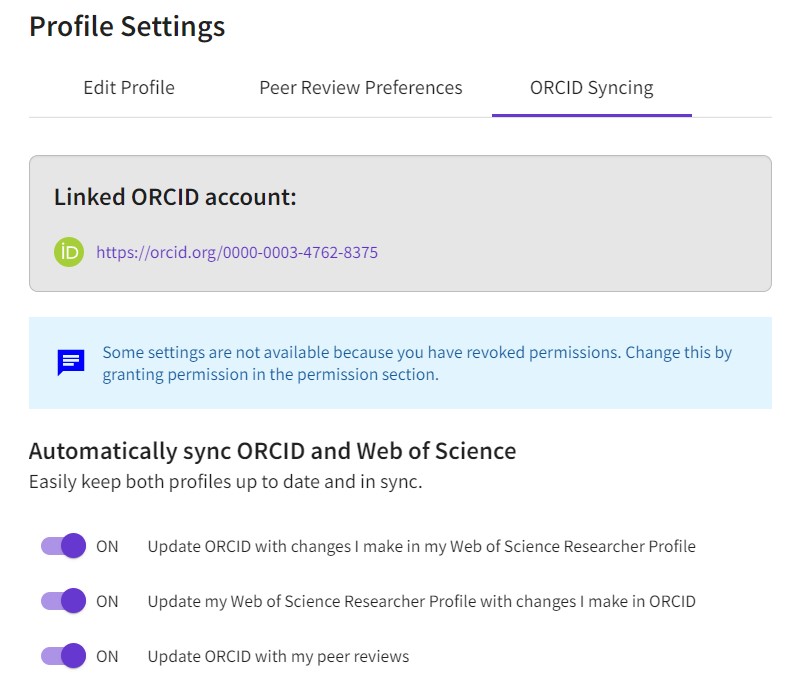
  2. Make sure that you connect your ORCID iD under “Settings” (see image below)
  3. On your profile page, click on edit and then the tab “ORCID syncing” to make sure that they are synced with each other (see image below)
  4. Add further information  to your profile

Read more about Web of Science researcher profiles here.


Connect to Crossref

It is very important to connect your ORCID iD to the database Crossref, because it will then automatically update your ORCID record as soon as you publish a new online article associated with a DOI. Read more here about this great feature.

 Get help

Enquiries: Marié Roux or Kirchner van Deventer

Read more about ORCID and its connectedness in this article: Connected Research


Welcome to Special Collections

Special Collections is a unique space in the Stellenbosch University Library where we focus on research, preservation, and accessibility of unique research material. The division house three sections, in the main library 1) Africana, 2) Manuscript section and 3) Rare books. The Music Library’s Special Collections is called the Documentation Centre for Music (DOMUS).

Researchers from all faculties are welcome to make use of the research sources in Special Collections.  To make optimal use of this collection researchers are requested to make an appointment by sending an e-mail to jsgspes@sun.ac.za. Special Collections is a closed collection. Books in this collection are searchable in the library catalogue and you are able to use the material, but you will not be able to borrow it. As preservation is one of the primary goals, clients will be requested to handle material with care, using a book cradle to support the books, wearing gloves, and no photocopies can be made.

Africana consists of a collection of valuable books, pamphlets, maps, pictorial works, and other material on sub-Saharan Africa, with a specific focus on the political, economic, and social history of South Africa, the Western Cape and the Stellenbosch district.  Books published from 1600 until 2022 form part of this collections.


Rare Books is a treasure trove of curiosities. A collection of valuable, unique, and sometimes irreplaceable books on a variety of subjects, including art, the sciences, religion, history, literature, and popular culture. This collection houses first- and special editions, signed copies and unique binding of printed material dating back from 1490 to the present.

Manuscript Section houses more than 461 document collections of individuals or organisations covering categories like the music, architecture, art, literature, political, social, and economic history of South Africa and, specifically, from the Western Cape. Finding aids to the indexes of the document collections and examples of documents are available on SUNDigital.

Documentation Centre for Music (DOMUS) is housed in the Music Library and consists of information on special music collections in South Africa aimed at stimulating music research on South African materials in South Africa and internationally.

For more information, researchers can visit the Special Collections library guides at:

Special Collections

Directory of South African Music Collections

Author: Marieta Buys

Stellenbosch University’s three repositories

Did you know that the Library has three different repositories?

SUNScholar  – Stellenbosch University’s institutional research repository

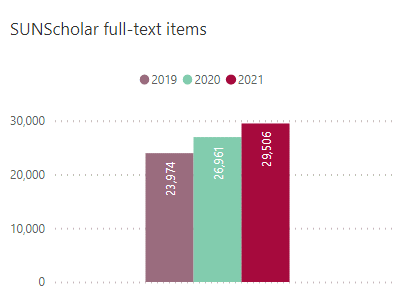
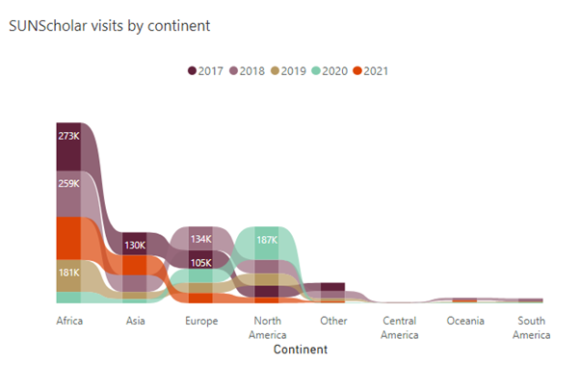
SUNScholar might be the most well-known of our repositories. Since the inception of SUNScholar and its predecessor, Electronic Theses & Dissertations (ETD),  the items in SUNScholar have grown steadily to reach a substantial number of 29 500 full-text items in 2021.  The entire process of submission, evaluation, verification and acceptance takes place online.  The ingest of new data into SUNScholar is partly due to the biannual graduation ceremonies, the SU research report and authors’ self-archived published articles.  Self-archiving of published articles gives authors the opportunity to disseminate their research more widely, as SUNScholar has established itself as an accredited institutional repository.

In total SUNScholar had 461 735 visits and 158 470 items downloaded. In the graph below it is interesting to see from which continents it is mostly visited.

SUNDigital – Digital Collections

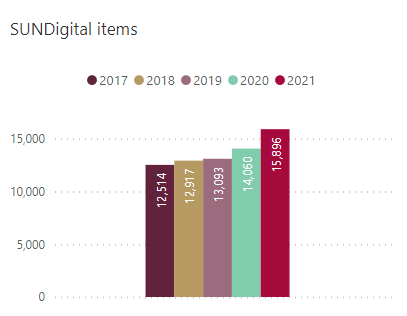
SUNDigital has also been around for a number of years, but might not be as well-known as SUNScholar. A wealth of interesting original manuscripts, maps and photographs have been digitised to form collections within SUNDigital. The total number of items in this digital heritage repository is 15 896 (2021). The repository usage is high at 51 983 times visited, and 37 051 downloads in total.

SUNScholarData  –  Stellenbosch University’s research data repository

The new kid on the block is SUNScholarData. Since its inception in 2019, a growing number of depositors have contributed to the datasets housed in this repository, including linked PLoS datasets. The use of this repository is also growing with 5 034 views and 3 078 downloads in 2021.

Enquiries: Paulette Talliard and Samuel Simango

Samuel Simango at the Mortenson Center Associates Program

Samuel Simango, Manager of Research Data Services, attended the Mortenson Center Associates Program recently. The following is his feedback on his time spent at the University of Illinois in Urbana-Champaign:

The Mortenson Center Associates Program is a unique non-degree professional development programme for librarians from outside the United States. The programme is run by the Mortenson Center for International Library Programs which is located at the University of Illinois in Urbana-Champaign. The 2022 Mortenson Center Associates Program took place between 25th May – 21st June. The theme for this year was Smart and Smarter: Leadership and Innovation in Libraries. The activities of the programme comprised seminars, workshops, tours, and various tasks.

The programme’s content was wide-ranging and touched on multiple areas relating to library and information services. To a certain degree, it represents a deep dive into the Library and Information Service at the University of Illinois at Urbana-Champaign. However, this was blended with perspectives from several other divisions of the University, such as the Center for Innovation in Teaching and Learning, Siebel Center for Design, as well as the Campus Instructional Facility. Furthermore, the associates were also provided with broader exposure to several other institutions, including the Urbana Free Library, Harold Washington Branch Chicago Public Library, University of Chicago Library, Ohio State University Library, Pritzker Military Museum and Library, Online Computer Library Center (OCLC), Westerville Public Library, Arthur Public Library, Abraham Lincoln Presidential Library and Illinois State Library.

There were no specific tracts for the different types of librarians. As such all librarians attending the programme were exposed to a broad range of library environments. The idea was to provide associates with exposure rather than pigeonholing them to the types of libraries in which they happen to work. The Mortenson Center Associates Program probably represents the single greatest transfer of knowledge in the library sector in the world – primarily due to the manner in which it facilitates knowledge acquisition. After attending this programme one certainly comes out with a better understanding and appreciation of libraries.

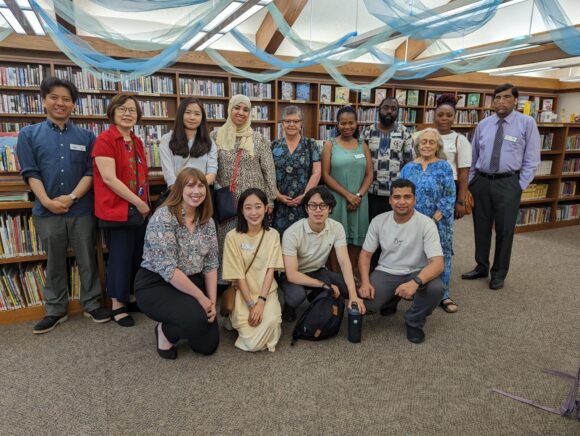
Samuel (third from the right at the back) with the other librarians who attended the programme, and some of the presenters

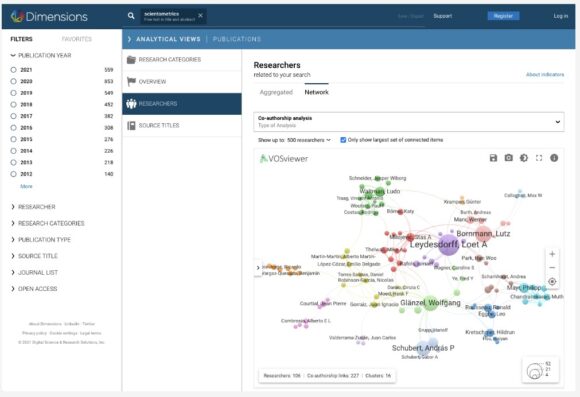
Visualise networks within the Dimensions database

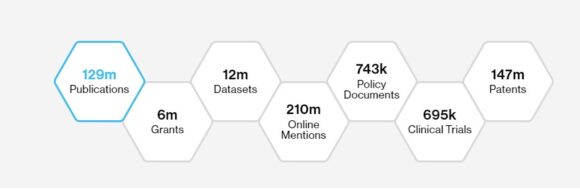
The free version of the Dimensions database is a powerful tool to search for publications, data sets, clinical trials and many more. Dimensions covers millions of research publications connected by more than 1.6 billion citations, supporting grants, datasets, clinical trials, patents and policy documents. It boasts to be the world’s largest linked research information dataset.  Read more here.

They have worked together with the Centre for Science and Technology Studies (CWTS) to integrate their VOSViewer tool into Dimensions. VOSviewer is a software tool for constructing and visualising bibliometric networks which may include citations, bibliographic coupling, co-citations, or co-authorship relations. VOSviewer Online has been fully integrated and added as a visualisation option in the Analytical views panel for all versions of Dimensions. Initially, it is only available in the Researchers Analytical View for publications. The following two types of analyses are available —co-authorship analysis and citation analysis.

Co-authorship analysis

With this fairly new feature you can now easily identify key patterns in bibliometric data. Try it out and contact us if you need any assistance.

Contact: Marié Roux

Library Research Week: Bridging uncharted waters

Day 5: Bridging uncharted waters

The last day of Library Research Week 2022 started out with a workshop on how to improve your impact as a researcher. Marié Roux, Manager of the Library’s division for Research Impact Services, took the participants through the steps on how to improve the online visibility of their research and why this is important. She explained why it is important to create unique author IDs (ORCID, Google Scholar, etc.), populate their profiles on academic network sites (ResearchGate) and showcase their research on social media (LinkedIn, Twitter). The last part of the workshop was about how to monitor your impact as an author with databases such as Web of Science, Scopus, scite, Dimensions and Altmetric.

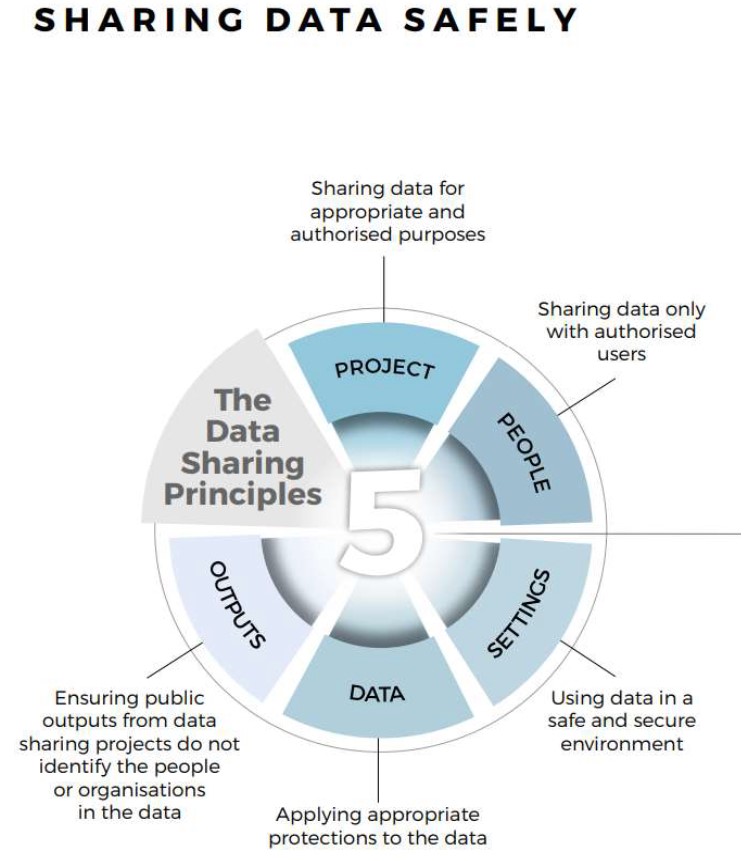
Samuel Simango, the Manager for Research Data Services then presented a  session on how to handle sensitive research data. This was an excellent workshop where he explained the SU research data governance framework and shared information on secure storage of sensitive research data and the de-identification thereof. The session ended with some data sharing principles which should be adhered to when you work with sensitive data.

The week ended on a high note with a session by Wiley on the topic of the recent Read and Publish Open Access Agreement that has been implemented. The two presenters, Janice Rimbault and Fabio DiBello, took the participants through the author workflow of how to submit a manuscript to a Wiley hybrid journal and get the APC covered through this agreement. This was a valuable practical look at how this works and we will definitely be able to re-use the recording when authors need to know more about the workflow.

Siviwe Bangani, the Director for Research Services, then concluded the week by giving thanks to all presenters and participants.

Author: Marié Roux

« Older posts Newer posts »