Page 2 of 23

SU recognises research visibility and impact through Open Access Awards

The establishment of institutional repositories such as SUNScholar, SUNScholarData, SUNDigital Collections, and SUNJournals stands as a direct testament to the University’s ongoing investment in supporting and expanding OA. The Library continues to promote OA through initiatives such as staff and student training, Open Access workshops, and participation in International Open Access Week.

In recognition of the role of OA in enhancing research visibility, impact, and societal benefit, the Library and Information Service initiated the introduction of the Open Access Awards at the University’s Research and Innovation Excellence Awards held on 22 October 2025. This initiative acknowledges that OA contributions often remain under-recognised, despite their importance.

2025 Open Access Award Categories and Winners

Category 1: Most Prolific OA Author (Scopus-indexed)

Awarded to the SU-affiliated researcher with the highest number of OA publications indexed in Scopus over the period 2022–2024. This was awarded to Professor Soraya Seedat, Department of Psychiatry. In her own words: I think I’m particularly encouraged by the Open Access Award, because it is really important. We ensure that all the work we produce is widely accessible, particularly to people living in a lower-income context, where they do not have ready access to scientific and medical literature. (View video of highlights of the event here)

Category 2: Highest Cited OA Output (Scopus-indexed)

Awarded for the OA publication by an SU-affiliated author, indexed in Scopus and published between 2022–2024, that received the highest number of citations. This was awarded to  Dr Houriiyah Tegally, Centre for Epidemic Response and Innovation.

Category 3: Most Downloaded OA Output (SUNScholar & SUNScholarData)

Awarded to the SU-affiliated author(s) whose OA output deposited in SUNScholar from 2020-2024 received the highest number of downloads. This was awarded to:  Drs Jerome Joorst, Education Policy Studies, Technology Transfer/Innovation team, and  Willie Smit, Mechanical and Mechatronic Engineering.

Prizes were sponsored by Elsevier, while the Office of the DVC: Research, Innovation and Postgraduate Studies provided the plaques. Through the introduction of these awards, the Library aims not only to recognise and celebrate researchers who actively choose Open Access, but also to encourage broader participation in OA publishing across the University.

Strengthening the University’s leadership in advancing equitable access to research is both a social justice imperative and a contribution toward sustainable human solutions. Increased Open Access publishing enhances the visibility and impact of SU research and aligns directly with the University’s aspiration to be Africa’s top university, which is ranked within the Top 100 globally.

From left to right: John Sterley (Research Account Manager, Elsevier), Ellen Tise (Senior Director: Library and Information Services and Dr Jerome Joorst (Education Policy Studies)

Author: Dr Siviwe Bangani

International Open Access Week: Who owns our knowledge?

International Open Access Week is a flagship global event dedicated to open access, held annually in October.  This year’s theme was Who Owns Our Knowledge? and it took place 20 – 26 October 2025. The Library aimed to use this year’s Open Access Week event to also commemorate the signing of the Berlin Declaration on Open Access by the then Rector of Stellenbosch University, Professor Russel Botman, on 20 October 2010.

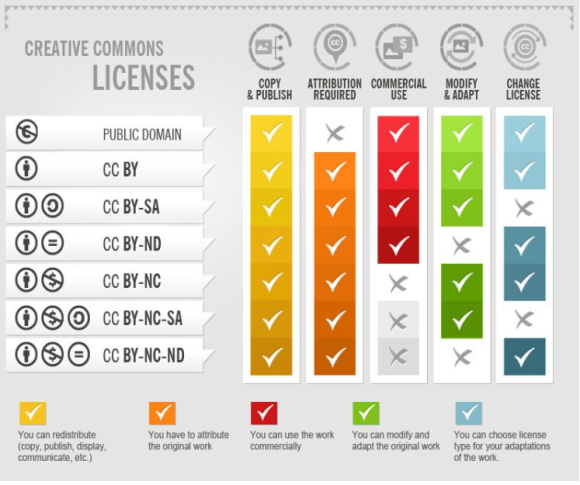
On 22 October 2025, a virtual seminar was held, involving various stakeholders. The programme included a presentation by the Library: “15 Years Unlocked: Celebrating Open Access since signing the Berlin Declaration,” by Ms Ellen Tise, the Senior Director of the Library.  She shared a candid account of the Library’s open access journey since the commitment to open access was made. She also highlighted the milestones and pitfalls encountered along the way.  This was followed by a lively panel discussion involving three experts, Emilie Algenio (Mason University Libraries), Dr Charles Akwe Masango  (University of Cape Town) and Denise Nicholson (Scholarly Horizons). While expressing frustration with the slow pace of assenting to the new South African Copyright Bill, the speakers empowered researchers and librarians on copyright, creative commons and fair use, and how these can be used by producers of knowledge to retain rights to their works. Ina Smith’s presentation “Policy and Research Ownership in the Age of Open Access” emphasised the need for clear institutional and national OA policies that prioritise researcher rights. She further encouraged universities to deposit research outputs in trusted institutional repositories for visibility and long-term preservation, as well as for compliance with funder requirements.

Screenshot of some attendees, by Theresa Schoeman

Author: Dr Siviwe Bangani

The University’s data repository, SUNScholarData, is a proud member of the World Data System

The Stellenbosch University Library and Information Service is proud to announce its membership in the World Data System (WDS), a global network that promotes trusted data services and open science. WDS membership supports the long-term preservation, accessibility, and interoperability of research data worldwide. This membership confirms SU’s commitment to the FAIR principles (Findable, Accessible, Interoperable, Reusable) and positions SUNScholarData as part of an international effort to advance data sharing and collaboration.

Joining WDS brings significant benefits for SUNScholarData and Stellenbosch University. It heightens the repository’s profile, giving worldwide visibility through the International Science Council, international funders, and the global data community. Membership also demonstrates our commitment to open science, promoting SUNScholarData as a trustworthy scientific data service aligned with WDS Data Sharing Principles. Finally, it enhances our repository’s performance and agility by improving data discovery and supporting international data exchange, thus ensuring our researchers’ work is more accessible, impactful, and globally connected.

SUNScholarData is also among a select group of CoreTrustSeal-certified data repositories in South Africa. These recognitions assure SU researchers that the data sets they deposit are curated and preserved according to internationally recognised standards of quality and trustworthiness.

Author: Kirchner van Deventer

Springer Nature “Free” Open Access allocation reached national annual cap

The Library and Information Service has long supported Open Access (OA) publishing, including the development of strong institutional repositories enabling both green and diamond OA. More recently, as part of the South African National Library and Information Consortium (SANLiC), the Library entered several “Read and Publish” (Transformative) Agreements. These agreements have allowed SU researchers to publish OA in selected journals without paying Article Processing Charges (APCs).

However, some agreements have a national annual cap on the number of OA articles that can be published. Once this cap is reached, APC waivers are no longer available for the remainder of that year.

As such, we wish to inform SU researchers that the 2025 national allocation for OA publishing in Springer Nature hybrid journals has now been fully used. Of the 1,074 articles allocated for South African institutions, SU researchers contributed 96 articles (approximately 9% of the national total).

As a result, Springer Nature has deactivated the no-fee OA publishing option for SU authors in hybrid journals with immediate effect. Any new OA submissions to Springer Nature hybrid journals will now incur APCs, which will be invoiced to authors or their departments, as they are no longer covered by the agreement. Researchers may still publish in Springer Nature hybrid journals without paying APCs if they choose the standard (paywalled) publication route.

Despite the latest developments, the 15% discount for BioMed Central (BMC) fully OA journals remains in place. Researchers will continue to be responsible for the full APCs when publishing in other fully OA Springer Nature journals.

We understand that this change may affect research publication planning. We encourage researchers to consider other OA options available through SANLiC’s remaining “Read and Publish” agreements, which still provide no-fee OA publishing in hybrid journals from several other publishers.

For more information, please consult the Library’s Open Access Publishing LibGuide.

For further assistance, please contact Sizwe Ngcobo.


SUNScholarData: Advancing Institutional Impact through Open Research

SUNScholarData is a relatively new repository for Stellenbosch University’s research data having been born in 2019. Since its inception, the research data repository has shown plenty of promise in its contribution to the global visibility and impact of SU’s research datasets. Its success so far reflects SU’s commitment to open science, global visibility, societal impact and responsible research data management. Per international standards, the repository adheres to the FAIR principles (Findable, Accessible, Interoperable and Reusable).

The FAIR principles are essential for ensuring that research data repositories serve their purpose effectively. They help make data easy to locate, open to use, compatible across systems, and ready for future research. In practice, FAIR encourages clear metadata, consistent formatting, and thoughtful documentation, which supports transparency, reproducibility, and long-term value. For institutions, applying these principles is a strategic move: it strengthens data quality, supports responsible research assessment, and ensures that repository outputs are not just stored, but usable.

SUNScholarData is also the first African institutional research data repository that received the CoreTrustSeal certification. This certification signals that a research data repository meets internationally recognised standards for trustworthiness, transparency, and long-term stewardship. It validates that the repository has robust governance, clear data access policies, and sustainable infrastructure, all of which are critical for institutional credibility and responsible data management. For researchers and stakeholders, it offers assurance that deposited data will remain accessible, usable, and protected over time. In practice, CoreTrustSeal strengthens alignment with FAIR principles and supports strategic integration into global research ecosystems.

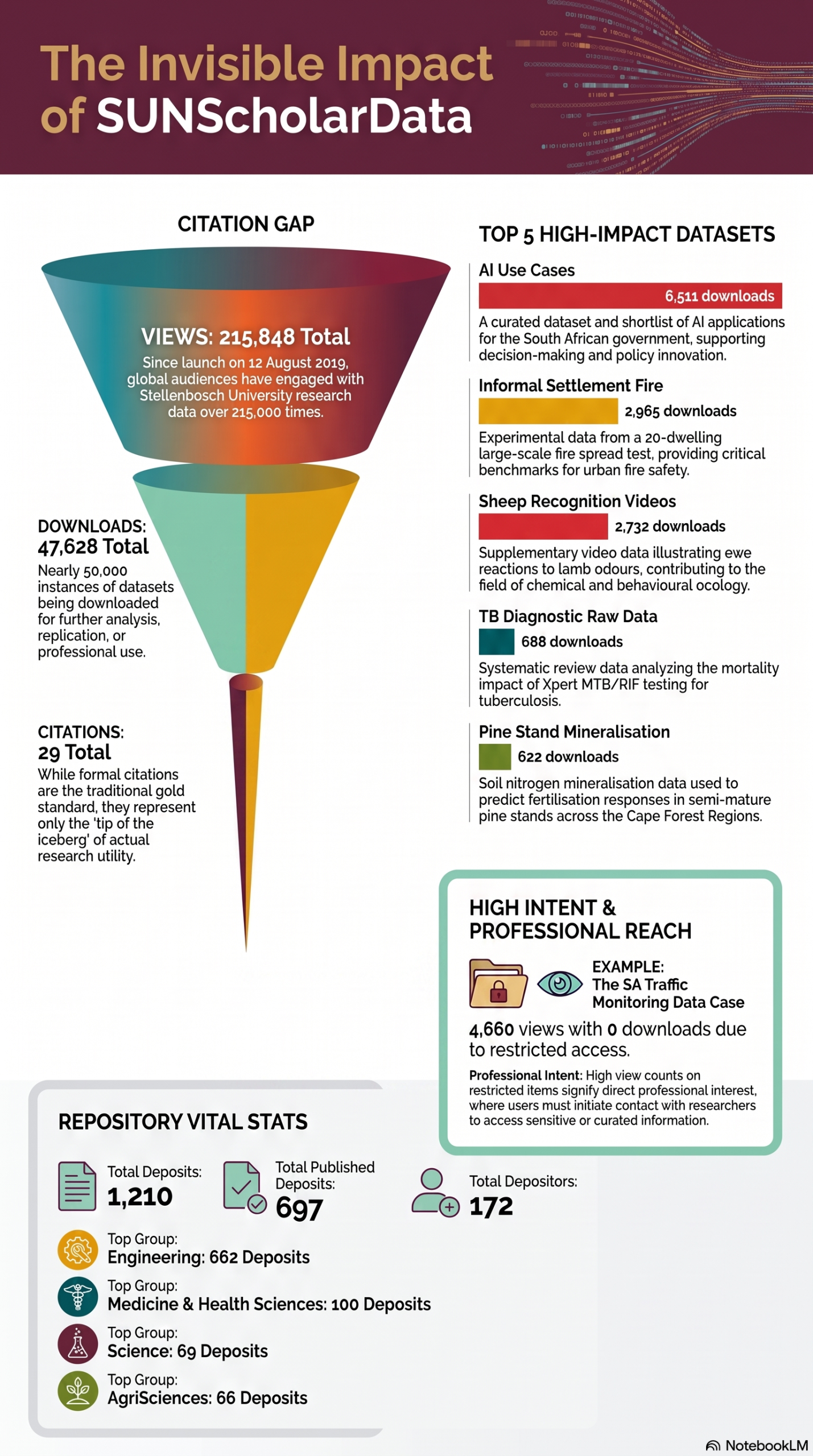
Below we provide an overview of some of the key statistics about the platform.

Repository Growth and Engagement

Total Deposits: 551 datasets have been archived, representing a broad spectrum of research outputs.

Contributor Base: 141 individual depositors have engaged with the platform, signalling widespread institutional participation.

Usage Metrics: Over 150,000 views and 30,000 downloads demonstrate sustained interest and practical reuse of hosted datasets.

Citation Count: 16 citations suggest growing scholarly recognition, with potential for increased uptake through enhanced discoverability.

Figure 1: SUNScholarData statistics 2019-2025

Disciplinary Reach

Disciplinary contributions span multiple faculties. This diversity reflects cross-disciplinary engagement, though further metadata refinement could improve attribution and reporting accuracy.

Figure 2: Datasets uploads per Faculty

Global Visibility

SUNScholarData has achieved notable international reach, with the United States accounting for over 120 000 views. Other top-viewing countries include South Africa, Germany, the UK, France, and Ireland – underscoring the repository’s relevance beyond national borders.

Figure 3: Global visibility of SUNScholarData

High-performing datasets:

Below are some of the datasets that appear to have had the highest impact in terms of views and downloads. In the table below, related articles published from the data were linked.

Figure 4: High-performing datasets


Dataset Publications linked to the data Views Downloads
Dwelling Informal Settlement Experiment 20 Dwelling Large-Scale Experiment of Fire Spread in Informal Settlements 2161 2774
N mineralisation data used to predict the response to fertilisation in semi-mature pine stands Modelling soil nitrogen mineralisation in semi-mature pine stands of South Africa to identify nutritional limitations and to predict potential responses to fertilisation 3366 538
Flexural properties of Pinus patula planted at different initial spacing The flexural lumber properties of Pinus patula Schiede ex Schltdl. & Cham. improve with decreasing initial tree spacing 2399 988
Supplementary information (videos) illustrating the reaction of a ewe to the odour of her own lamb versus that of another lamb Olfactory cue mediated neonatal recognition in sheep, Ovis aries 1701 2580
Oceanic_Al_Menzel A First Global Oceanic Compilation of Observational Dissolved Aluminum Data With Regional Statistical Data Treatment 2515 501
Erica species anthocyanin biosynthesis gene expression data Floral Color, Anthocyanin Synthesis Gene Expression and Control in Cape Erica Species 2717 568
Petrochemical blending problem instances On the solution of petrochemical blending problems with classical metaheuristics 2160 1031
Synthetic domestic hot water profile generator A probabilistic hot water usage model and simulator for use in residential energy management 1837 1102
Celtis africana metabolite profiles: Supplementary Materials Antibacterial activity and gas chromatography mass spectrometry (GC–MS)-based metabolite profiles of Celtis africana and its endophytic extracts 1659 843

The datasets listed above reflect notable engagement, with several attracting considerable attention through both views and downloads. For instance, the Dwelling Informal Settlement Experiment – linked to research on fire spread in informal settlements – received over 2,100 views and nearly 2,800 downloads, highlighting its relevance to urban safety and planning. Datasets tied to real-world issues like urban safety, environmental modelling, and agriculture are drawing thousands of views and downloads, which suggests they’re reaching the right audiences. This level of engagement suggests the repository is successfully enhancing both visibility and reuse of research outputs.

SUNScholarData provides Stellenbosch University with a certified, standards-aligned repository that supports responsible data stewardship and institutional credibility. By adhering to the FAIR principles, it ensures that research data is structured for long-term access, reuse, and interoperability, which are critical for reproducibility and strategic assessment. Its CoreTrustSeal certification affirms that governance, access policies, and infrastructure meet global benchmarks, positioning the university’s data outputs within trusted research ecosystems. SUNScholarData is consequently a durable asset for transparent, auditable, and future-ready scholarship that remains an important part of Stellenbosch University’s open research infrastructure. Its increasing use, varied content, and integration with institutional systems reflect steady progress in supporting data sharing and stewardship within the African research context.

Author: Kirchner van Deventer

Graphics: Marié Roux

Lessons in Open Research and Research Data Management: Reflections from the Figshare South Africa User Group Conference 2025

In partnership with Stellenbosch University Library and Information Service, Digital Science held its first Figshare South Africa User Group Conference at STIAS from 31 July to 1 August 2025. Figshare is the platform used for Stellenbosch University’s institutional research data repository, SUNScholarData. It forms part of the products that Digital Science makes available, alongside other important platforms such as  Symplectic Elements, Dimensions, and Altmetric Explorer.

Attendees were research data professionals, librarians, and institutional stakeholders from across the country who came to explore the evolving landscape of open research and data management and share their experiences. The event highlighted strategic innovations, platform developments, and institutional leadership in advancing responsible data practices.

Stellenbosch University’s Deputy Vice-Chancellor: Teaching and Learning opened the conference. Together with Dr Mark Hahnel (VP Open Research at Digital Science), they set the tone for a forward-looking dialogue. They emphasised the global momentum behind Open Access, the ethical responsibilities of data publishers, and the transformative potential of AI in research. Dr Mark Hahnel, in particular, praised South African institutions for their proactive stance and reaffirmed the importance of institutional support in making open data both feasible and rewarding.

During the conference, platform updates from Figshare included a redesigned interface for research outputs, enhanced mapping tools for geospatial data, and improved usability features. These developments aim to streamline data sharing and increase accessibility for researchers and institutions alike.

Institutional case studies showcased practical applications of Figshare across diverse contexts:

  • The University of Pretoria demonstrated SDG tagging within metadata, boosting discoverability and supporting its impact rankings performance.
  • The University of the Witwatersrand previewed its Open Data Vault, integrating Figshare with Altmetric and Dimensions to support large-scale impact tracking.
  • Stellenbosch University presented SUNScholarData, its FAIR-compliant repository, with ongoing efforts to build researcher capacity and efforts to align outputs with the SDGs.

A panel discussion explored challenges in research data management, including cultural resistance, infrastructure gaps, and the role of data in performance evaluation. Collaboration, automation, and community engagement emerged as key factors for sustainable progress.

Day two focused on research assessment reform, innovative workflows, and the broader role of open science. Speakers included Ms Nosisa Dube (National Research Foundation), who delivered the keynote and advocated for inclusive, values-driven assessment models aligned with DORA and UNESCO’s Open Science Recommendation.UCT showcased its digitisation of the Bolus Herbarium via Figshare’s API, illustrating scalable workflows for digital preservation. The HSRC presented its Dataset Request System, balancing openness with compliance for sensitive national survey data. UJ highlighted Figshare’s versatility in hosting diverse outputs, from exam papers to creative works, while Stellenbosch University shared its implementation of Symplectic Elements to streamline DHET reporting and researcher profiling.

The conference concluded with a group session identifying barriers – such as fragmented policies and skills shortages – and opportunities in automation, interdisciplinary collaboration, and national coordination.

Overall, the event affirmed South Africa’s leadership in open research and data stewardship, underscoring the importance of institutional innovation, inclusive assessment, and strategic collaboration in shaping the future of scholarly communication. The case studies from the various institutions showcased the power of open science in the pursuit of excellence in research and how our own platform, SUNScholarData, may be further utilised going forward.

Author: Kirchner van Deventer 

Highlights from the Library’s  2024 Annual Report: A year of innovation, global engagement, and impact

The 2024 Library annual report was shared with various University stakeholders and clearly depicts 2024 as a year of innovation, global engagement, and renewed impact.

A major milestone was hosting the International Association of Music Libraries (IAML) Congress, which held for the first time on African soil. The event took place from 23 to 28 June 2024 in Stellenbosch and brought together delegates from 28 countries. This historic occasion underscored the Library’s role in international scholarly exchange and its alignment with the University’s internationalisation strategic agenda.

Innovation remained central. The Library launched SunDMP, a data management planning tool to help researchers meet funder requirements. By year-end, 125 active users had created 121 research data plans. The Library also piloted a generative AI search tool and developed a chatbot system to enhance support services.

The annual Library Research Week drew 780 participants. The theme, “Let’s achieve excellence in research”, aligned with Stellenbosch University’s core value of research excellence and shaped a rich programme of daily webinars covering all stages of the research process, from preparing and writing proposals to building research impact.


Figure 1: Training remained a cornerstone of our service.. Infographic by African Sun Media.

The Library also advanced Open Access through the new #BeOpenAccessSmart webinar series, of which the inaugural webinar attracted 460 registrations from 23 countries. This initiative built on strong foundations of OA publishing and advocacy at SU.

Figure 2: Our Open Access activities. at SU Infographic by African Sun Media.

A special exhibition celebrating 30 years of South African democracy showcased archival treasures from our Special Collections before moving to the Stellenbosch Public Library for wider public access.

Figure 3: User engagement with the Library soared in 2024,  Infographic by African Sun Media.

Recognition came in the form of a top 10 placement in the IFLA PressReader International Marketing Awards for the Library’s creative TikTok campaigns.

From advancing open access and digital scholarship to preserving heritage and fostering global connections, the Library’s achievements in 2024 reflect its pivotal role in supporting research, teaching, and learning at Stellenbosch University.

Author: Theresa Schoeman

Attend the SciVal webinar to enhance your research evaluation skills

Since Stellenbosch University subscribed to Elsevier’s research evaluation tool, SciVal, in 2023, it has been used productively for evaluating research for the University as a whole, for departmental groups, and for individual researchers. The following training will take place in October to further enhance research administrators’ and researchers’ skills in using the tool to their advantage.

Introduction to SciVal for research evaluation

Thursday 2 October, 14:00-16:00.

An overview of the features of SciVal will be presented, including the following:

  • The underlying data of Scopus
  • Overview of the different modules and entities
  • An overview of all the different metrics and some example reports for individuals
  • Customised template for a researcher at Stellenbosch University
  • Measuring contributions to the Sustainable Development Goals
  • Benchmarking with colleagues internally and externally

 Staff, please register here

Students, please register here

 Enquiries: Marié Roux

Get inspiration and advice for your data visualisations

Are you a researcher looking for the best tools to visualise your research results, or an administrator eager to showcase the impact of your faculty’s work?

Since 2020, the Library has incorporated Data Visualisation as a service, as part of the division, Research Impact Services. This service has grown over the years to four workshops on the topic. If you need any assistance with visualising your data, a consultation service is also available. Libraries are taking on the role of data visualisation support worldwide. An article published in 2020 in the Journal of Interactive Technology and Pedagogy describes the library’s role in this regard:  “As libraries already play a key role in advocacy for information literacy and ethics, they may also serve as unaffiliated, central places to gain basic competencies in associated information and data skills. Training patrons how to accurately analyze, assess, and create data visualizations is a natural enhancement to this role”.

The topics covered in these workshops vary from basic principles of data visualisation, an overview of tools available for effective data visualisation and introductory workshops on three of the tools, Microsoft Power BI, Tableau Public and Flourish. These workshops are general in nature and not directed towards specific types of visualisations used in different subject fields. The aim is also to introduce you to the tools for future self-exploration.

The workshop series on Data Visualisation for the year has concluded earlier in September. If you need access to the recordings of the workshops, you are very welcome to contact us. Or if you need one-on-one assistance, please make an appointment.

Contact: Marié Roux

Make an appointment for a consultation

Reference:

Aghassibake, Negreen; Jocque, Justin and Sisk, Matthew L. 2020. Supporting Data Visualization Services in Academic Libraries. Journal of Interactive Technology and Pedagogy. No 18.


Towards becoming Africa’s first Global Top 100 university: Carving a Role for the Library

Introduction

A few months ago, the then newly appointed Vice-Chancellor (VC) of Stellenbosch University (SU) shared his “bolder” vision for the institution. This vision not only seeks to position SU as Africa’s leading research-intensive university but also aspires to secure a place as Africa’s first global Top 100 university. In an article published on the University’s website, SU welcomes second cohort of SUNRISE fellows, the VC emphasised that this ambition is not a mere slogan but a call to action, requiring the collective commitment of all University stakeholders.

In this context, it is imperative that the Library, as a strategic academic partner, clearly articulates its role in helping to realise this ambitious goal. As Mushtaq and Shahzan (2025) note, libraries have an influential role in shaping institutional rankings.

What does it mean for SU to be Africa’s first global top 100 university?

Although the vision of becoming a Top 100 university has not yet been fully unpacked, it is useful to consider how university rankings operate. A simple search reveals that there are over 47 ranking systems globally, each using its own indicators to benchmark the performance and impact of academic institutions. Despite these differences, there is broad consensus that the “Big Three” rankings: Times Higher Education (THE) World University Rankings, QS World University Rankings, and the Academic Ranking of World Universities (ARWU, or Shanghai Rankings), are the most influential (Bernal, 2019; Östlundh, 2019).

The “Big Three” institutional ranking systems

This section provides an overview of the ‘Big Three’ ranking systems as explained by Bernal (2019).

  • THE World University Rankings

For nearly five decades, Times Higher Education has ranked universities and provided data to prospective students. THE uses 13 performance indicators, grouped into five categories: teaching (learning environment), research (volume, income, reputation), citations (research influence), international outlook (staff, students, research), and industry income (knowledge transfer). Citation data is drawn from Scopus and measured over a six-year window.

  • QS World University Rankings

The QS rankings currently cover approximately 1,000 universities across 85 countries, based on six indicators: academic reputation, employer reputation, faculty/student ratio, citations per faculty, international faculty ratio, and international student ratio. Like THE, QS also uses bibliometric data sourced from Scopus.

  • Academic Ranking of World Universities (ARWU / Shanghai Rankings)

First published in 2003 by the Center for World-Class Universities (CWCU), ARWU evaluates institutions using six objective measures: the number of alumni and staff who have received Nobel Prizes and Fields Medals; the number of highly cited researchers (Clarivate Analytics); publications in Nature and Science; papers indexed in the Science Citation Index-Expanded (SCIE) and Social Sciences Citation Index (SSCI); and overall per capita performance. ARWU is the only one of the Big Three to use Web of Science (WoS) data. Each year, ARWU evaluates more than 1,200 universities and publishes the top 500.

How does the Library Contribute?

Libraries act as strategic partners in enhancing institutional rankings through the provision of quality information resources, researcher support, and visibility services (Dimzov, Matošić, and Urem, 2021).

Given the strong emphasis of most ranking systems on research impact and visibility, the Libraries contribute in several key ways:

  • Open Access and Open Science infrastructure: By managing institutional repositories (IRs), negotiating favourable OA agreements, promoting OA-first policies, and raising awareness among researchers, the Library can significantly increase the visibility and citation potential of SU’s research outputs. IRs also serve as a showcase for the University’s scholarship and unique heritage collections. Stellenbosch University hosts four repositories: SUNScholar, SUNJournals, SUNDigital Collections and SUNScholarData. In addition, as a member of the South African National Library and Information Consortium (SANLiC), SU has signed 18 “read and publish” (transformational) agreements that make it possible for researchers to publish OA in hybrid journals of those publishers and/or get a discount on Article Processing Charges (APCs). All these efforts serve to increase the reach, impact and visibility of SU research.
  • Research publishing support: Librarians advise researchers on selecting reputable journals, while discouraging submissions to predatory or low-quality outlets. The Library also provides bibliometric and altmetric analyses to individuals, departments, and centres to track outputs, citations, and visibility. Additionally, the Library provides research/er assessment tools such as SciVal, Scopus and Web of Science that enable researchers and research entities to benchmark and gauge themselves and their research impact with others. Knowing where the University really stands may help galvanise it into seeking knew strategies to strengthen its research capacity or target certain publishers favoured by the ranking agencies.
  • Promotion of multiple literacies: The Library has evolved beyond being a traditional hub for developing basic literacy skills. It now plays a pivotal role in capacity building by offering specialised workshops tailored to the diverse needs of students and researchers. These include training in digital and information literacy, as well as emerging areas such as data literacy and the ethical use of artificial intelligence. Mastery of these literacies is essential for advancing high-quality research and innovation in the 21st century, directly contributing to the University’s academic excellence and global competitiveness.
  • Research and learning spaces: The Library provides innovative and inclusive spaces, such as research commons, learning commons, makerspaces, collaborative spaces, and virtual meeting facilities, that foster both academic excellence and institutional visibility. These dynamic environments serve as incubators for innovative research ideas, support interdisciplinary collaboration, and enrich the student learning experience. These spaces have the potential to contribute to the elevation of the quality of research and innovation at the University, serving as strategic assets that contribute to its global competitiveness and ranking profile.

Conclusion

While libraries may not contribute directly to rankings through research output, their influence is nonetheless substantial. Universities rely on libraries to make research visible, accessible, and impactful, as well as to provide the essential teaching and research resources that underpin academic excellence. Additionally, these libraries provide capacity building offerings for multiple literacies required for research and academic excellence. In this way, the Library functions as an enabler of research, teaching, and innovation, all of which are critical considerations in institutional rankings and SU’s journey toward becoming Africa’s first global Top 100 university

References

Bernal, L. 2019. Library impact with international rankings—one library’s continuous journey to figure it out. https://www.libraryassessment.org/wp-content/uploads/2019/09/17-Bernal-LibraryImpact.pdf.

Dimzov, S., Matošić, M. and Urem, I., 2021. University rankings and institutional affiliations: Role of academic librarians. The Journal of Academic Librarianship47(5), p.102387.

Mushtaq, M. and Shahzan, M., 2025. Libraries as Supporting Agencies for Enhancing the Ranking Score of Academic Institutes. International Information & Library Review, 1-14.

Östlundh, L., 2019. The role of academic libraries in ranking of institutional research impact. https://scholarworks.uaeu.ac.ae/cgi/viewcontent.cgi?article=1002&context=presentations

Author: Dr Siviwe Bangani

« Older posts Newer posts »