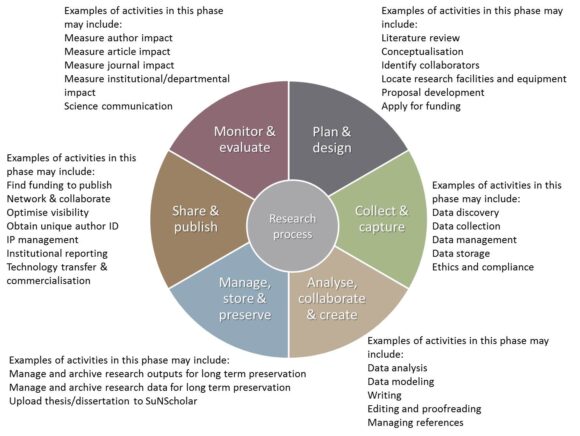
Do you know about this helpful Library Guide that assists you with all the aspects of the research process? It follows all the steps involved with conducting research, from the planning phase, data collection, the writing process, archiving, publishing, and measuring your impact. Where the Library is not involved, you will be referred to the correct information elsewhere on campus.
Please contact us if you need further assistance with any of these steps.
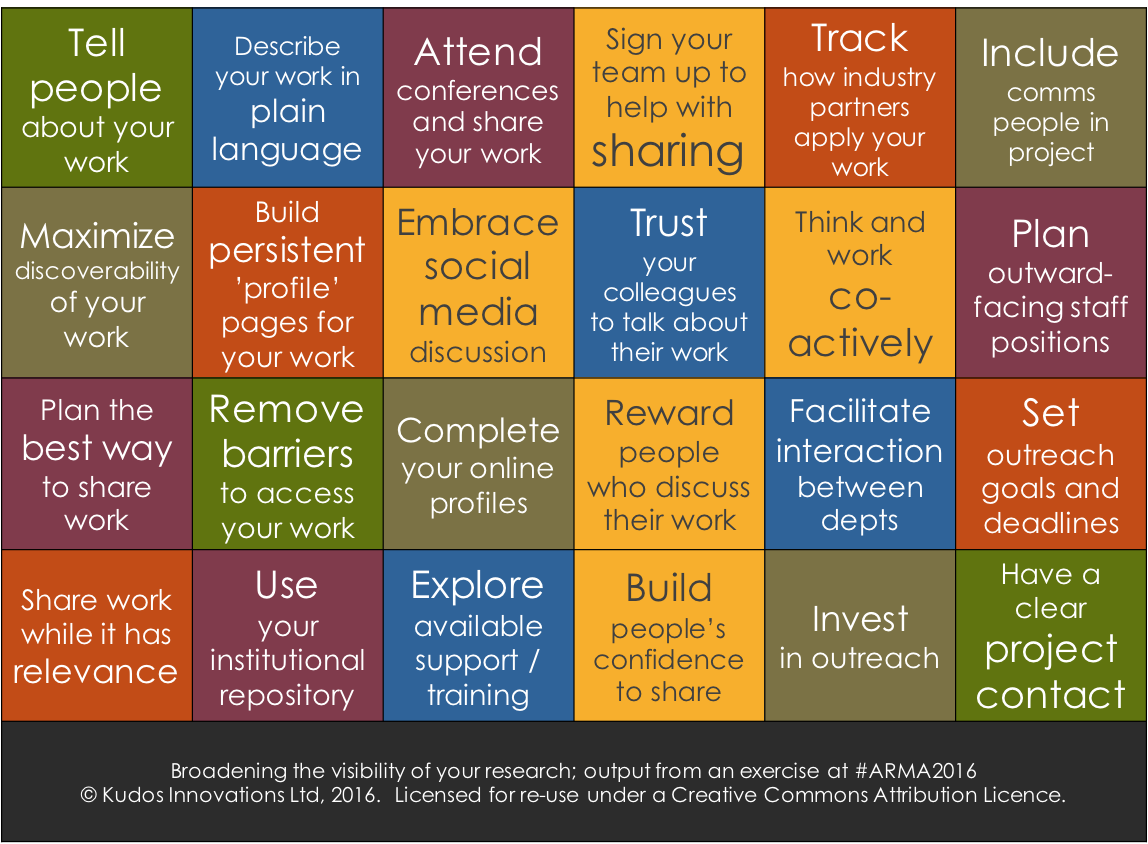
During a workshop held at the 2016 ARMA conference, a Kudos team led a workshop to consider what researchers can do to increase the visibility of their research. Some great ideas emerged from this workshop. Below a visual version of the key points which came out of the discussion. Read more about it on this Kudos blog post.
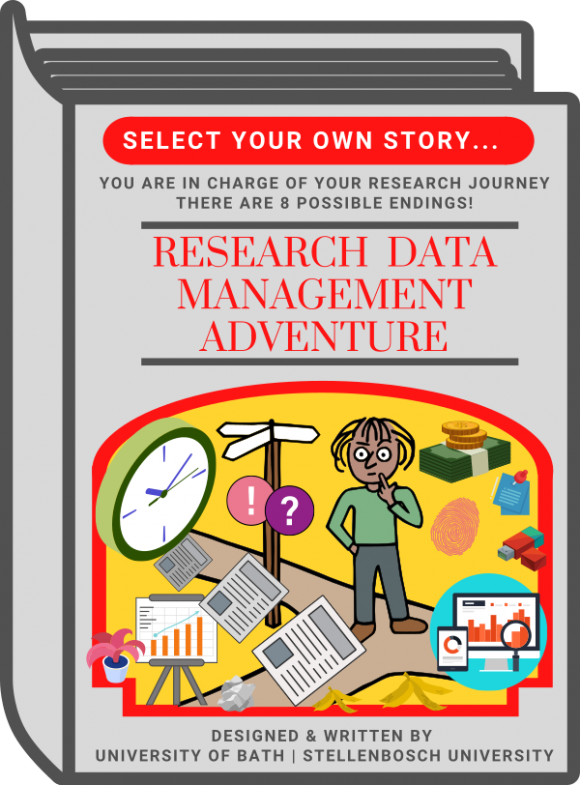
The Library recently launched a Research Data Management Adventure Game. It is a text-based role-playing interactive serious game based on an academic research project’s data management challenges. The game takes the form of an online choose-your-own-adventure format in which game players take a simulated research project through the processes below whilst encountering data management challenges along the way.
The game focus on the following learning outcomes:
Data management planning
Designing participant information sheets and consent forms
Choosing appropriate equipment for research projects
Acquiring suitable third-party research data
Organising research data
Storing research data appropriately
Analysing and documenting research data
Preparing research data for archiving
Publishing research data
The game was developed as part of a collaboration between the University of Bath Library and Stellenbosch University’s Library and Information Service.
When you create or update your ORCID record, it is quite important to remember to add a short biography too. This might help to distinguish yourself from other researchers with the same name. See below a nice guide that ORCID created to assist you.
International Open Access Week is an annual event aimed at promoting the Open Access movement’s principles and practices of free and easily accessible research outputs. This year’s theme is Open with purpose: Taking action to build structural equity and inclusion and it is being held this week (19-25 October) worldwide. It is an opportunity for the wider community to coordinate and take action to make openness the default for research:
“We need to examine who these spaces and systems are designed for, who is missing, who is excluded by the business models we use, and whose interests are prioritized. As we work together to rebuild these structures, we need to commit to moving from conversations to concrete commitments and to hold one another accountable for making real progress.” – Nick Shockey
In line with this theme, Stellenbosch University Library and Information Service has chosen to focus on Open Data (a sub-component within the broader context of Open Research) and to also showcase SUNScholarData. SUNScholarData is SU’s digital repository for research data and it was developed in line with the recognition that research data should be open, transparent and easily accessible.
For more information on Open Access initiatives at Stellenbosch University, you can view the video below:
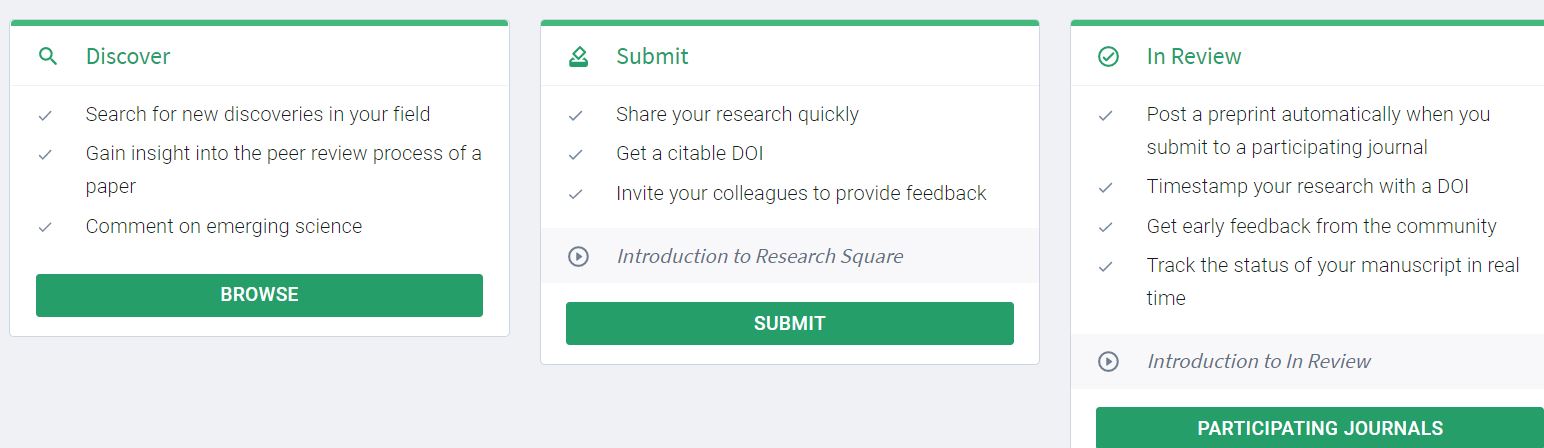
Research Square has partnered with Dimensions to provide early citation data on preprints. It lets you share your work early, gain feedback from the community, and start making changes to your manuscript prior to peer review in a journal.
About Research Square
Research Square is a division of the Research Square Company, and exists to make research communication faster, fairer, and more useful. The preprint platform, launched in 2018, is a large, author-centric preprint server that brings transparency to the peer review process. Through the journal-integrated In Reviewservice, innovative author dashboard, manuscript assessments, and research promotion services, they enable researchers to share their research with the broader community,and receive useful feedback much earlier in the publication process.
The policy requires that full-text copies of published journal articles or conference proceedings of SU research output be hosted in the institutional repository, SUNScholar .
The following versions of your articles may be submitted to the repository (all in compliance with the policy of the publisher):
Publisher’s version
Post-print (final peer-reviewed manuscript with the incorporation of revisions)
PDF of peer-reviewed conference paper
https://en.wikipedia.org/wiki/Self-archiving
You may contact your Faculty Librarian who will be able to submit on your behalf, or submit your research output yourself by sending an e-mail to scholar@sun.ac.za, requesting to register as a submitter. The steps are also set out on our help page. One individual may also submit on behalf of a department after they have been registered and have all the necessary information to complete the citation.