
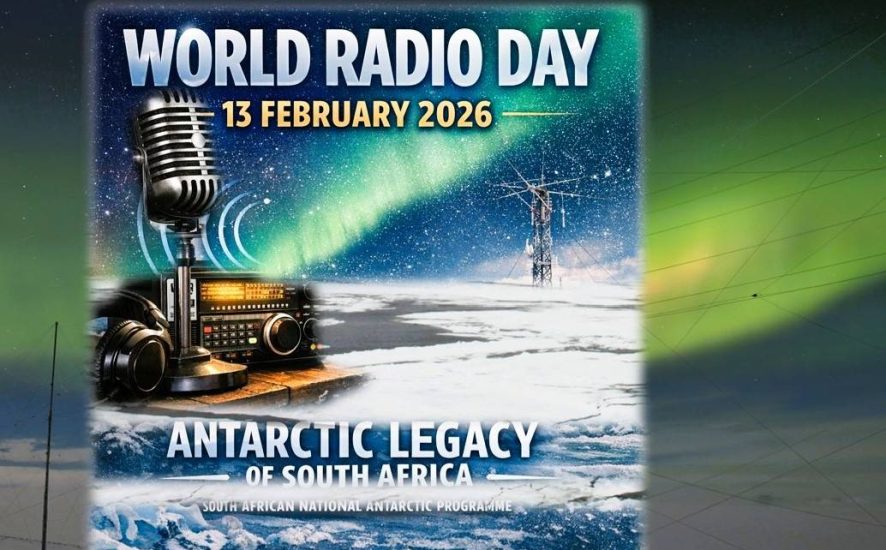
On 13 February 2026, the world once again celebrates World Radio Day, an international day proclaimed by the UNESCO to recognise the enduring power of radio. The day highlights radio broadcasting as a platform to improve international cooperation, strengthen access to information, and connect communities across vast distances. For South Africa’s Antarctic community, this celebration holds particular meaning.

For decades, radio has played a role in sharing the story of SANAP with the public. Long before livestreams and social media updates, radio waves carried news of departing expeditions, overwintering teams, and homecomings. When research voyages set sail for Antarctica aboard the polar vessels such as the S.A. Agulhas and the S.A. Agulhas II, radio kept South Africans informed. Broadcasts announced departures from Cape Town and when expeditioners returned months later, radio once again connected families, scientists and the public in celebration.
In an era before constant digital connectivity, radio was the bridge between remote frontiers and home.

Amplifying Science Through Sound – Radio broadcasting remains a powerful tool to highlight the work of researchers operating in some of the most remote and challenging environments on Earth. Through interviews, features and documentaries, radio it brings Antarctic and sub-Antarctic science into classrooms and homes. It gives voice to researchers explaining climate science, geology, oceanography and biodiversity in accessible language.
One excellent example is the recent Afrikaans podcast series on RSG featuring the University of Johannesburg geology team. These programmes showcase the work of the University of Johannesburg researchers involved in Antarctic field studies, demonstrating how radio continues to translate complex science into compelling storytelling.
For Antarctic Legacy of South Africa, it is also a moment to thank the broadcasters who have told the story of our voyages, our stations, and our scientists. Let us celebrate that we have this powerful means of communication — and that we use it wisely. From the icy shores of Antarctica to the airwaves across South Africa, radio continues to carry the legacy forward.
Let’s celebrate! That we have this means of communication and use it wisely
More podcasts- potgooie on RSG – These will be made available on the ALSA archive later in the year