
How do archives protect rights, preserve memory and support justice across generations? These are the questions at the heart of this year’s International Archives Week (IAW2026), taking place from 8–12 June. The Antarctic Legacy of South Africa (ALSA) is proud to join the global archival community in celebrating this year’s theme #ArchivesForJustice: Rights, Memory & Futures.
Justice spans many dimensions, including legal, social, cultural, environmental, historical, and intergenerational justice. Across all these dimensions, archives play an essential role. They preserve collective memory and evidence of past events, document decisions and responsibilities, and provide the foundation for accountability. By ensuring long-term access to records, archives help communities pursue truth, uphold rights, better understand the past, and shape a more informed future. ALSA’s open-access digital repository reflects these ideas through records documenting South Africa’s Antarctic, sub-Antarctic and Southern Ocean history, spanning from the Heroic Age of Antarctic exploration to the present day.
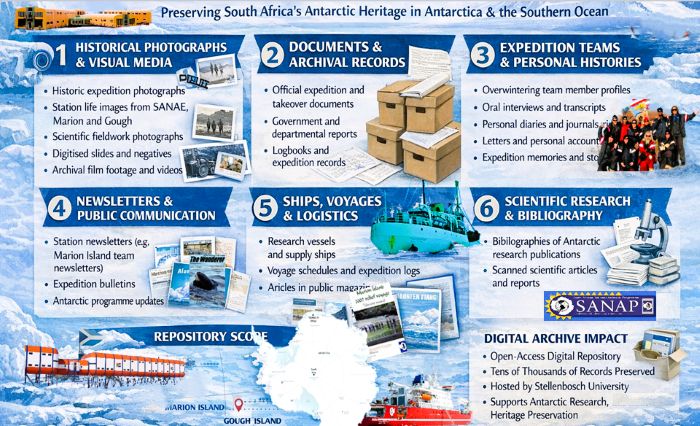 Among the archive’s most significant holdings are foundational documents that define how Antarctica is governed and protected. These include the Antarctic Treaty (1959), signed by the original twelve Antarctic Treaty nations, including South Africa. The Treaty established Antarctica as a region dedicated to peaceful scientific cooperation, prohibiting military activity and territorial claims. Also preserved is the Protocol on Environmental Protection to the Antarctic Treaty (Madrid Protocol, 1991) and its six annexes. This agreement strengthened environmental safeguards by designating Antarctica a “natural reserve devoted to peace and science”. On a more national level, the archive additionally stores government gazette notices, such as the 1995 declaration: Declaration of the Territory Known as the Prince Edward Islands to be a Special Nature Reserve. Issued under South African environmental legislation, this notice formally strengthened protection for Marion Island and Prince Edward Island, recognising their ecological importance and vulnerability.
Together, these digitised records reflect a system of collective stewardship of the Antarctic region, rather than control by a few groups or nations. By ensuring this knowledge is preserved and accessible, the archive helps uphold the rule of law in Antarctica. This is central to environmental justice, as the records document the rules that limit harm to fragile ecosystems. They also provide evidence of international agreement to protect Antarctica for the benefit of all humankind, rather than for short-term exploitation.
Alongside official reports and scientific documentation, the archive contains deeply personal accounts from those who lived and worked in some of the world’s most extreme and isolated environments. Diaries, letters, photographs, audio-visual material, and news clippings bring these experiences to life, capturing the everyday realities of Antarctic work and ensuring that individual stories are included in the telling of history. These collections also highlight important milestones in the growing diversity and representation of South Africa’s Antarctic programme. Among them are photographs and family letters belonging to Mustakim Gierdien, the first South African Muslim to work in Antarctica through the Department of Public Works.
In terms of gender representation, SANAE expeditions were exclusively male for nearly four decades, until 1997, when Dr Aithne Rowse became the first South African woman to overwinter in Antarctica. A newspaper article held in the collection, The Doc’s head over heels in love – with snow, captures her distinctive journey. More recent materials include audio-visual interviews with women who have gained recognition for their exceptional dedication and work, including Dr Abigail Paton and Prof Annie Bekker.
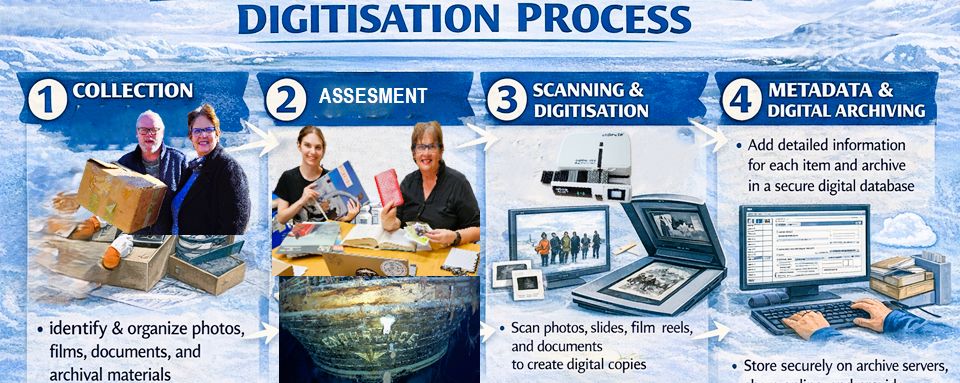 By archiving these personal testimonies and oral histories, ALSA helps build a more inclusive and representative historical record. In doing so, it reflects the spirit of #ArchivesForJustice, ensuring that the voices and contributions of all those involved in South Africa’s Antarctic region remain part of our collective memory.
To learn more, explore the Antarctic Legacy of South Africa Archive
Archive Migration in Progress: The Antarctic Legacy of South Africa (ALSA) digital archive is currently being migrated to a new and improved repository platform that will offer enhanced functionality, greater accessibility, and a more user-friendly experience. We apologise for any temporary disruptions you may encounter while accessing the archive. If you experience any difficulties, please contact us at RiaOlivier@sun.ac.za or danajellin@sun.ac.za.
We will announce the launch of the new repository as soon as the migration is complete and will share updates via our website and social media platforms.
Thank you for your patience and support.