On 13 and 14 November 2025, the 2nd Combined Annual Research Meeting (ARM) was held for the SU School for Climate Studies and the Centre for Invasion Biology.
Under the theme ‘Climate Overshoot – Impacts on Invasives and Biodiversity’, this year’s annual research meeting (ARM) featured keynote addresses from experts from across the world, showing the extensive interconnection between climate and invasion science. The ARM also showcased the work of the MSc and PhD students supervised and supported under the SCS and C·I·B, or the ‘hot and hostiles species collective’ – a term coined by MC, Nicola van Wilgen-Bredenkamp.
The ARM opened with an insightful welcome address by Prof Francesco Petruccione – Director of the National Institute for Theoretical and Computational Sciences (NITheCS) – who kicked off with the notion that the world is moving away from the binary way of thinking, and thus we should see the Anthropocene instead as the ‘Polycene’ – a collective of multiple issues cascading simultaneously. He also argued that we ought to “put problem solving at the centre of what we do.”
The audience was then introduced to and addressed by Prof Tatenda Dalu, the incoming Director of the C·I·B. In a talk that brought excitement around the future of the C·I·B, he said, “Overshoot is not the end, but a signal of transformation.” He emphasized that invasions compel us to reimagine biodiversity futures – turning understanding to foresight and foresight into renewal.
The PhD and MSc presentations that followed were held under the theme of Climate Change and Species Adaptation – Investigating how species’ physiology, behaviour, and genetic traits mediate their responses to temperature variation and climate change. Their work revolved around ladybeetles, rodents and lizards, and the audience was introduced to Thermal Performance Curves, Melanisation and Plasticity.
The next batch of student presentations was grouped as Terrestrial invasions and Ecosystem Resilience – Patterns, drivers, and impacts of terrestrial invasive species and biodiversity responses. Their talks entailed tree ferns, ladybeetles, iNaturalist and ecosystem degradation trends.
Prof Jaco Le Roux, School of Natural Sciences, Macquarie University, Australia gave a keynote address around biotic interactions of invasive plants. His talk showed that interaction ecologies of invasive plants provide fascinating opportunities to answer fundamental questions in biogeography, ecology and evolution – and novel ways to manage and restore ecosystems.
Next in the line of student presentations was Marine Invasions and Ecosystem Change – Understanding patterns, processes, and ecological consequences of marine invasions and biodiversity change in southern African coastal ecosystems. Marine alien species in the Langebaan and Knysna estuaries and kelp forests were the main topics.
The audience then heard from students grouped Restoration, Conservation and Citizen Science – Applied restoration, conservation planning, and participatory monitoring, which included restoration on Robben Island, secondary data from iNaturalist and fynbos proteas.
Day 1 came to an end as Prof Neville Sweijd – Director, ACCESS and professor, SU School for Climate Studies – gave a final keynote presentation. He highlighted that climate science is no longer concerned with “if, what and when”, nut now focusses on “where, how and whom”, giving important examples of wind at Cape Town Harbour and heat extremes liked to deaths in South African communities.
The second day began with a keynote address from Prof Marc Cadotte – Department of Biological Sciences, University of Toronto, Scarborough – who spoke of the trends of invasives seen between rural-urban contexts, highlighting the importance of large databases being used to track species.
The final pod of student presentations took place under the title Climate, Hydrology, and Environmental Modelling – Quantitative and predictive modelling of environmental and hydrological systems. Work done in the Berg river catchment and the Southern Ocean as well as work on remote sensing and seagrass was presented.
The best MSc presentations were awarded to Tiaan Engelbrecht and Miranda Anderson, and the best PhD presentations to Kurtley Tonkin and Sarah Jane Ackland.
“The School for Climate Studies and C·I·B is at a point of acceleration. This is evident in the spread and depth of the work that we are doing,” said Professor Guy Midgley in the closing address, “we are building towards being the southern hemisphere node of excellence in climate, invasives and beyond.”
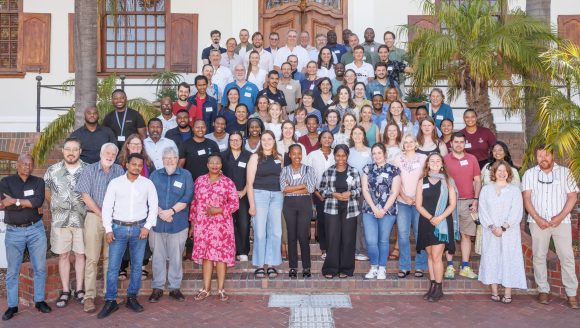
Photo credit: Ignus Dreyer