The Centre for Invasion Biology (C·I·B) is celebrating the first year of its partnership in the OneSTOP project, an international initiative aimed at tackling the growing problem of biological invasions.
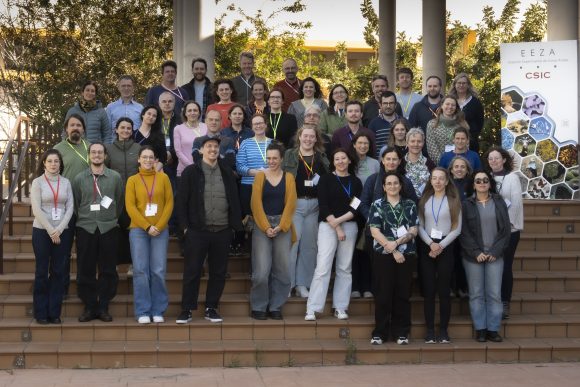
A year after the project kicked off, members of the OneSTOP consortium met in Almería, Spain, from 19 – 22 January 2026 to review the progress made during the first year and to plan the next phase of the project.
OneSTOP is a multinational effort funded by the European Commission as a Horizon project that seeks to minimise the introduction, establishment and spread of terrestrial invasive alien species. The project does so by combining new technologies for detecting invasive species with improved systems for sharing data to prioritise species, and action through working closely with stakeholders.
Stellenbosch University is the only African partner in the project, represented by C·I·B Core Team member Prof Sabrina Kumschick.
OneSTOP’s work is organised around four main pillars: detection, prioritisation, dissemination, and socio-political action.
A central part of the project is the creation of Living Labs—real-world testing environments where researchers and stakeholders work together to develop and test new tools for detecting and monitoring alien species. The project has already established Living Labs in five countries: the United Kingdom, Romania, Finland, Portugal and Belgium. During its first year, the project team tested novel tools like camera traps for insects, plants, and road-killed animals, eDNA from air samples and data from social media, to detect alien species.
OneSTOP is also developing an open and reproducible workflow to make detection data available through global biodiversity platforms such as the Global Biodiversity Information Facility (GBIF), which can be useful for detection data collected through various methods and in any region globally.
The project also investigates the social and economic factors that influence the spread of alien species. This includes examining public perceptions and common misconceptions. The OneSTOP team used culturomics—the study of cultural trends through digital data—to analyse how invasive alien species are discussed in online media such as Wikipedia and YouTube.
As the project enters its second year, partners will continue testing new technologies, improving data sharing, and working with stakeholders to strengthen efforts to manage invasive species across Europe. Furthermore, methods to improve integrated governance in alien species management will be explored, led by Prof Kumschick at the C·I·B.
For more information about OneSTOP, visit https://onestop-project.eu/, or contact Prof Sabrina Kumschick at sabrinakumschick@sun.ac.za