Read more about the article Australian acacias are genetically highly diverse across the globe
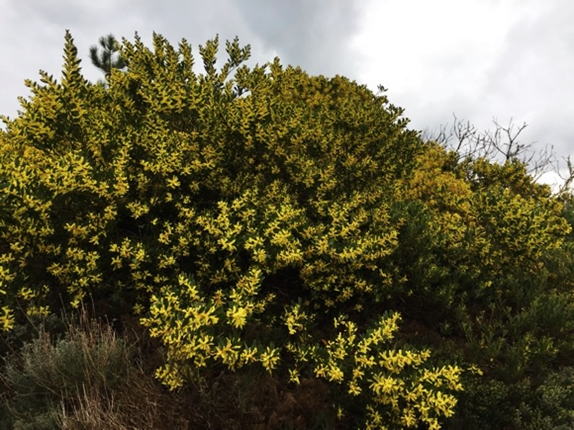
Invasive Sydney Golden Wattle (Acacia longifolia) invading areas in Pinheiro da Cruz, Setúbal district, Portugal (photo provided by Sara Vicente).

Australian acacias are genetically highly diverse across the globe

Australian acacias are some of the world’s worst invasive plants and their success has been heavily shaped through their usage by humans for various purposes. C·I·B research members Prof Jaco Le Roux, Prof Dave Richardson and Prof John Wilson, together with colleagues from the University of Lisbon, published a meta-analysis on the genetic diversity of 37 Australian Acacia species.

Comments Off on Australian acacias are genetically highly diverse across the globe

Legacies, hard boundaries and adaptation to temperature extremes explain the variation of temperature tolerance across the tree of life

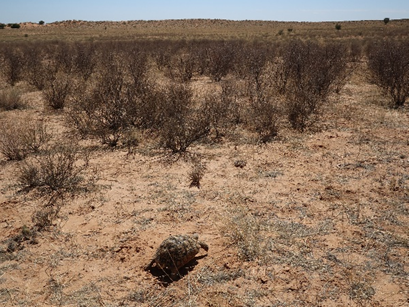
Ectothermic organisms rely on their surrounding conditions to maintain temperatures within a range that optimizes essential activities such as running, foraging and reproducing. Beyond this range, their performance or fitness decreases with a particularly fast loss of performance at high temperatures.

Comments Off on Legacies, hard boundaries and adaptation to temperature extremes explain the variation of temperature tolerance across the tree of life
Read more about the article Neither tristylous flowers nor pollinators limit reproduction in a new invader: purple loosestrife
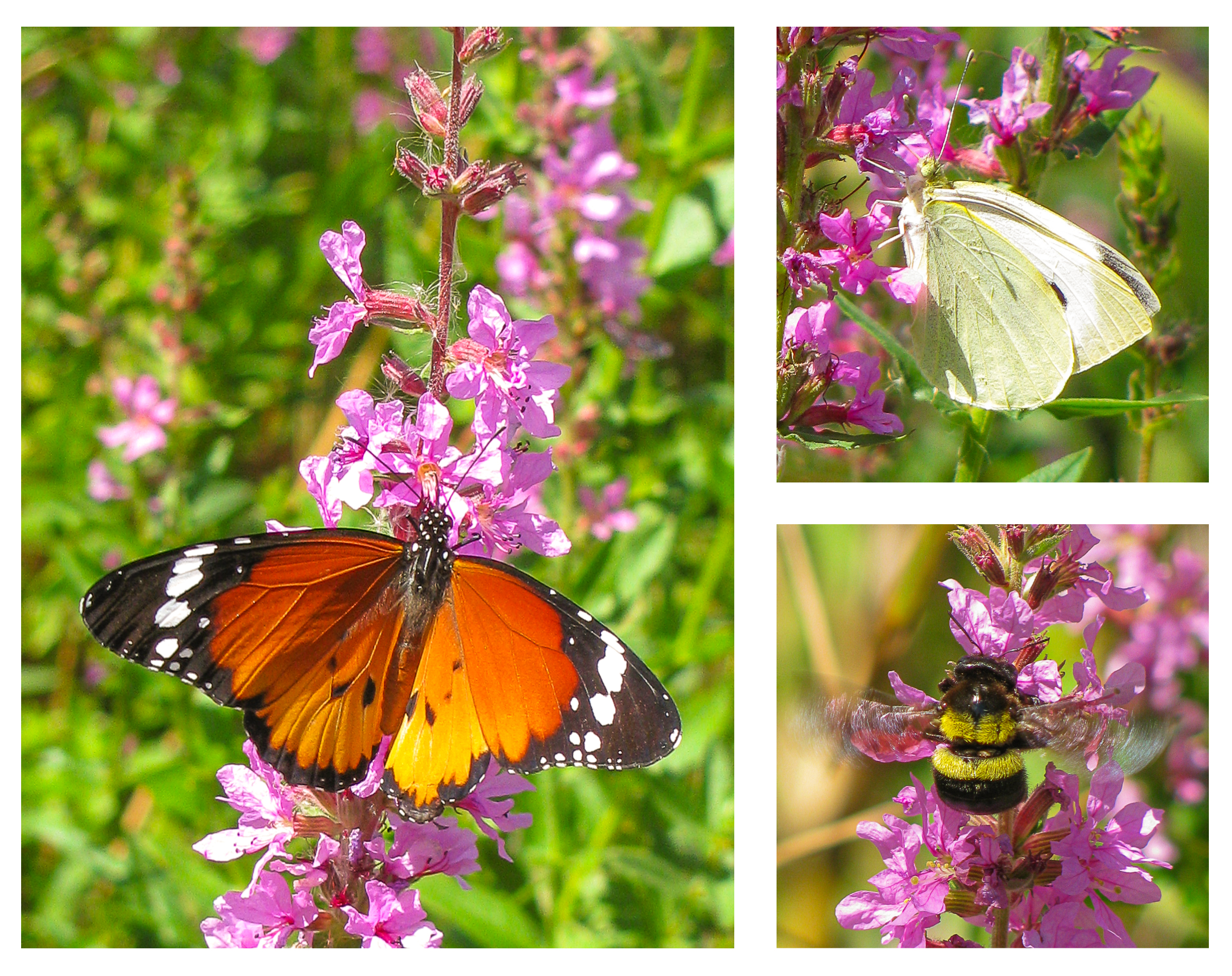
Pollinators including an African Monarch butterfly, a Cabbage White butterfly and a Cape honeybee visiting purple loosestrife flowers. Photo credit: Prof Sjirk Geerts

Neither tristylous flowers nor pollinators limit reproduction in a new invader: purple loosestrife

A recent study, published in Biological Invasions, had a closer look at the role of flower structure and pollinators in the reproduction of a new invader in South Africa, called purple loosestrife.

Comments Off on Neither tristylous flowers nor pollinators limit reproduction in a new invader: purple loosestrife
Read more about the article Ecological restoration needs sharing of knowledge to be successful
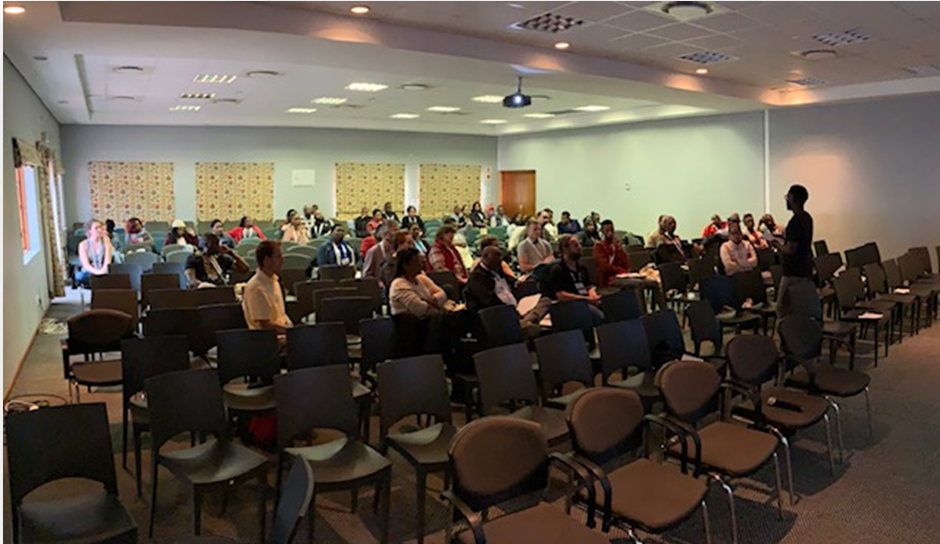
Workshop on secondary invasion with researchers and practitioners working on biological invasions in South Africa organised by the CIB in 2019. Image: Mlungele Nsikani

Ecological restoration needs sharing of knowledge to be successful

Restoration efforts need to ensure that project components are informed by relevant stakeholders, and this would require (1) identifying and working with stakeholders during a restoration effort; (2) recognising the unique needs and contributions of stakeholder groups; and (3) providing information back to stakeholders through outreach.

Comments Off on Ecological restoration needs sharing of knowledge to be successful
Read more about the article Retooling invasion science to deal with rapid global change
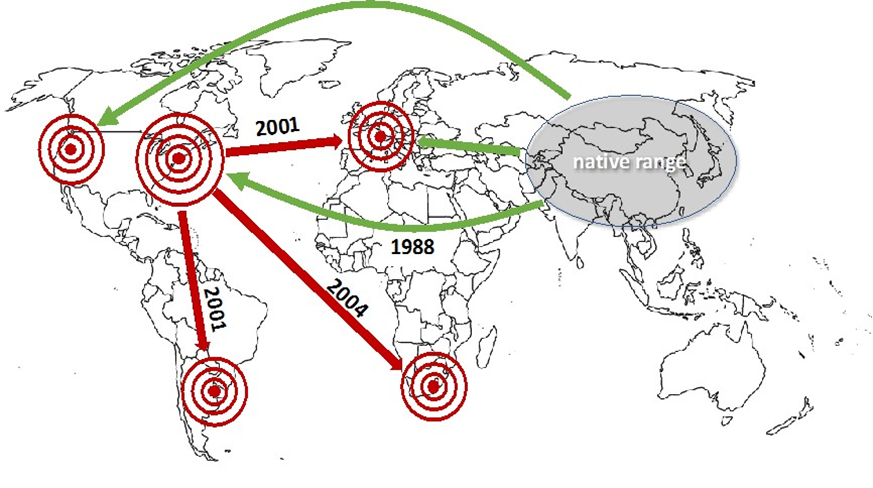
Figure 2. The “bridgehead effect” of the global spread of the harlequin ladybird beetle Harmonia axyridis, based on genetic analyses by Lombaert and colleagues (2010; PLoS ONE 5: e9743). The beetle was introduced intentionally as an insect biocontrol agent in some regions (shown in green). From these bridgehead regions, the beetle was transported inadvertently to other continents. Most of the global spread of this species has originated from non-native populations in Eastern North America.

Retooling invasion science to deal with rapid global change

Invasion science must adapt to meet growing societal demands and biosecurity challenges in the face of rapid global environmental change. This task was addressed at a workshop during the NEOBIOTA conference in Dún Laoghaire, Ireland, in September 2018 that was attended by several researchers affiliated with the Centre for Invasion Biology (C∙I∙B).

Comments Off on Retooling invasion science to deal with rapid global change